Traffic reaches the store. The story does not carry it forward.
A D2C storefront has to turn positioning, product education and proof into a buying decision on a small screen. Generic themes rarely solve that journey by themselves.
 Chronexa
SHOPIFY & E-COMMERCE DEVELOPMENT SERVICES
We design and build Shopify storefronts and connected e-commerce systems—from product discovery and checkout to analytics, fulfillment, retention and the tools your team uses every day.
FOR GROWING D2C BRANDS / NEW BUILDS, REDESIGNS, MIGRATIONS AND CONTINUOUS IMPROVEMENT
THE BUSINESS PROBLEM
The interface is only one part. We map the decisions, systems, exceptions and ownership around it so the result can operate inside your business.
A D2C storefront has to turn positioning, product education and proof into a buying decision on a small screen. Generic themes rarely solve that journey by themselves.
Inventory, payments, tax, fulfillment, support, returns and lifecycle marketing all depend on accurate data moving between tools. A polished front end cannot compensate for broken handoffs.
Reusable sections, clear product data, documented integrations and trustworthy analytics give your team control. A store should not require a developer for every campaign or merchandising change.
SOLUTION ORCHESTRATION
We treat commerce as a connected product, not a collection of pages. The buying experience, data model, operational workflows and measurement plan are designed together.
Campaign and search intent continue into the right collection, product or offer instead of dropping every visitor on a generic homepage.
Navigation, search, filters, merchandising and product taxonomy help customers narrow a complex catalog without friction.
Product information, media, variants, proof, subscriptions, bundles and delivery expectations answer the questions holding back purchase.
Cart behavior, payment methods, promotions, tax, shipping and checkout configuration are validated across devices and customer states.
Orders, inventory and customer records flow into the systems responsible for fulfillment, support, finance and returns.
Lifecycle messaging, service events and analytics connect acquisition to repeat behavior without creating conflicting customer records.
WHAT WE BUILD
Scope is tailored after discovery. These are the workstreams we combine when the engagement calls for them.
The platform, information model and delivery plan based on the business you actually run.
A responsive buying experience shaped around the product, audience and brand.
A maintainable storefront built on Shopify’s current theme and platform capabilities.
Move the commerce operation without losing the information and search equity it depends on.
Connect the store to the systems that fulfill, support and account for each order.
A measurement layer the team can trust, followed by focused iteration after launch.
QUALITY, CONTROL & FAILURE HANDLING
We test the full path from landing page to fulfillment handoff and give your team the tools, documentation and access required to own the store.
We review image delivery, third-party scripts, theme code and responsive behavior throughout the build. Speed is not left as a cleanup task after every app has been installed.
Products, collections, content and customer records are mapped before import. Existing URLs are retained or redirected deliberately, and launch includes validation of search and analytics essentials.
We test products, variants, discounts, customer states, payment paths, shipping rules, notifications and downstream order handoffs on agreed devices and markets.
Reusable sections, structured fields and documentation let marketers and merchandisers make routine changes without editing code or waiting for an agency.
COMMERCE WORK
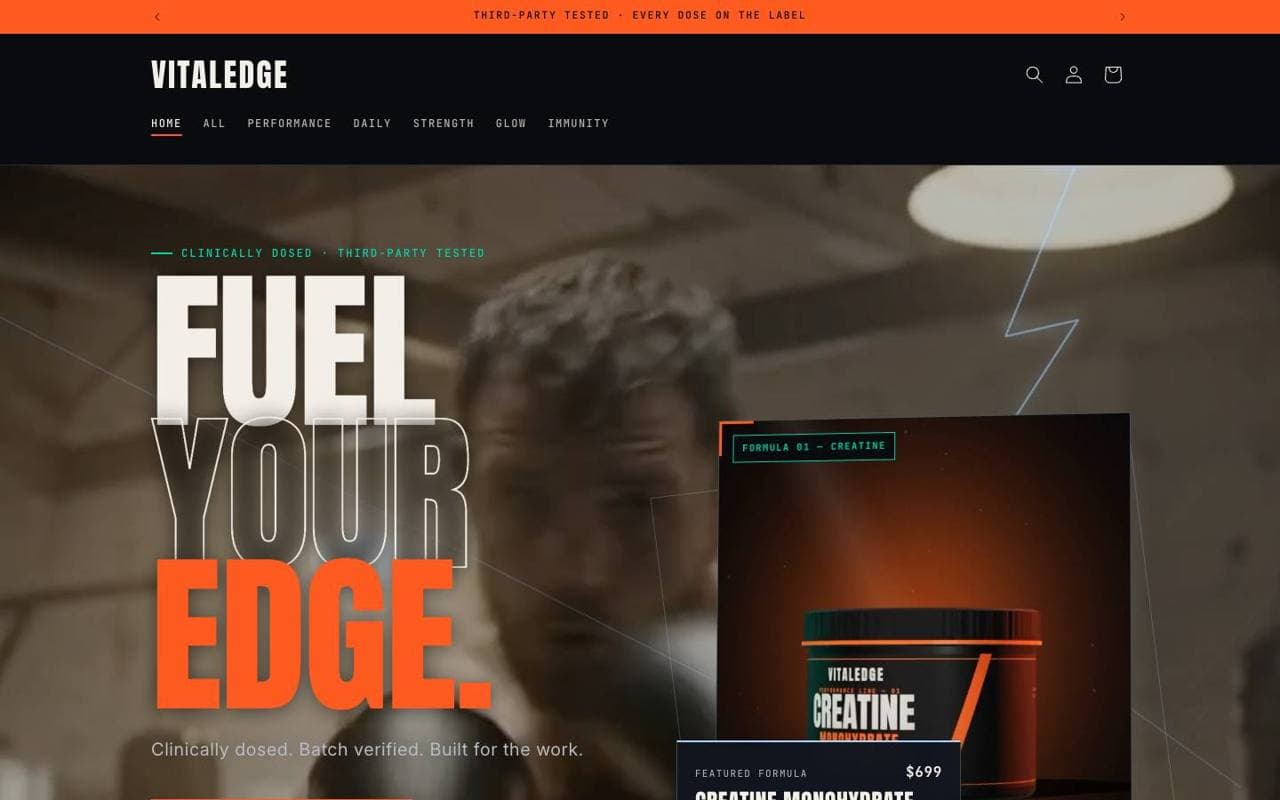
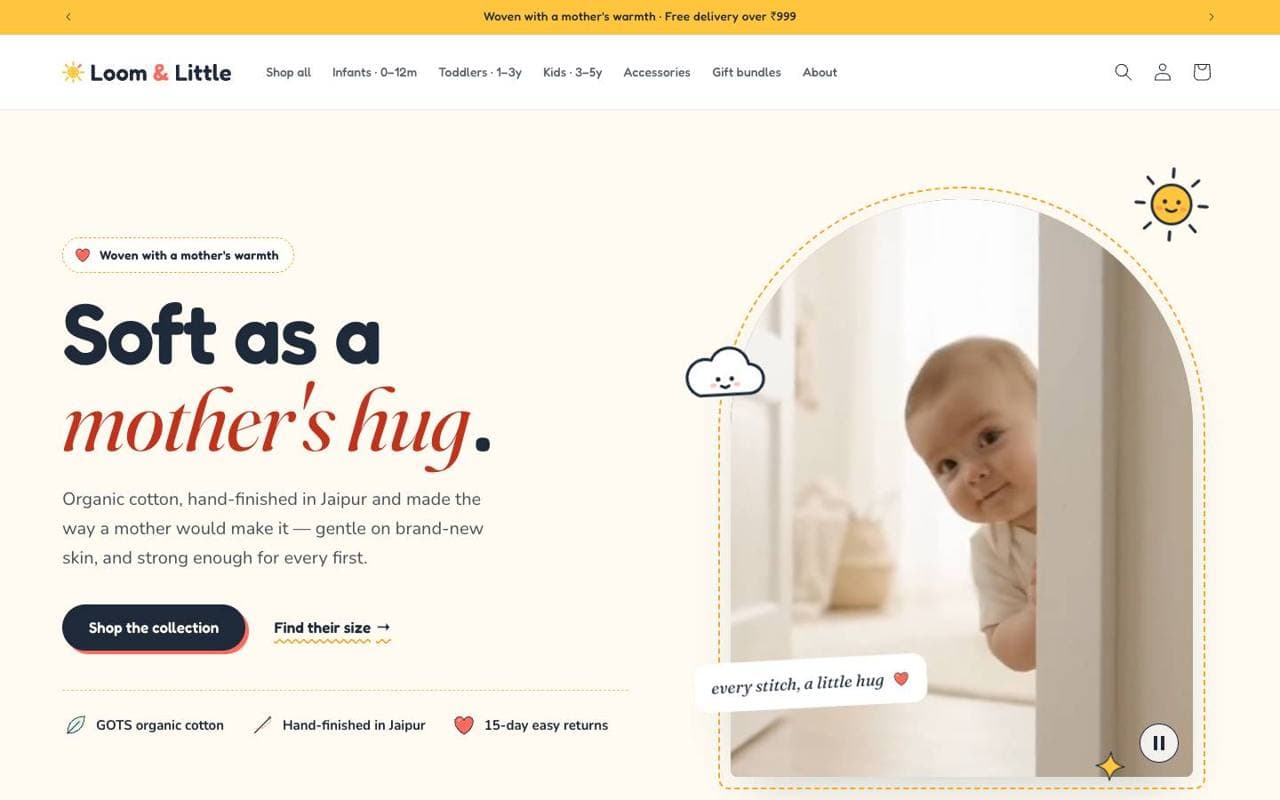
These existing storefront projects show different brand and merchandising problems. The engagement for your business begins with its own customers, catalog and operating requirements.

A DEFINED ENGAGEMENT
There is no one-size-fits-all package. We agree the scope, dependencies, acceptance criteria and quote before implementation begins.
Customer journeys, page model, platform decisions, integrations, risks and a sequenced delivery scope.
Approved designs for the critical templates and reusable components across desktop and mobile.
Theme code, structured content, configuration and agreed applications built in your store account.
Product, collection, navigation and merchandising structures prepared for the agreed launch scope.
Defined commerce data flowing into operational and measurement systems, with test evidence.
Deployment support, documentation, team training and a prioritized list for ongoing improvement.
Review customers, catalog, analytics, brand, current technology and the work your team performs behind the storefront.
Agree information architecture and high-value journeys, then make platform, data and integration decisions before visual refinement.
Implement the storefront and connections in stages so your team can review real behavior, content and edge cases.
Run the acceptance plan, complete redirects and analytics checks, launch with a controlled checklist and train the team that will operate it.
PLATFORMS & INTEGRATIONS
Shopify is our primary storefront platform for this service. Apps and external systems are selected only when they solve a defined requirement; we account for subscription cost, ownership, performance and operational complexity before recommending them.
BEFORE WE START
We will tell you when a simpler implementation is the better choice and when a dependency needs to be fixed before development begins.
Both. We can design and build a new store, rework an existing theme, or plan a larger migration. The right approach depends on whether the current platform, data structure and codebase can support the required customer experience and operations.
We can build a custom theme or use a strong modern theme as a deliberate foundation when that is more economical. Either way, the information architecture, component system and design are adapted to the brand and customer journey; we do not present an unchanged template as a custom build.
Yes. We map products, variants, customers, content, order-history requirements and URLs before migration. Historical orders and customer passwords need platform-specific handling, which we make explicit in the scope rather than discovering during launch week.
We provide commerce strategy, UX/UI design and the content structure required for the store. Brand identity, product photography, video and copy can be included when needed or coordinated with your existing specialists.
Yes, provided the systems expose an appropriate API, connector or file exchange. We define the system of record, field mapping, sync direction, error handling and reconciliation process for each integration.
We implement the technical foundations within scope: crawlable architecture, metadata patterns, redirects, structured product information, sitemap and canonical behavior, performance, and indexation checks. Rankings and inclusion in generative answers also depend on product demand, content quality, authority and ongoing marketing, so we do not promise a position.
Yes. We can scope a stabilization period, ongoing maintenance, conversion improvements or embedded commerce engineering. Ownership, response expectations and included capacity are written into the engagement.
Pricing depends on design depth, catalog complexity, migration, custom functionality, integrations, markets and content production. We first understand the requirements, then provide a tailored scope and quote; there is no one-size-fits-all package.
YOUR REQUIREMENTS. A CLEAR SCOPE.
Tell us what you want to change, what systems are involved and what a useful result looks like. We will shape the engagement and provide a tailored quote.
Talk to our team info@chronexa.io