
CASE / THE WALK-IN STORE
A luxury store
you walk into.
Online luxury usually looks like a catalogue. A real boutique sells with light, craft and a person who knows the product. We built a store that does the same, to see how far a small team can push it.
- Live now
- Works on phones
- Talk to the stylist
01 / WHAT YOU EXPERIENCE
Five moments,
one store.
Every one of these is real and working in the live demo.
- 01
Walk in
There is no page to scroll down. Scrolling walks you from the street, through the door and into five rooms. Each room has a living model; tap one and the camera leans in and she turns so you see every side of the look.
- 02
The spotlight
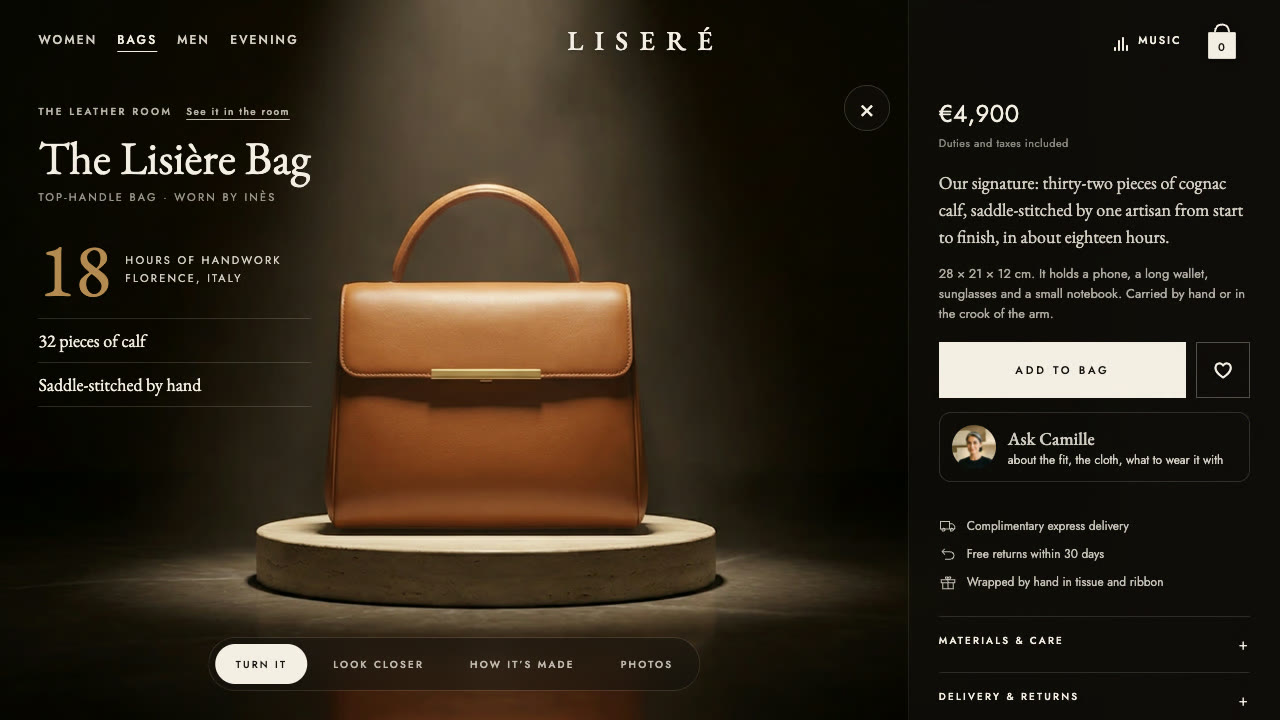
Tap any piece and the room goes dark. A spotlight finds it alone on a stone plinth. The signature pieces turn slowly, and you turn them yourself by dragging. Sizes and Add to bag stay on screen the whole time, so nobody who just wants to buy is slowed down.
- 03
The craft
Luxury is the care in the making, so we show it. Three marked points on each signature piece take you close to the saddle stitch, the hand-turned edge or the hand-rolled hem. A short silent film shows an artisan’s hands doing the work, with the story in captions.
- 04
The stylist
Camille is a voice stylist you can talk to. She knows each piece’s cloth, origin and fit, and she acts on the screen while she talks: she walks you to a room, opens a piece, takes you in close to a stitch, plays the film and answers “will this fit me, I’m 1.62 m” with a straight answer. She tells you she is AI if you ask.
- 05
The Wrap Desk
Checkout is a place. You walk to the desk, an associate wraps your pieces in tissue and ribbon, and you get a paper receipt. (No payment is taken in the demo.)
- 5rooms, each with a living model
- 43pieces, four photos each
- 12signature pieces with a turntable, close-ups and a film
- 8workshop films: tailor, knitter, goldsmith and more
02 / THE DECISIONS
What we chose,
and what we refused.
The useful part of a build is the roads you did not take.
What we chose
- Generated film, not real-time 3D. Generated 3D models look like a video game and cannot show a stitch. We generate short film clips and let the visitor’s scroll or hand play them frame by frame.
- The product opens inside the store. No white product page, no grid of products. Those make it look like every other website and break the spell.
- Craft is content. Hours of handwork, where it is made and why a detail matters sit next to the price, because that is what luxury customers pay for.
- The stylist acts, not just talks. A chatbot in the corner is a search box. Camille moves the store while she speaks.
What we refused
- Pretending it is real. LISERÉ is a fictional house, the imagery is AI-generated, and the stylist says she is an AI if you ask.
- Slowing down buyers. Everything is optional. A visitor can add to bag from any view.
- Heavy pages. The next room always loads first, the clips are compressed and the page shows a progress line instead of freezing on slow connections.
- Invented craft claims. The facts Camille quotes come from one source file, so she cannot make a product up.
03 / WHAT IT TOOK
One small team,
days, not months.
The store, its film, photography, music and voice stylist were built in a few days by our studio working with AI tools, and the generated media cost under $250. A conventional version of this (a film crew, a set, a 3D team and a developer) is a six-figure project.
That is the point. The same method works on a real brand: your real products and your real craft, staged digitally, at a fraction of the usual cost.
04 / FOR YOUR STORE
Want this for
your products?
You do not need a full walk-in store to use it. The spotlight view works on any product page.
We can add the spotlight, the turning view and the craft close-ups to a store you already have, or build a full walk-in flagship. Tell us about your products and we will show you what yours would look like.