
AI AGENT DEVELOPMENT
Agents that work like
your best employee.
We build AI agents with real knowledge of your business: they research, draft, check work against your rules, approve what is routine and send the rest to a person. Human-in-the-loop by design, not by accident.
- Audit free
- First workflow free
- Live in a week
The agent approves the routine and escalates the rest. A person still owns the outcome.
WHAT YOU ALREADY USE
 Claude
 OpenAI
 n8n
n8n Slack
Slack Google Docs
 Notion
 HubSpot
01 / WHY MOST AGENTS FAIL
Autonomous is easy.
Trusted is hard.
Demos of agents doing everything alone are easy. In a real business, nobody lets them near clients until they know the rules and show their work.
They do not know your business
Without your knowledge and rules, agents produce generic output someone has to redo.
They act without boundaries
An agent that can do anything will eventually do the wrong thing in front of a client.
They do not show their work
If a reviewer cannot see why an agent decided something, they review everything again.
EXAMPLE ENGAGEMENT
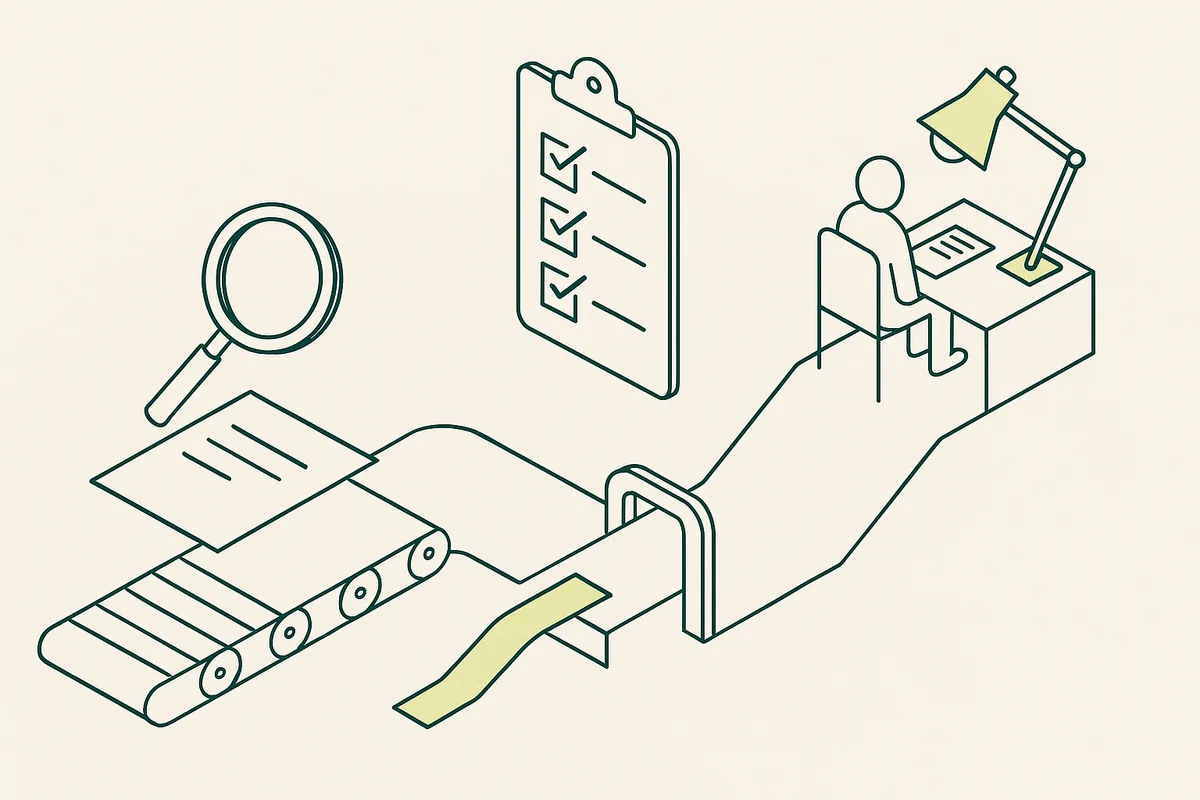
A 20-person research boutique
Every client report went through three rounds of senior review. Most comments were the same: wrong number, off-style phrasing, missing source.
- A knowledge layer of house style, past reports and data sources
- A reviewer agent that checks every draft and fixes routine issues
- Escalation to a senior only for judgement calls, with the evidence attached
A composite example with details changed. We do not name clients without their permission.
02 / HOW WE BUILD AGENTS
Knowledge, limits,
then autonomy.
We widen what an agent may do only after it has proved itself on the narrower job.
We sit with the foundersFREE
One working session on how the business actually runs: the systems, the workflows, the people in each step, and the one lever that matters most this quarter.
We audit your stack and your knowledgeFREE
Which tools you run, where data is retyped between them, where know-how lives only in people’s heads, and which work is worth automating at all.
We build one workflow, free, inside a weekFREE
Not a demo. A real automation on your real tools, so you see the output and the time saved before you pay us anything.
We size the next builds on ROI
Hours saved, capacity gained, revenue unlocked. Each next build is priced against that number and agreed in writing before we start.
We stay on as your AI team
We monitor, fix, extend and train. Workflows change as your strategy changes, so we do not hand over one automation and disappear.
03 / AGENTS WE BUILD
Jobs, not
chatbots.
Each agent owns a defined job with clear inputs, rules and an approval path.
Research agents
Gather, compare and summarise sources into a briefing.
Drafting agents
Reports, proposals, replies and decks in your format.
Reviewer agents
Check work against rules and data before a person signs.
Operations agents
Onboarding, data entry and follow-ups across tools.
Inbox agents
Triage, prioritise and draft replies for approval.
Briefing agents
A daily summary of what needs attention, in Slack or email.
04 / THE ROI LENS
Review time is
where agents pay.
Drafting faster helps. Removing the second and third round of senior review helps far more.
Run your own numbers| Example | Today | With the system |
|---|---|---|
| Senior review rounds per deliverable | 3 | 1 |
| Hours per report | 8 | 2 |
| Errors reaching the client | Occasional | Caught by agent |
| Work an agent approves alone | 0% | Routine items only |
Illustrative, not a client result. Your audit replaces these numbers with your own.
05 / WHAT WE WON’T BUILD
Saying no is
part of the job.
Most automation fails because someone automated the wrong thing. These are the builds we turn down.
- Agents that email clients without approval
- Agents with access beyond their job
- Agents that cannot explain a decision
- Fully autonomous financial or legal decisions
- Agents with no failure alerts
START HERE
Hire your first
AI employee.
Book the free audit. We pick one job, build the agent free, and show you its work before it touches anything important.
- A free audit of your systems, workflows and team
- One workflow built free, live inside a week
- A plan sized on ROI, priced before we build anything else
You talk to the people who build it, not an account manager.info@chronexa.io
Rather write it down first?
What does an AI agent development company build?
Software agents that use AI models plus access to your tools and knowledge to complete defined jobs: research, drafting, reviewing, data work and follow-ups, with rules about what they may do alone and what needs a person.
What is human-in-the-loop AI?
A design where AI does the work and a person approves the steps that matter. We go further: agents act as reviewers themselves, approving routine items and escalating judgement calls, so people only see what genuinely needs them.
Can’t we just use a template or an off-the-shelf tool?
For basic jobs, yes, and we will tell you when that is the right answer. Most apps now ship connectors and simple AI features. What they cannot do is understand your company: your strategy, your rules, your past work and the people who approve things. That knowledge is what makes automation behave like an experienced employee, and it has to be built for you.
How much does it cost?
There is no single price, because no two companies run the same way. The audit is free and the first workflow is free. After that, every build is priced against the return it produces, agreed in writing before work starts. Most clients start with one high-return workflow and add more once it pays for itself.
How fast do you ship?
The first working automation goes live inside a week, including the infrastructure it runs on. Larger systems are shipped in weekly increments, so you see progress every week rather than at the end.