
A Voice Agent That Checks the Calendar Before It Books
For an appointment-led business, Chronexa built a three-workflow voice layer that checks live availability, books the selected slot and records the conversation outcome without giving the voice model direct calendar authority.
- Proof basisDeployed for a client
- IndustryCustomer Operations
- Year2026
- ServicesVoice AI, Calendar Integration, Workflow Automation
Verified from three active client workflows integrated with ElevenLabs and Google Calendar. The client is anonymised and no call-volume or booking-rate claim is made without client-approved measurement.
The short answer
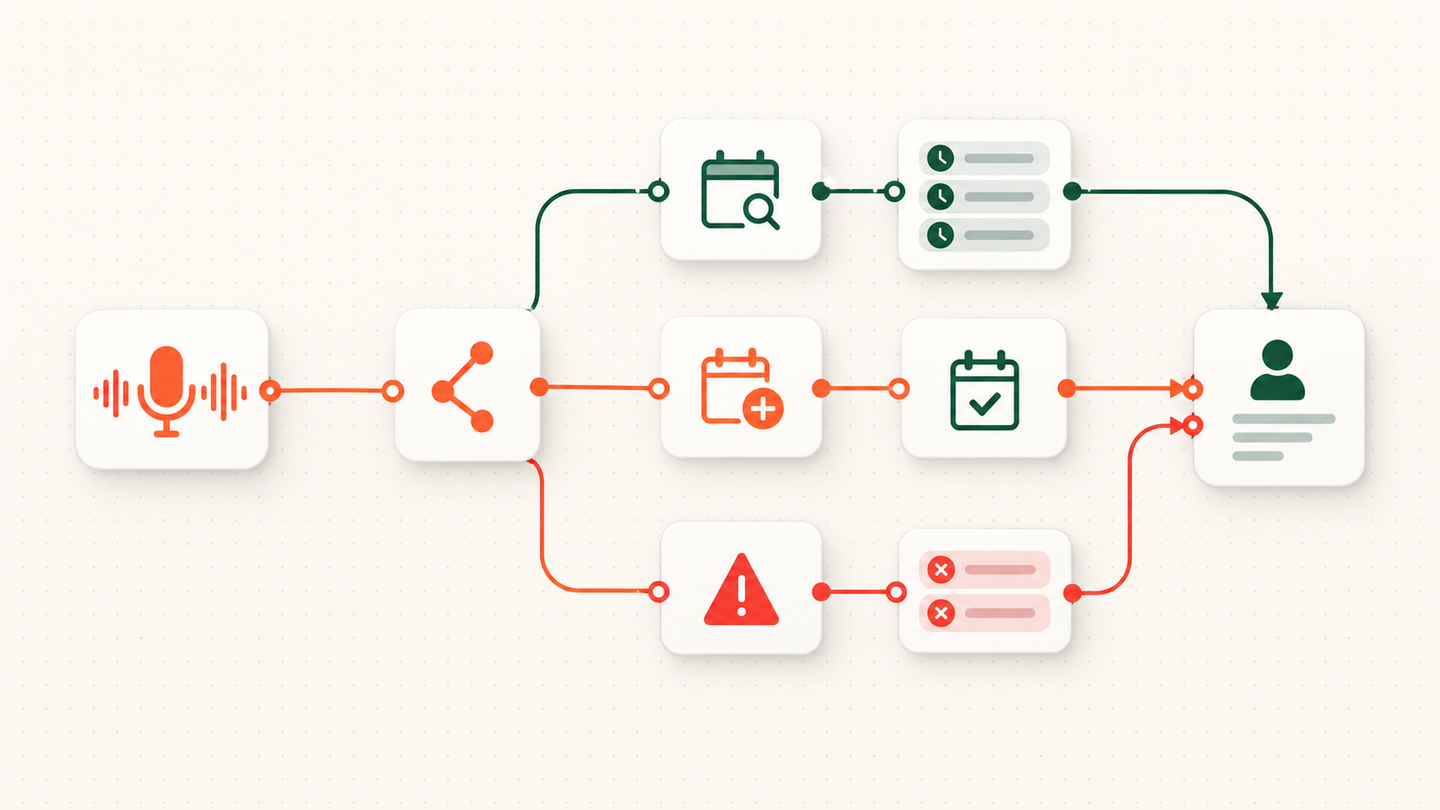
Chronexa split a voice booking system into three small n8n workflows: check availability, book the chosen slot and store the result after the call. ElevenLabs handles the conversation, Google Calendar remains the booking record, and Airtable receives the structured call outcome.
Tools and systems used
- ElevenLabs
- n8n
- Google Calendar
- Airtable
- Webhook tools
A conversational agent still needs deterministic operations
A voice model can understand a caller asking for Tuesday afternoon, but it should not invent availability or write directly into a business calendar. Calendar conflicts, time zones and post-call records require ordinary software rules around the conversation.
The build separated language handling from the actions that create business commitments.
One giant workflow would have been harder to trust
Availability checks, booking writes and call summaries fail in different ways. Keeping them separate makes each action easier to test, retry and audit, and limits what the voice platform can do with any one tool call.
How the workflow runs
- Receive the tool call
ElevenLabs sends a structured request when the caller asks about times or confirms a booking.
- Check live availability
n8n queries Google Calendar using the requested date and service context.
- Return usable slots
The workflow sends a small structured response that the voice agent can say clearly.
- Validate the chosen slot
The booking path checks the requested time again before creating the event.
- Create the event
Google Calendar stores the appointment as the final booking record.
- Write the post-call record
A separate post-call workflow stores the outcome and useful call fields in Airtable.
The three-part system
The first workflow receives the requested date range, queries Google Calendar and returns valid open slots to the voice agent. The second accepts the caller’s confirmed choice and creates the calendar event. The third receives the completed-call payload and writes the call outcome into the operating record.
The voice agent handles natural language; n8n validates tool input and controls the calendar actions. The model never needs unrestricted calendar access.
What changed
Callers can move from a spoken request to a confirmed appointment in the same conversation, while the business retains a clean separation between conversation, availability and booking. The system’s success criterion is concrete: a real slot checked, one event created and one post-call record written.
This separation also makes change safer. Calendar rules can be updated without rewriting the conversation, and the voice provider can change without moving the business logic that protects booking integrity.
Why three workflows were better than one
A long voice workflow is hard to test and easy to break. The live agent needs quick, narrow tools. We therefore gave it one endpoint for availability and one for booking. A third workflow receives the post-call payload after the conversation. Each has a clear input and output contract.
The availability response contains structured slots, not a paragraph of model-generated times. The booking route receives the selected time and contact details, checks the calendar again and creates the event. This reduces race conditions when two people ask about the same period.
What “AI booking” means here
The AI handles conversation. Calendar truth and the booking action remain deterministic system calls. This boundary is important: a friendly spoken answer is not proof that an event exists. The successful calendar response is the proof. Airtable then gives the operations team a searchable record of what happened after the call.
Safeguards and failure handling
- Availability is checked against the live calendar rather than a model’s memory.
- Booking is a separate tool action and only runs after the caller confirms.
- Small tool responses reduce ambiguity in the live conversation.
- Post-call logging is isolated so a CRM write failure does not invent a calendar booking.