
How a Staffing Firm Turned Candidate Intake Into a Shortlist
Recruiters were receiving resumes from job boards, referrals and email. Good candidates were hard to compare because every CV used a different format and notes lived in individual inboxes.
- Proof basisMarket solution story
- IndustryStaffing and Recruiting
- Year2026
- ServicesWorkflow Automation, System Integration, AI Automation
This is a market solution story built from Chronexa’s research into real businesses, roles, technology stacks and operating problems. It shows how we would engineer the system. It is not presented as a named client deployment, and no unverified savings or performance result is claimed.
The short answer
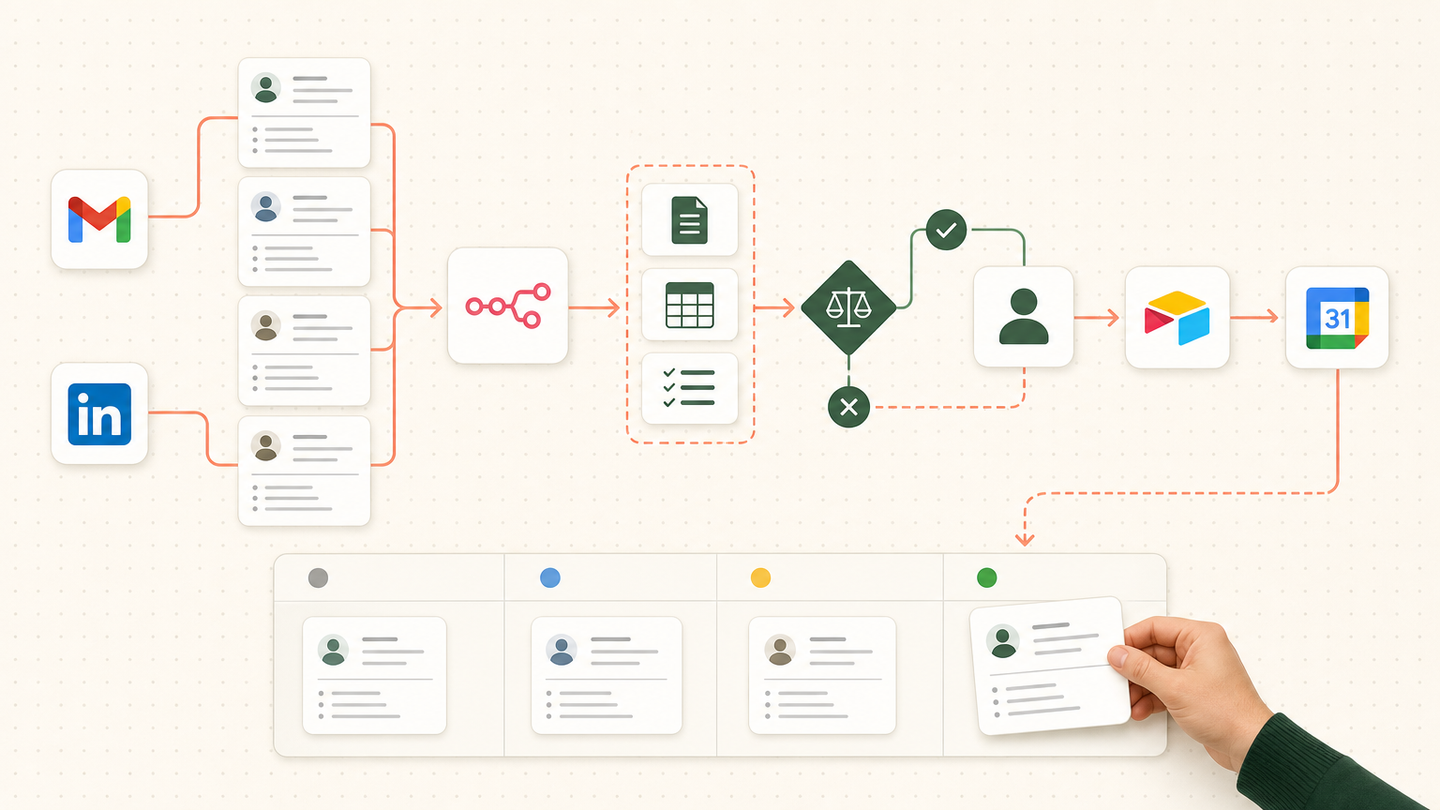
We designed a recruiting workflow that collects resumes, extracts comparable skills and experience, applies job-specific rules and prepares a recruiter shortlist. A person makes every advancement decision; the system organises evidence and schedules the next step.
Tools and systems used
- Gmail
- n8n
- OpenAI
- Airtable
- Google Calendar
The bottleneck appeared before the interview
The firm could find applicants, but turning them into a useful shortlist required opening dozens of differently formatted files. Recruiters copied details into Airtable, searched email for updated resumes and wrote the same availability questions repeatedly.
Speed mattered because qualified people were speaking to several agencies. But faster automated rejection would have created a different risk. The workflow needed to accelerate preparation while keeping employment decisions human.
How the workflow runs
- Collect applications
Accept resumes and source data from approved channels.
- Parse each resume
Extract work history, skills, location, availability and contact fields.
- Apply job rules
Compare evidence with required and preferred criteria without inventing missing experience.
- Build the shortlist
Create a side-by-side recruiter view with source passages.
- Record the decision
A recruiter advances, rejects or holds the person and adds a reason.
- Schedule interviews
Offer approved times and write the confirmed event to the live calendar.
The system we designed
n8n collects application events and files. Document extraction produces a consistent candidate schema. Job criteria live as editable data, not inside a prompt. The comparison step returns matched evidence, missing requirements and questions for the recruiter.
Airtable provides the operating view. Approved candidates receive a scheduling link or a set of live calendar options. The final booking and recruiter decision are written back to the same record.
How success would be measured
Useful measures include time from application to first review, resumes processed per recruiter, extraction corrections, qualified candidates contacted within one day and interview no-show rate. Hiring quality still depends on the recruiter and client.
What makes the shortlist trustworthy
Structured output is validated before it reaches Airtable. Scores are calculated from visible job rules. The model can extract and summarise evidence, but it cannot add experience that is not present or change the weighting by itself.
What remains manual
Recruiters assess context, speak with candidates and decide whether to advance them. The system removes document handling and coordination around those decisions.
Safeguards and failure handling
- Protected characteristics are excluded from scoring.
- Every extracted claim links back to the resume text.
- Missing information stays missing rather than being inferred.
- Recruiters own shortlist and rejection decisions.
- Calendar availability is checked again before booking.