
A Shopify Lead Funnel That Teaches Meta Which Leads Matter
Chronexa connected a conversion-focused Shopify landing page, lead-quality checks, consent-aware WhatsApp follow-up and offline Meta feedback so campaign optimisation can learn from useful leads rather than raw form volume.
- Proof basisRunning inside Chronexa
- IndustryEcommerce & Paid Acquisition
- Year2026
- ServicesConversion Engineering, Lead Qualification, Meta Conversions API
Verified from the deployed Shopify lead-capture route and the active 30-minute Meta feedback workflow. Campaign economics are documented separately; this study makes no claim that the automation alone caused revenue growth.
The short answer
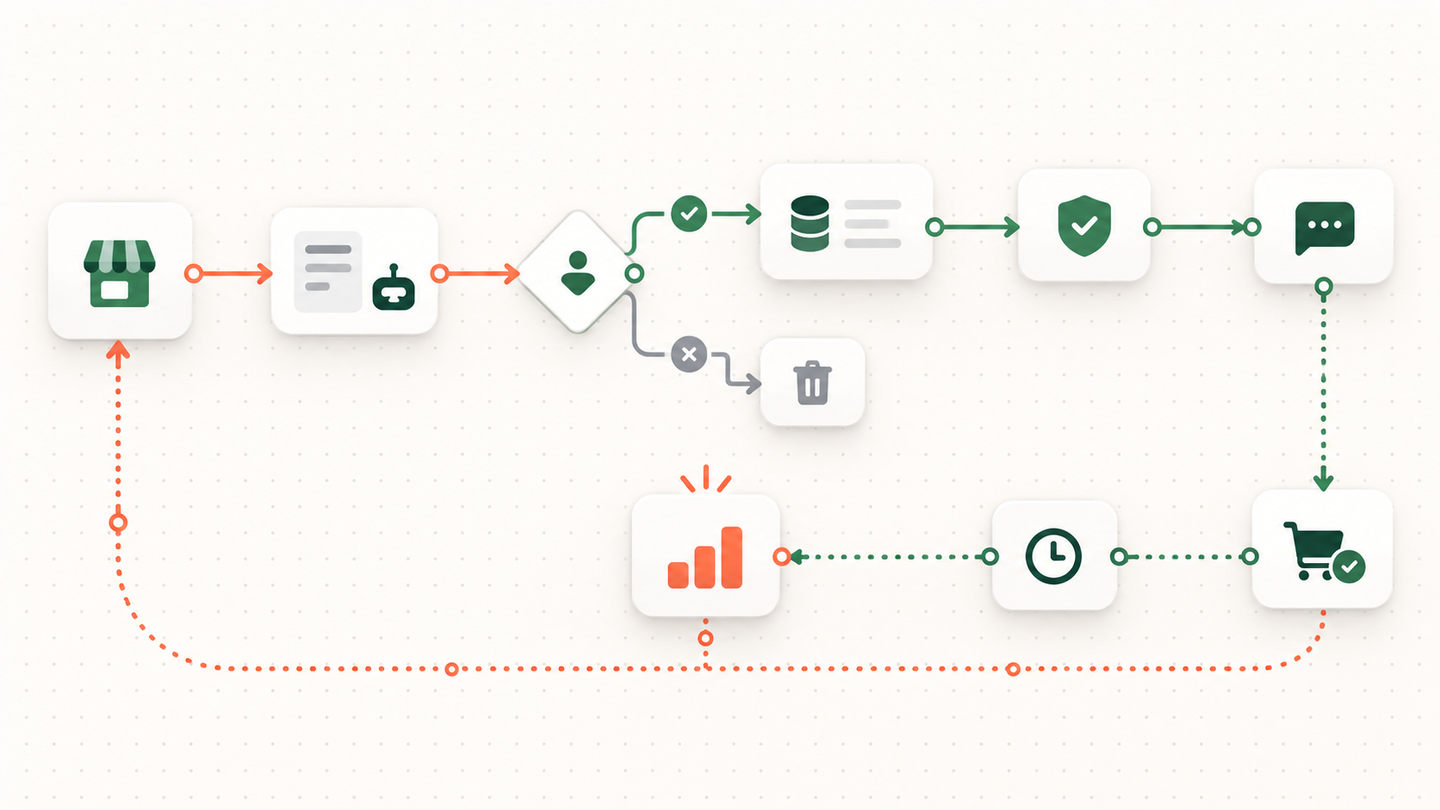
Chronexa connected a Shopify lead page to n8n so every form submission is checked before it reaches sales. Valid, consented leads can receive a WhatsApp follow-up. A separate 30-minute job sends qualified conversion signals back to Meta so ad optimisation can learn from lead quality, not form volume alone.
Tools and systems used
- Shopify
- Next.js lead form
- n8n
- Google Sheets
- WhatsApp Cloud API
- Meta Conversions API
Cheap leads were the wrong target
An instant form can produce a low cost per lead while sending sales a queue of unreachable people, businesses without a real product and prospects with no workable budget. Optimising only for form submission teaches the ad platform to find more of the same.
The funnel needed to capture richer context, filter obvious junk and report meaningful downstream events back to Meta.
The landing page also needed operational controls
Public forms attract bots, duplicate submissions and incomplete records. A reliable workflow had to validate required fields, isolate honeypot traffic, log clean leads, respect WhatsApp consent and fail loudly if the destination sheet was unavailable.
How the workflow runs
- Capture the form
The landing page submits structured business and contact fields to a controlled endpoint.
- Reject obvious bots
A hidden honeypot and server-side validation remove malformed or automated submissions.
- Apply qualification rules
The workflow checks the fields used by sales to decide whether the lead is useful.
- Store the source data
The raw and normalised values are written to an inspectable lead record.
- Follow up with consent
WhatsApp runs only when the person has opted in.
- Return the quality signal
Every 30 minutes, eligible unsynced records are sent to Meta and marked after a successful response.
The connected build
The landing page sends one structured payload to n8n. The workflow validates it, blocks bot-shaped submissions through a honeypot, writes accepted leads to Google Sheets and nudges opted-in leads on WhatsApp. If the sheet write fails, the workflow raises an operational alert instead of returning silent success.
Every 30 minutes, a separate feedback job reads the lead sheet, selects records that reached the defined reporting state, sends the matching conversion event to Meta and marks the row as synced. Idempotent row state prevents the same event being reported repeatedly.
What the business gains
Marketing and sales now share the same definition of a useful lead, and the ad platform receives a better training signal than form completion alone. The architecture links acquisition, qualification and follow-up without pretending that cost per lead is revenue.
The architecture behind the funnel
The landing page is responsible for a clear offer and clean input. n8n is responsible for orchestration. Google Sheets is the simple operating record used by the team. The Meta Conversions API receives only the records that meet the chosen quality rule. Keeping those jobs separate makes each failure easier to see.
The feedback job is scheduled instead of coupled to the form response. A visitor therefore does not wait for Meta. The job queries rows that are qualified and not yet synced, sends the permitted identifiers and event fields, checks the API response, then marks the record. Failed rows stay eligible for review or retry.
What the workflow changes
Meta can optimise toward a downstream signal rather than treating every form fill as equally valuable. Sales sees a cleaner queue. The case does not claim a revenue lift caused by automation alone because offer, traffic, creative and sales follow-up still determine performance.
Safeguards and failure handling
- The browser never decides whether a Meta event succeeded.
- A synced flag supports idempotency and reduces duplicate conversion events.
- Consent and lead quality are separate checks.
- Bad inputs are rejected before they reach sales or advertising systems.