
How an Investment Team Turned CIMs Into Comparable Deal Records
New opportunities arrived as CIMs, pitch decks and spreadsheets. Analysts repeatedly copied company facts, historical financials and market claims into the deal tracker before serious evaluation could begin.
- Proof basisMarket solution story
- IndustryPrivate Markets and Investment Management
- Year2026
- ServicesWorkflow Automation, System Integration, AI Automation
This is a market solution story built from Chronexa’s research into real businesses, roles, technology stacks and operating problems. It shows how we would engineer the system. It is not presented as a named client deployment, and no unverified savings or performance result is claimed.
The short answer
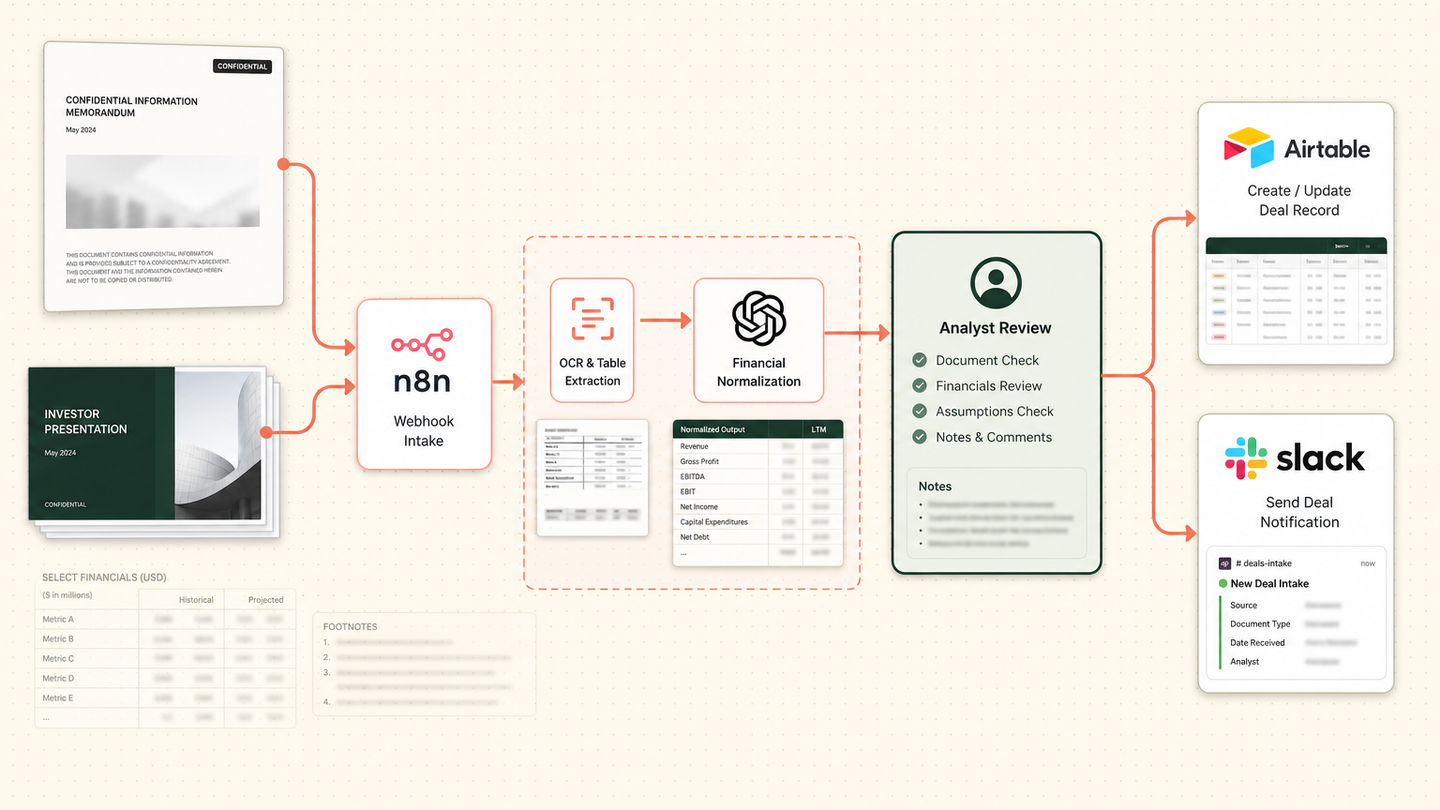
We designed a deal-intake workflow that reads CIMs and pitch decks, extracts company and financial data, normalises periods and units, and prepares a source-linked record in Airtable. Analysts review every value and investment judgment before the opportunity moves forward.
Tools and systems used
- Deal inbox
- n8n
- Azure Document Intelligence
- OpenAI
- Airtable
- Slack
- Excel
The first hours of every deal looked the same
The investment team received good information, but it was packaged for persuasion rather than comparison. An analyst opened the CIM, found tables, converted units and created the same tracker fields for every opportunity.
This preparation delayed screening and introduced inconsistent definitions. The useful automation target was intake, not the investment decision.
How the workflow runs
- Receive the opportunity
Save the original CIM, deck and spreadsheet under one deal ID.
- Identify document sections
Locate company overview, market, customers, risks and financial pages.
- Extract structured data
Read facts and tables with document and page references.
- Normalise financials
Map units, currency, fiscal periods and adjusted metrics without changing the source.
- Review the deal record
An analyst confirms values, adds judgment and resolves conflicts.
- Create the tracker entry
Write the approved fields to Airtable and notify the assigned team in Slack.
The system we designed
n8n creates a deal ID and stores the source package. Document Intelligence extracts text, tables and page coordinates. OpenAI maps narrative sections into a strict deal schema. Code handles currencies, units and fiscal periods and keeps the original presented value beside the normalised value.
Airtable receives a draft record with source links. The analyst confirms it, adds qualitative judgment and decides whether to advance the deal. Slack reports completion or a specific exception.
How the team would judge it
Measure analyst preparation time, corrected fields, missing citations, deals screened per week and time from receipt to first decision. Investment performance is not an automation metric.
Why financial normalisation is code
Models can locate and label tables, but currency conversion and unit rules must be repeatable. The workflow stores source value, source unit, normalised value, formula and date.
Why the keyword is broader
Direct CIM automation searches are small. The page therefore targets the larger AI document processing category while using the investment workflow to demonstrate a concrete high-value application.
Safeguards and failure handling
- Original documents remain immutable.
- Every extracted field keeps a page reference.
- Adjusted EBITDA and management claims are labelled as presented, not verified fact.
- Currency and unit conversions show the formula.
- The model cannot recommend an investment or approve a deal.