
A GoHighLevel Speed-to-Lead Engine Built for Real Edge Cases
A production-grade reference build for home-services lead operations: multi-source intake, deduplication, AI qualification, transparent scoring, capacity-aware routing, SLA escalation and a human review queue.
- Proof basisWorking reference build
- IndustryHome Services & Lead Operations
- Year2026
- ServicesGoHighLevel, AI Qualification, Lead Routing, SLA Automation
This is explicitly a reference build, not a client outcome. It runs in a HighLevel developer environment with synthetic leads; the n8n logic, database functions and decision paths were tested end to end.
The short answer
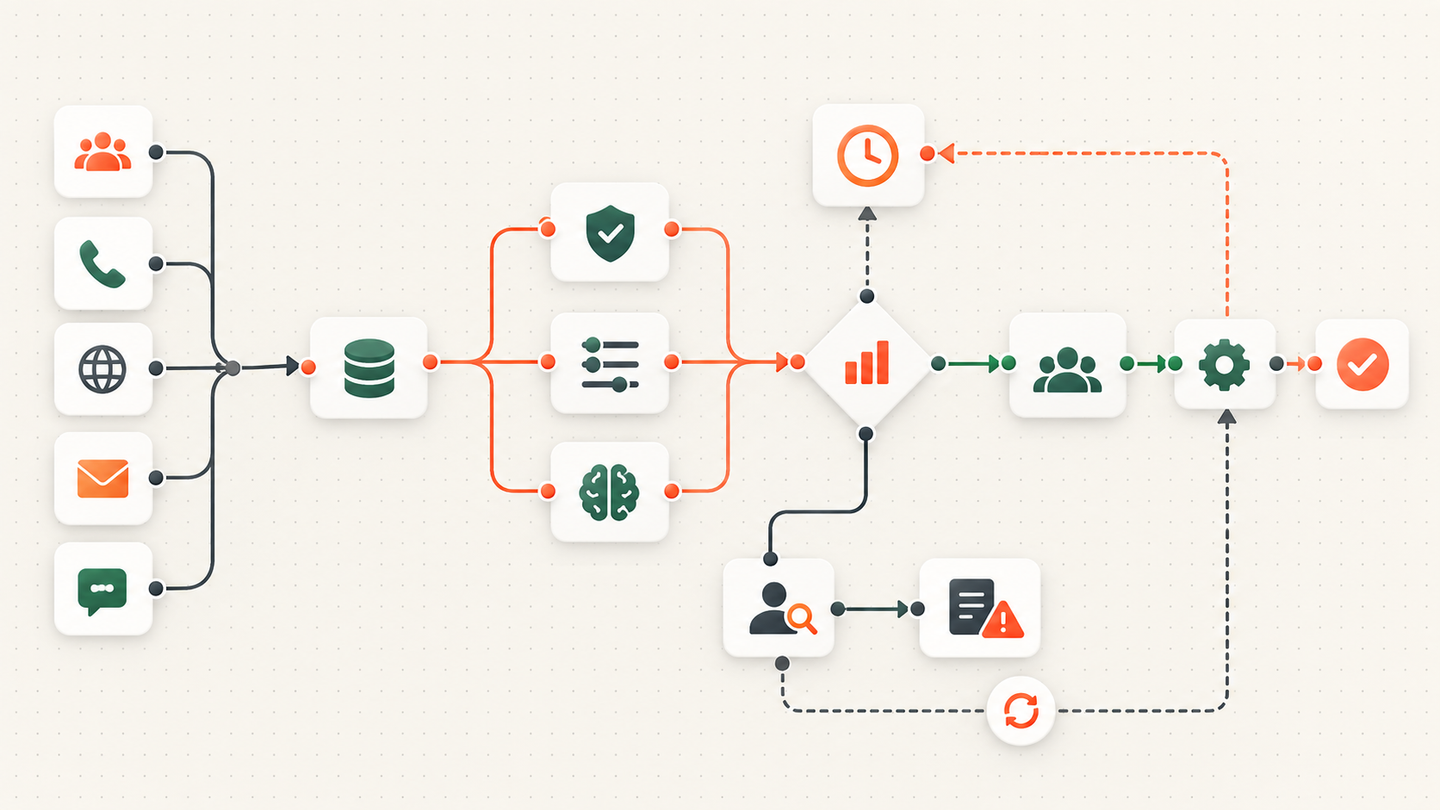
Chronexa built and tested a GoHighLevel speed-to-lead reference system that accepts leads from several channels, removes duplicates, classifies intent, scores with fixed rules and routes the record. OpenAI can classify text, but code controls the lead score and routing. Twelve synthetic scenarios test normal, duplicate and failure paths.
Tools and systems used
- GoHighLevel developer sandbox
- n8n
- Supabase Postgres
- OpenAI GPT-4.1 mini
- JSON Schema
- Webhooks
- SLA watchdog
Native CRM automation stopped too early
A home-services operator can receive leads from Meta, Google, a website, a marketplace and phone calls. Basic CRM recipes create contacts and send messages, but they often duplicate the same person, ignore rep capacity and route uncertain AI classifications as if they were facts.
The reference build was designed around the failures that matter when response time affects revenue.
The rules had to stay explainable
AI extracts intent, urgency, service and confidence from messy text. It does not decide the final score or owner. Those decisions belong to a visible rubric the operator can tune and test.
How the workflow runs
- Accept multiple sources
Web forms, calls, imports and campaigns enter one normalised lead contract.
- Create an idempotency key
Stable source fields let the system recognise a replay or duplicate.
- Claim the record
A database lock prevents two workers from processing the same lead at the same time.
- Classify the message
GPT-4.1 mini returns a constrained intent label and supporting fields.
- Score in code
Deterministic rules combine source, fit and intent into the routing decision.
- Write, route and watch
GoHighLevel receives the update; retry, dead-letter and SLA checks watch the handoff.
The system
All sources enter one canonical webhook. Phone and email resolution run under an idempotency lock, preventing retries from creating duplicates. AI produces structured qualification fields; deterministic rules calculate the score and tier. Routing considers region, skill, capacity and on-call status.
Low confidence, unclear services and existing-customer messages enter human review without automatic outreach. A watchdog checks SLA timers, escalates overdue work and can reassign urgent leads. Every decision and latency event is stored for diagnosis.
How it was tested
The build includes twelve synthetic leads covering emergencies, ordinary enquiries, spam, out-of-area requests, duplicates, replays and ambiguous messages. Database deduplication, live model calls, emergency routing, human review and SLA escalation were exercised. The case makes no client revenue claim because none exists yet.
How model work is kept narrow
The model reads free-text context and assigns a constrained intent category. It does not own the final score and it cannot choose an arbitrary destination. n8n validates the JSON response, then code applies the scoring table. This makes the operational decision repeatable and testable.
Supabase Postgres stores the idempotency key and processing state. An advisory lock prevents concurrent executions from claiming the same record. GoHighLevel remains the CRM-facing system. The database provides the control layer that a simple webhook chain would lack.
Why this is labelled a reference build
The system was built in a developer sandbox and tested with 12 synthetic scenarios, including duplicates and recoverable failures. It shows a production-minded architecture, but it is not presented as a named client deployment or as proof of a revenue result. That evidence label is deliberate.
Safeguards and failure handling
- Postgres idempotency and an advisory lock control duplicate or concurrent events.
- The model returns a JSON Schema; malformed output fails validation.
- Lead score and routing rules run in code, not model prose.
- 429 and transient API failures use retry and backoff.
- Unresolved failures enter a dead-letter path with context.
- Twelve synthetic scenarios cover normal and failure behaviour.