
A Five-Stage SEO Publishing System With Quality Gates
Chronexa built its own content operations system from Search Console opportunity through research, writing, image production and Sanity publishing, with explicit locks and failure states at every handoff.
- Proof basisRunning inside Chronexa
- IndustryContent & SEO Operations
- Year2026
- ServicesAI Agents, Content Operations, CMS Integration
Verified from Chronexa’s production workflow definitions and live website output. This study describes the pipeline architecture; organic ranking changes are measured separately and are not attributed to automation alone.
The short answer
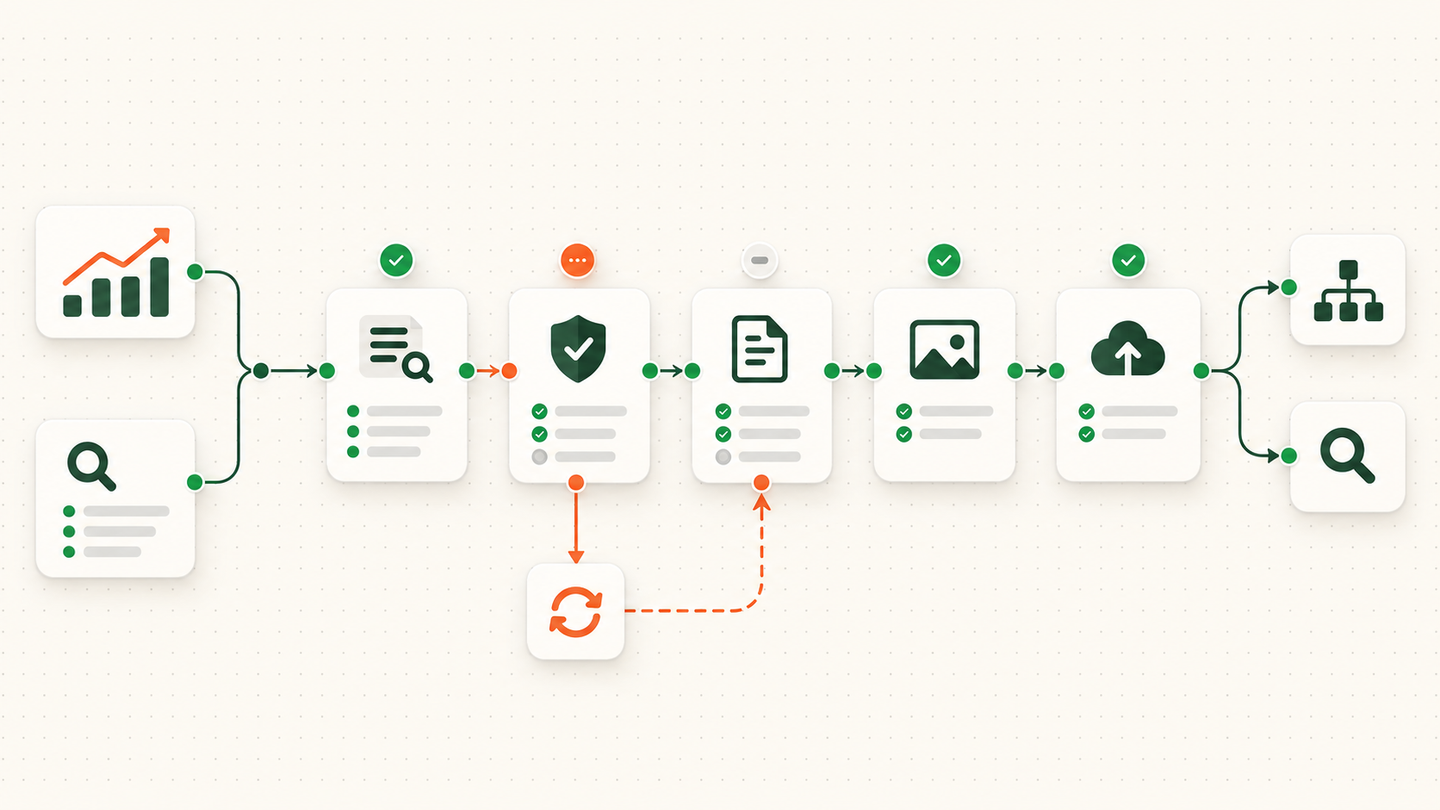
Chronexa runs a five-stage n8n content system that turns Google Search Console data into researched, reviewed and published articles. Baserow tracks every topic, Exa supplies source material, language models assist with drafts, images are commissioned separately, and Sanity publishes only after validation.
Tools and systems used
- n8n
- Google Search Console API
- Baserow
- Exa
- Anthropic
- OpenAI image generation
- Sanity
- Next.js
Publishing volume was not the real bottleneck
A model can draft an article quickly. The difficult work is choosing a query worth targeting, finding current evidence, keeping claims traceable, producing consistent images, validating required fields and updating the CMS without duplicate slugs.
When those tasks live in separate chats and documents, context disappears at every handoff.
The pipeline needed to stop bad work
An autonomous sequence is only useful if it can refuse thin research, malformed copy, missing metadata or a failed image upload. Status locks were needed so two agents could not process the same record at once.
How the workflow runs
- Find a real search gap
Search Console queries, impressions, clicks and page coverage inform the brief.
- Research the question
Exa collects relevant sources and page evidence for the assigned topic.
- Draft in plain English
The writing stage follows the brief, source boundaries and house style.
- Review words and claims
A human checks meaning, unsupported claims, headings, links and metadata before approval.
- Create the cover
The image stage uses the approved brief and stores accessible alt text with the asset.
- Publish and expose
Sanity receives structured content; Next.js exposes the page in HTML, metadata, sitemap and RSS.
The system Chronexa runs
The strategist reads Search Console opportunities and creates a structured brief. The researcher attaches current sources and operational evidence. The writing stage produces the article, title, description and key takeaways in a strict format. The design stage creates and uploads the cover. The publisher converts the body into Portable Text and writes the final document to Sanity.
Every stage locks the record before work, advances it only after validation and writes a failure state that can be inspected. Publishing revalidates the article, blog index, taxonomy hubs, sitemap and RSS feed.
What changed
The editorial record became the source of truth instead of a collection of disconnected outputs. Automation handles repeatable coordination, while topic strategy, factual standards and final commercial judgment remain explicit controls rather than implied model behaviour.
The record is the control plane
Baserow is not only a topic list. It stores the search intent, target query, sources, stage, draft, image status, review notes and Sanity result. n8n workers pick records that are ready for their stage, lock them, write the output and advance the state. This makes the pipeline restartable.
Research and writing are separate because evidence and prose have different failure modes. Exa results can be weak or irrelevant. A model can write a fluent sentence that overstates them. The review stage checks both. The image is also a separate asset with its own prompt, file and alt text instead of a generic fallback.
How publication supports search and LLM access
Sanity stores structured fields and Portable Text. Next.js renders server-readable HTML, a canonical URL, title, description, Open Graph data and Article JSON-LD. The sitemap and RSS feed expose discovery paths. Clear summaries, descriptive headings and explicit tools make passages easier to retrieve and quote, but no implementation can guarantee that Google or an LLM will cite a page.
Safeguards and failure handling
- One Baserow record owns the topic and status to reduce duplicate work.
- Stages use explicit states and locks so two workers do not publish the same brief.
- Source review and claim review happen before publishing.
- Title, description, slug, headings, links and image alt text are validated.
- A failed publish remains visible and does not masquerade as a live article.