
How an AI Product Team Turned Feedback Into Model Fixes
Millions of product interactions produced corrections, support tickets and app reviews. The signals were valuable, but product and ML teams could not consistently connect recurring complaints with affected features and user segments.
- Proof basisMarket solution story
- IndustryConsumer Software and Machine Learning
- Year2026
- ServicesWorkflow Automation, System Integration, AI Automation
This is a market solution story built from Chronexa’s research into real businesses, roles, technology stacks and operating problems. It shows how we would engineer the system. It is not presented as a named client deployment, and no unverified savings or performance result is claimed.
The short answer
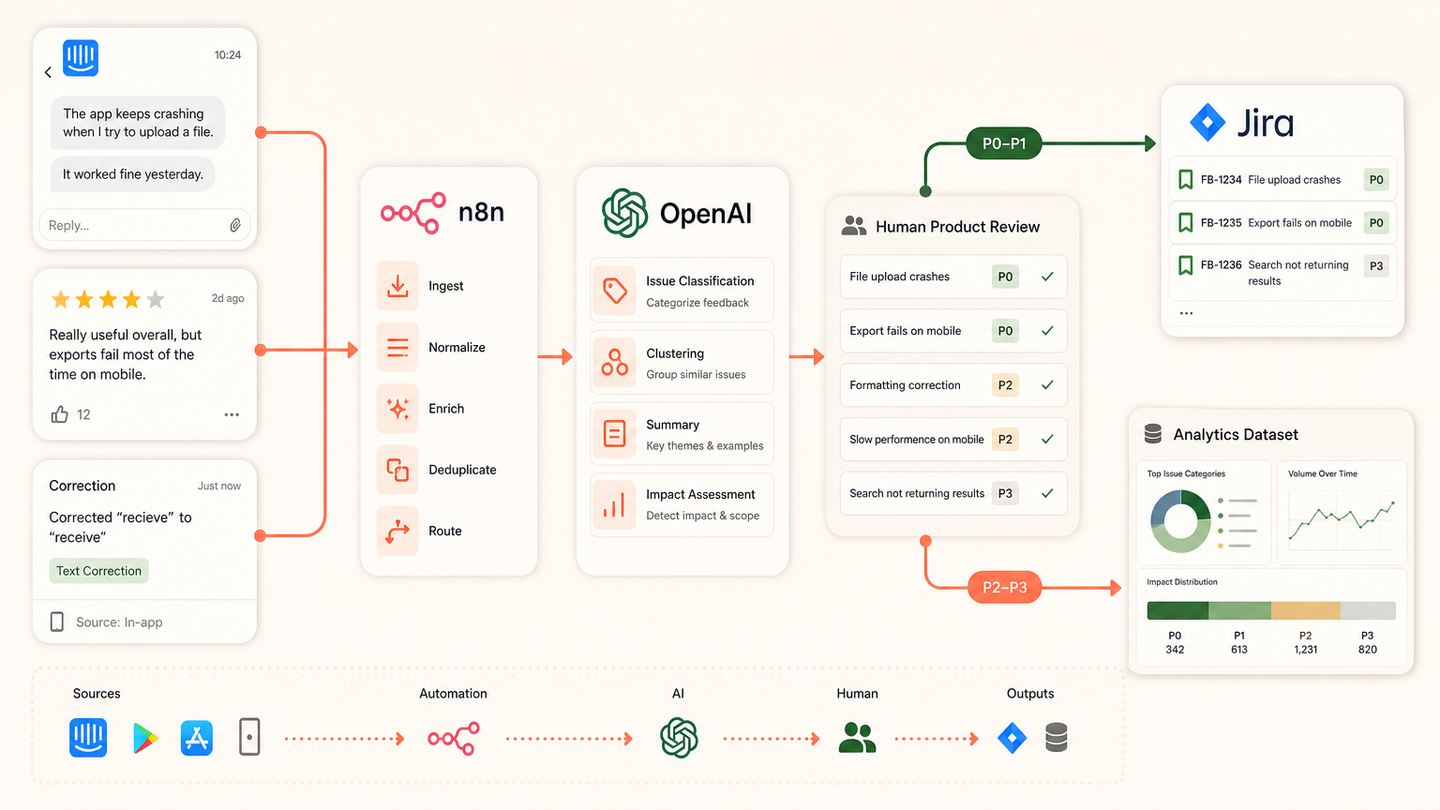
We designed a feedback workflow that combines Intercom messages, app reviews and in-product corrections, removes personal data, classifies the issue, clusters repeated patterns and creates ranked Jira tasks. Product and ML teams approve priorities and training-data changes.
Tools and systems used
- Intercom
- App review feeds
- Product events
- n8n
- OpenAI
- Postgres
- Jira
- Slack
The company had more feedback than understanding
Support saw individual complaints. Product analytics saw events. The ML team saw evaluation data. Nobody had one view of the recurring real-world errors affecting customers.
Manual tagging worked at small volume, then became inconsistent. The danger was building an impressive sentiment dashboard that still did not create actionable engineering work.
How the workflow runs
- Collect feedback
Ingest support, review and correction events with source and timestamp.
- Remove sensitive fields
Strip direct identifiers before classification and clustering.
- Classify the issue
Apply a controlled taxonomy for product area, error type, severity and user impact.
- Cluster repeated patterns
Group semantically similar events while preserving the originals.
- Rank for review
Combine frequency, severity and customer context into a visible priority score.
- Create the work item
A product owner approves the cluster before Jira receives a ticket or dataset task.
The system we designed
n8n collects events from Intercom, review feeds and the product. A privacy step removes direct identifiers. OpenAI maps each item to an approved taxonomy and generates an embedding. Postgres stores originals, labels and clusters.
Code calculates priority from frequency, severity, customer segment and recent growth. A product owner reviews the evidence, merges or splits clusters and chooses whether Jira should receive a bug, research task or training-data request.
How the company would judge it
Track feedback coverage, taxonomy corrections, time to identify a repeated issue, clusters accepted by product, linked fixes and recurrence after release. Sentiment alone is not the outcome.
Why clustering keeps the raw events
A summary can hide important edge cases. Each cluster therefore acts as an index over source events. Reviewers can inspect examples, channels and dates before accepting the theme.
Why this came from the sheet
The outbound research identified this bottleneck at a fast-growing AI consumer product: model accuracy problems were generating feedback faster than a small team could organise it. The story uses that researched operating pattern without naming the prospect as a client.
Safeguards and failure handling
- Personal data is removed before model analysis.
- Every cluster links to its original feedback events.
- Priority score components are visible.
- A model cannot publish a product issue or alter training data.
- Taxonomy and prompt versions are stored for comparison.