The $2.1 Million Problem Sitting Inside Your Onboarding Process
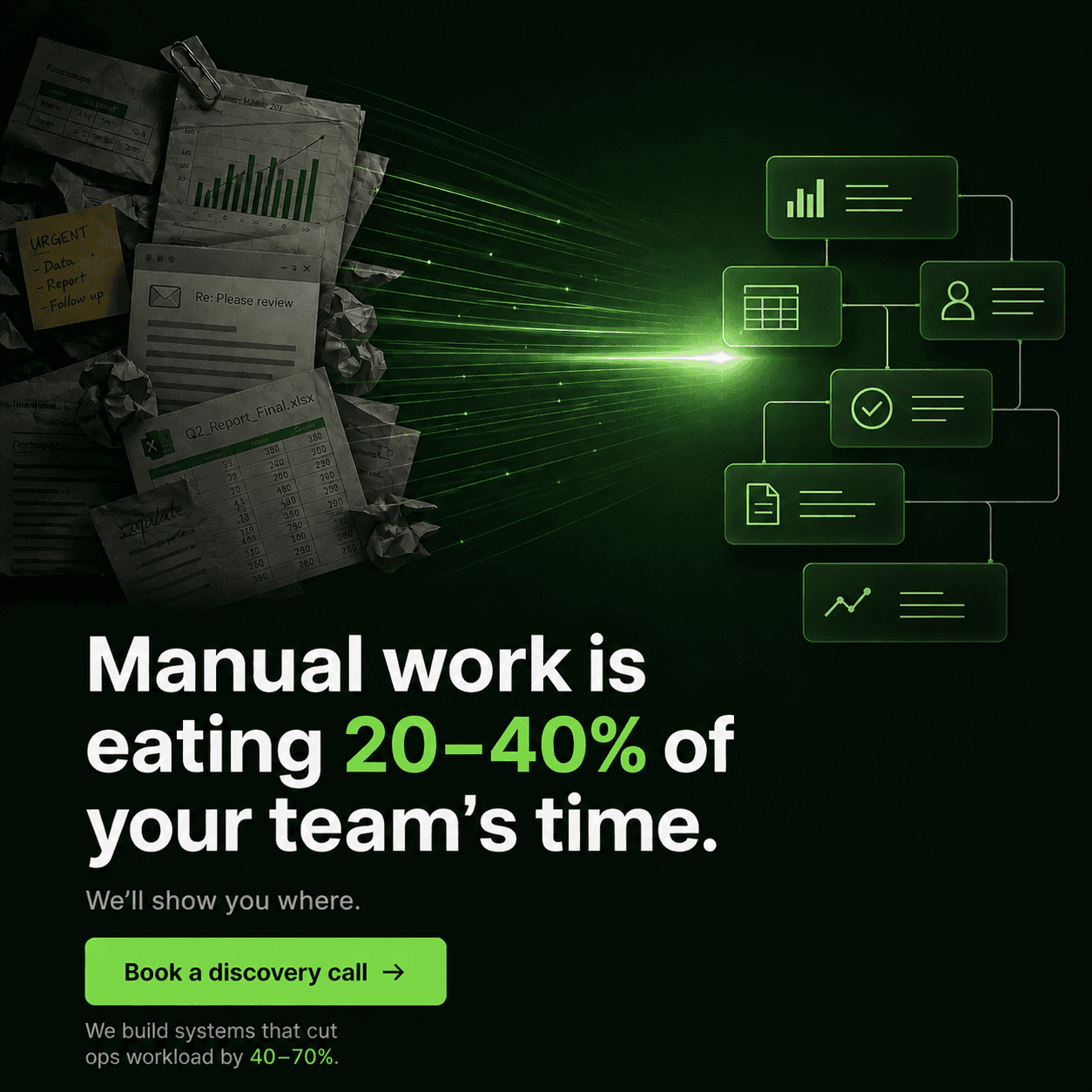
The average RIA takes 15–21 business days to onboard a new client. Automated firms do it in 3–5. That gap is not a minor operational inconvenience—it is a quantifiable revenue risk. Cerulli Associates puts the figure at $2.1 million in annual revenue at risk per $500M AUM due to onboarding friction alone. Meanwhile, J.D. Power data shows that 34% of first-year client terminations cite slow or disorganized onboarding as the primary reason.
The instinct at most mid-market wealth management firms is to throw another SaaS tool at the problem—a new client portal here, a document collection app there, a compliance checklist in a shared drive somewhere else. The result is a worse version of the same problem: more systems, more manual handoffs, and a KYC experience so frustrating that Thomson Reuters and EY surveys report 89% of clients have had a negative KYC experience, and 12% have switched providers because of it.
The firms closing the gap are not buying a better single platform. They are building custom AI workflows that orchestrate the entire onboarding sequence—document capture, data extraction, compliance screening, CRM population, and custodian sync—without requiring a single manual handoff or expensive API integration project. This post explains exactly how that works, and why the architecture matters as much as the automation.
Why No Single Wealth Management Platform Solves This End-to-End
The core tension in wealth management client onboarding automation is structural. Your compliance requirements live in one system. Your CRM lives in another. Your custodian has its own data format. Your document signing workflow runs through a third-party tool. And your advisors are coordinating all of it through email and calendar reminders.
Even well-resourced firms that invest in purpose-built onboarding technology run into this ceiling. The Pacific Financial Group's Guided Paperwork Solution—recognized by Celent's 2025 Model Wealth Manager Award—is an instructive example. TPFG built a sophisticated onboarding system integrating SmartIQ, Salesforce, DocuSign, and Orion. The result was impressive: 4,000+ transactions processed and $332 million in assets added since the 2022 launch. But that outcome required deliberate integration work across four enterprise platforms, institutional-grade IT resources, and ongoing maintenance capacity that most mid-market RIAs and private banks simply do not have.
Finantrix benchmarks onboarding complexity in private banking at 5–15 hours of staff time for standard clients and 40+ hours for complex entities—trusts, family offices, multi-jurisdictional structures. Relationship managers are burning 20–30% of their productive time on administrative onboarding tasks. That is capacity that should be generating advisory revenue.
The bottleneck breakdown tells the same story from a different angle. Broadridge 2025 data identifies the major onboarding delays as document collection (5.8 days, 38% of total time), ACAT and transfer processing (4.2 days, 27%), compliance review (2.1 days, 14%), CRM and system setup (1.4 days, 9%), and first meeting preparation (1.8 days, 12%). Every one of these delays exists because data has to be manually moved between systems that were never designed to talk to each other.
The solution is not a better point tool for any one of these steps. It is a workflow orchestration layer that sits above all of them.
What a Custom AI Onboarding Workflow Actually Does
Custom AI workflows built on platforms like n8n act as an orchestration layer—connecting your existing systems through automated logic rather than custom API development. The workflow triggers on a defined event (a signed engagement letter, a completed intake form, a new record in your CRM), then executes a structured sequence of actions without human intervention at each step.
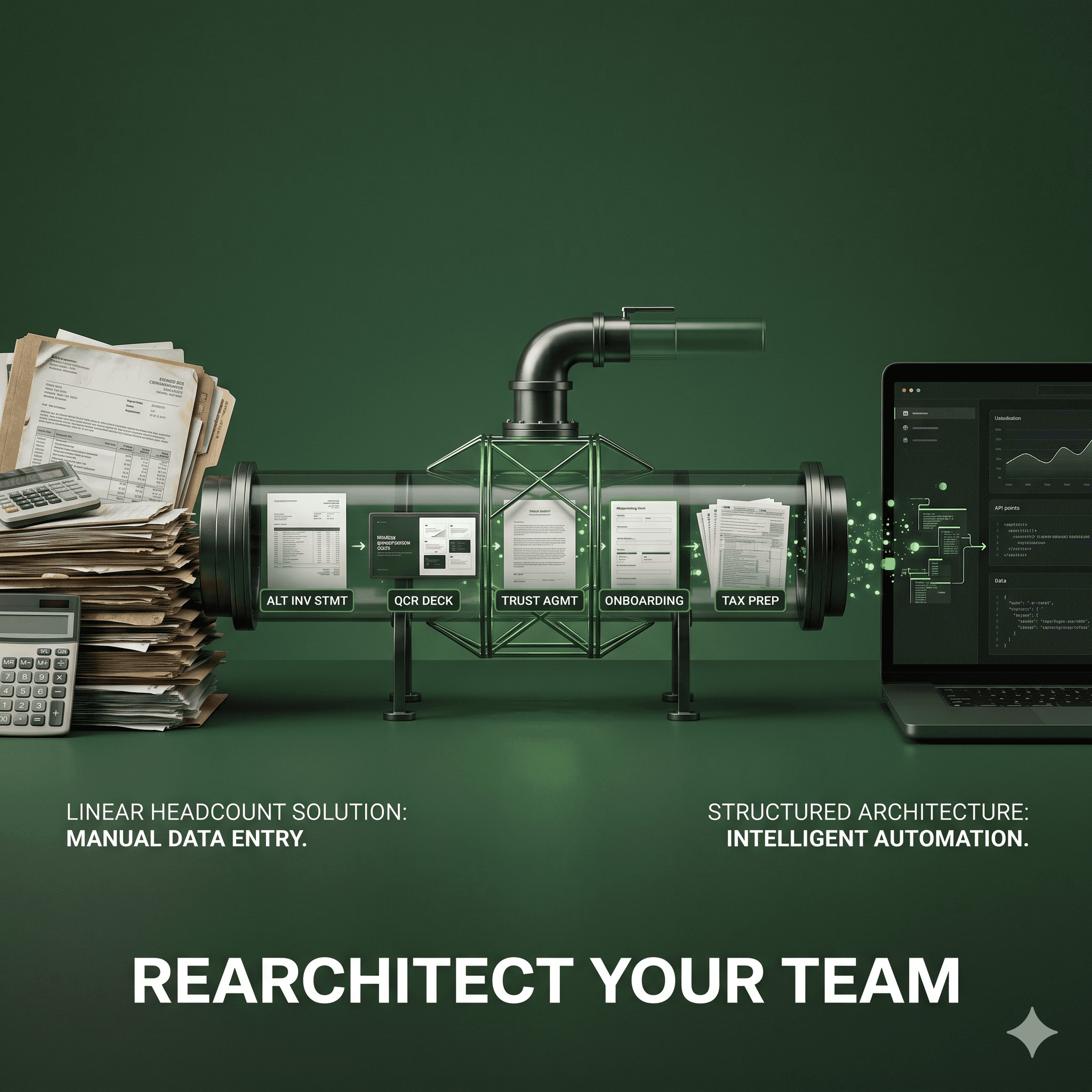
For wealth management client onboarding automation, a production workflow typically covers five operational stages:
Document capture and routing: The workflow monitors a designated intake channel—email, a client portal form, or a secure upload link—and automatically captures incoming documents. No one needs to sort an inbox or rename files. The system identifies document type, assigns it to the correct client record, and flags missing items for automated follow-up.
KYC data extraction: AI document processing reads submitted identity documents, financial statements, trust agreements, and account transfer forms. It extracts structured data fields—name, address, tax ID, entity type, beneficial ownership, account numbers—and populates your CRM or a staging data record without manual re-entry. Broadridge data shows automated KYC and document collection can cut compliance review time by 68% at this stage alone.
Compliance screening triggers: Once KYC data is extracted, the workflow automatically triggers AML screening, sanctions list checks, and suitability assessments based on client profile data. Results are logged to the compliance record and the workflow either advances to the next stage or routes to a compliance officer for exception handling—with full audit trail documentation generated automatically.
CRM and data synchronization: Validated client data is written to your CRM, investment management platform, and financial planning system simultaneously. No duplicate entry. No version conflicts. A single, validated data record that eliminates the disjoint systems problem that Kenway Consulting identifies as one of the primary sources of onboarding delay and downstream data quality issues.
Custodian account setup: The workflow formats account opening data to custodian specifications and submits it programmatically—whether that means populating a custodian's web form, generating a pre-filled PDF, or writing to a custodian API if one is available. This step eliminates the 4.2-day ACAT and transfer bottleneck that accounts for more than a quarter of average onboarding time.
The output is an onboarding sequence that runs from document submission to account-ready status in hours rather than weeks—with every action logged, every document filed, and every compliance step documented without a single manual handoff.
The Architecture Advantage: Orchestration Without Lock-In
The reason custom AI workflows outperform both manual processes and off-the-shelf onboarding platforms is architectural. Purpose-built wealth management onboarding tools are designed around their own data models and their own integrations. When your custodian updates its account opening requirements, or your compliance team adds a new screening step, or you bring on an advisor who uses a different financial planning tool, you are dependent on the vendor's roadmap and integration partnerships.
Orchestration-based workflows are built around your specific process logic, your specific systems, and your specific compliance requirements. They are modifiable without vendor involvement. When Kingsbridge Wealth Management rebuilt its investor onboarding process using automated signing workflows, the outcome was 95% reduction in manual onboarding tasks, 100% error-free document processing, and onboarding time reduced from weeks to minutes. The key design decision was mapping the ideal workflow first—14 customized signing and routing logic sequences—and then building the automation around that workflow rather than adapting their process to fit a vendor's template.
That design principle applies directly to custom AI workflow architecture. The workflow is the product. The automation tools—n8n for orchestration, AI document processing for extraction, your existing CRM and custodian systems as endpoints—are the infrastructure. This means:
You control the compliance logic, not a SaaS vendor.
You can add a new document type to your extraction workflow without submitting a feature request.
You can route complex entity clients through a different compliance path than standard individual accounts.
You can adapt the workflow for new custodian relationships without rebuilding from scratch.
You own the data flow, which means you maintain a defensible audit trail for regulatory review.
For RIAs and private banks operating across multiple jurisdictions or custodians, this flexibility is not a nice-to-have. It is a compliance and operational necessity. Multi-jurisdictional KYC and AML requirements—the exact pain point Finantrix identifies as a primary driver of 30–90 day onboarding timelines for complex private banking clients—require workflow logic that can be configured for specific regulatory contexts, not a generic compliance module that treats all clients identically.
Implementation: Where to Start and What to Measure
The instinct when scoping an onboarding automation project is to try to automate everything simultaneously. That is the wrong sequencing. Finantrix recommends an iterative approach: start with high-impact, low-risk improvements, then layer in AI capabilities. That guidance holds for custom workflow implementation as well.
The highest-ROI starting point for most mid-market wealth management operations teams is the document collection and KYC extraction layer. Investment Adviser Association 2025 data puts the average onboarding cost at 8.2 hours of staff time per new client at $85 per hour—approximately $697 per client. Automation reduces that to 1.4 hours per client. At 50 new clients per year, that is a $28,000 annual labor cost reduction before accounting for advisor time freed from administrative coordination.
The retention impact compounds that number significantly. Cerulli 2025 data shows 94% 12-month retention for clients onboarded in five business days or fewer, versus 62% for clients onboarded in 21 or more days. For a firm managing $500M AUM with an average revenue yield of 0.75%, moving from a 21-day process to a 5-day process is not just an operational improvement—it is a direct driver of the revenue at risk figure Cerulli identifies.
A practical three-phase implementation sequence looks like this:
Phase 1 — Document intake and extraction (weeks 1–4): Automate document capture from your intake channel, build AI extraction for your standard KYC document set, and populate a staging data record for compliance review. Measure: document collection cycle time and error rate.
Phase 2 — Compliance workflow automation (weeks 5–8): Connect extracted data to your AML and sanctions screening tools, automate compliance record creation and audit trail logging, and build exception routing for complex cases. Measure: compliance review cycle time and exception rate.
Phase 3 — CRM sync and custodian submission (weeks 9–12): Automate validated data write to CRM, investment platform, and custodian account opening system. Implement status notifications to advisors and clients at each workflow milestone. Measure: total onboarding cycle time and NIGO (not in good order) submission rate to custodians.
Each phase produces measurable operational improvement independently, which means the project does not require a full-quarter build before it generates value. Advisors see document collection cycle time drop in week two. Compliance sees review queue reduction in week six. Operations sees custodian submission errors drop in week ten.
The Competitive Case for Acting Before Your Peers Do
Wealth management is in the middle of a client expectations reset. Digital-native HNW and UHNW clients—the cohort set to receive a projected $84 trillion in intergenerational wealth transfer over the next two decades—do not experience a 21-day onboarding process as a premium, white-glove service. They experience it as friction. They have a reference point for fast, transparent, self-service digital experiences. A slow onboarding process signals operational incompetence, not careful service.
The firms building custom AI onboarding workflows now are not doing so because it is operationally convenient. They are doing so because the retention math is unambiguous, the cost reduction is material, and the competitive differentiation window is real but finite. When 34% of first-year terminations cite slow or disorganized onboarding, and when 12% of wealth management clients have already switched providers because of poor onboarding experiences, the question is not whether to automate—it is whether you will build the capability before your competitors do.
The firms that will own client relationships through the great wealth transfer are the ones building scalable, compliant, fast onboarding infrastructure today. Custom AI workflows are the architecture that makes that infrastructure buildable without a multi-year technology transformation project, without seven-figure platform licensing, and without a team of developers on retainer.
Chronexa builds custom AI onboarding workflows for mid-market wealth management and RIA operations teams. If your onboarding process still depends on email follow-ups, manual data entry, or a compliance coordinator chasing documents, we can map your current workflow, identify the highest-ROI automation points, and build a production system in 90 days. The bottlenecks are known. The architecture is proven. The only variable is when you start.
About author
Ankit is the brains behind bold business roadmaps. He loves turning “half-baked” ideas into fully baked success stories (preferably with extra sprinkles). When he’s not sketching growth plans, you’ll find him trying out quirky coffee shops or quoting lines from 90s sitcoms.

Ankit Dhiman
Head of Strategy
Subscribe to our newsletter
Sign up to get the most recent blog articles in your email every week.