You're Not Understaffed. You're Under-Automated.
There is a precise moment every quarter when the Managing Partner of a mid-size wealth management firm decides to hire another operations associate.
It usually happens during reporting week. The partner walks past the operations desk at 6:30 PM on a Thursday and sees their most capable Senior Client Service Associate staring blankly at a dual-monitor setup. On the left monitor is a heavily watermarked, 14-page PDF capital account statement from a private real estate fund. On the right is a sprawling, color-coded Excel spreadsheet. The associate is manually typing ending net asset values (NAV) from the PDF into the spreadsheet, preparing to manually upload that data into Black Diamond.
The partner thinks: "Our team is overwhelmed. We are growing fast. We need more hands."
The next morning, a job description for a new $85,000-a-year Client Service Associate goes live on LinkedIn.
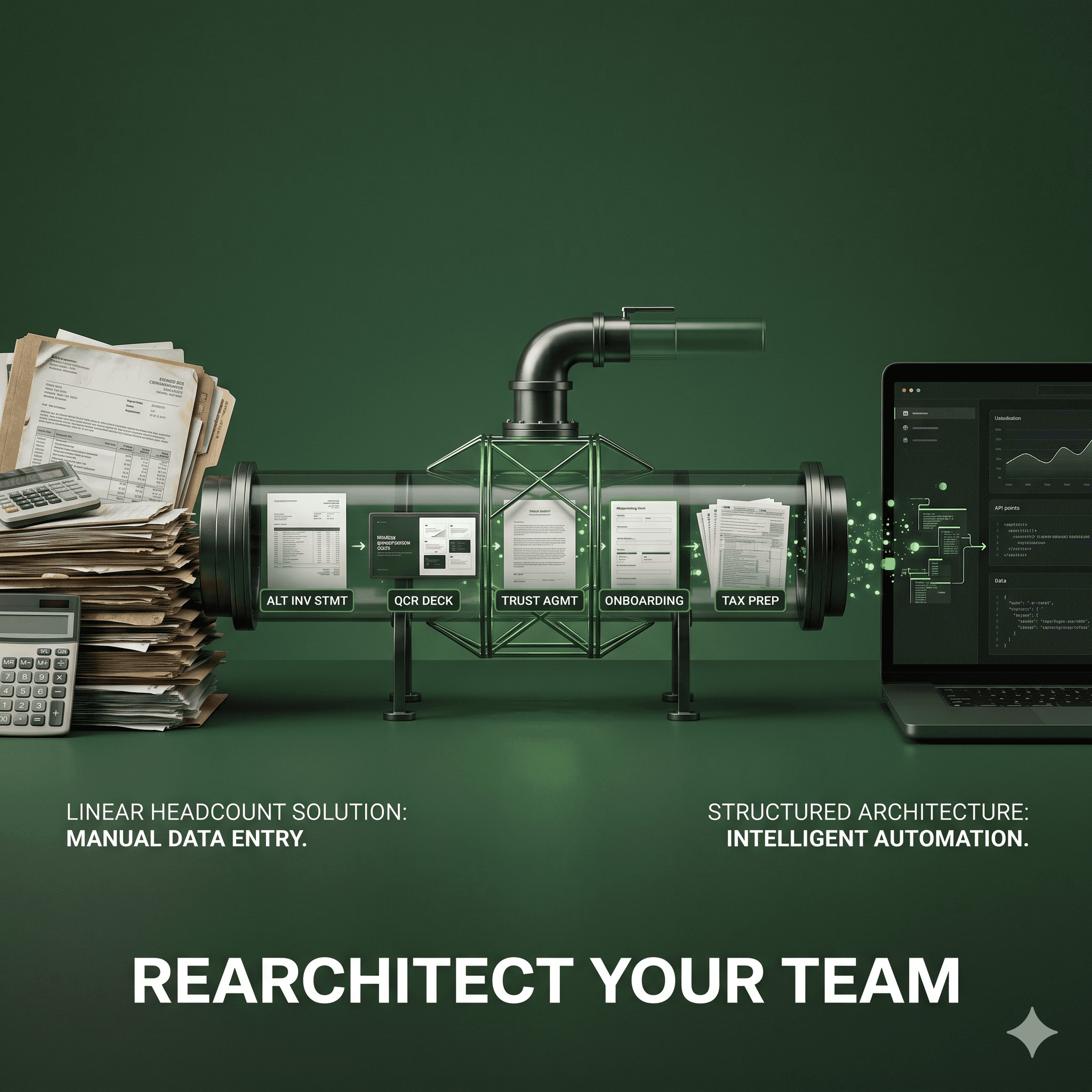
This is the headcount trap. When operations teams are drowning, leadership assumes the problem is a lack of capacity. But for firms managing $1 Billion to $10 Billion in AUM, the problem is rarely a lack of people. The problem is a lack of architecture. You are attempting to solve a broken, manual workflow problem with a highly expensive, linear headcount solution.
Every time you hire a professional to act as a human API between disconnected financial systems, you are permanently capping your firm's profitability.
If you want to fundamentally improve wealth management operational efficiency, you must stop treating your operations team as human data processors. You must quantify exactly where their time is burning, understand the annualized cost of that friction, and redesign the unit economics of your firm around intelligent automation.
The Five Workflows That Burn Your Team's Time
To understand the cost of manual processes in financial services, we must look past the P&L and audit the actual hours. Wealth management is a high-margin business on paper, but those margins are routinely eaten alive in the back office.
Based on operational audits of mid-market RIAs, here are the five specific workflows that consume the vast majority of your operations team's capacity.
1. Alternative Investment and Held-Away Asset Reporting Custodial feeds from Schwab, Fidelity, and Pershing handle standard equities flawlessly. But high-net-worth clients hold private equity, hedge funds, and real estate. These investments do not have APIs. They generate unstructured PDFs. An operations associate must monitor an inbox, download the PDF, find the ending NAV, capital calls, and distributions, and manually key them into Addepar or Tamarac. For a firm with 500 households, processing these alternative statements can easily consume 15 to 20 hours per week during peak quarter-end cycles.
2. Quarterly Client Review Preparation An advisor needs a meeting deck. To build it, the operations associate must log into the CRM to pull recent notes, log into the portfolio management system to run performance, log into eMoney for the financial plan, and access a shared drive for the Investment Policy Statement (IPS). They manually stitch these screenshots and data points into a PowerPoint template. This process averages 60 to 90 minutes per client meeting. Across a firm conducting dozens of reviews a month, this equates to a permanent tax of 10 to 15 hours per week, per associate.
3. Fiduciary Document Retrieval When a client asks for a discretionary distribution, the trust officer or advisor must verify the distribution standards (e.g., HEMS - Health, Education, Maintenance, and Support). The associate is tasked with finding the answer. They log into Egnyte or SharePoint, navigate complex folder structures, and read through 60-page scanned trust agreements and subsequent amendments to ensure they have the right clause. Acting as a human search engine for legal documents conservatively drains 5 to 8 hours per week.
4. Client Onboarding and NIGO Resolution Account opening remains stubbornly manual. Data collected via a secure portal or email is manually typed into custodial forms. A single typo results in a NIGO (Not In Good Order) status, triggering a frustrating cycle of client signatures and custodial follow-ups. Managing the friction of manual data transfer and error correction easily consumes 8 to 10 hours per week.
5. Tax Season CPA Coordination Between February and April, wealth firms essentially become document-hunting agencies for their clients' CPAs. Associates spend hours tracking down missing K-1s from private managers, downloading 1099s from custodians, securely bundling them, and transmitting them to outside tax professionals. During tax season, this highly repetitive coordination acts as a complete operational bottleneck, commanding 15 to 20 hours per week.
When you audit these five categories, you realize your operations talent spends roughly 60% of their working hours moving data from one screen to another.
The Annualized Cost Model
Let’s translate those lost hours into a back-of-the-napkin cost model. This is the math that every COO should run before approving their next operations hire.
Assume you are a $3B AUM firm with 6 Client Service/Operations Associates. The current market rate for an experienced CSA in the US is roughly $85,000. When you factor in a conservative 20% burden for health insurance, 401(k) matching, payroll taxes, and bonuses, the fully loaded cost of that employee is $102,000 per year.
Based on the workflow analysis above, conservative estimates indicate that 40% to 60% of their week is spent on repetitive, manual tasks. Let's use a conservative baseline: 20 hours per week of manual data entry, retrieval, and reconciliation.
20 hours represents 50% of a standard 40-hour work week. Therefore, 50% of their salary is being spent exclusively on robotic, administrative tasks.
Cost per Associate: $51,000 per year wasted on manual friction. Firm-Wide Cost (6 Associates): $306,000 per year.
That is over $300,000 in pure, annualized EBITDA walking out the door every year to subsidize broken architecture. That is the $300,000 problem hiding in plain sight on your P&L. And importantly, this number grows linearly. If you double your AUM, you will inevitably hire six more associates, pushing that waste past $600,000.
You are paying premium salaries for professional judgment, but you are buying administrative data entry.
The Hidden Costs Nobody Calculates
The $306,000 is just the direct salary waste. The hidden costs of manual workflows are arguably more destructive because they directly impact client experience and enterprise value.
Advisor Attention Diverted: When operations teams are bogged down in K-1 hunting and PDF extraction, they cannot provide proactive support. Advisors are forced to step in, double-checking data or hunting down documents themselves. Every hour a lead advisor spends managing an administrative bottleneck is an hour they are not spending on business development or complex estate planning.
Talent Burnout and Churn: Ambitious, intelligent operations professionals do not want to spend their careers keying numbers into Excel. When their day-to-day reality consists of repetitive friction, they burn out. The cost to replace a highly trained operations professional—accounting for recruitment, training, and lost productivity—often exceeds 50% of their annual salary.
Errors Reaching Clients: Manual data entry guarantees transposition errors. It is a statistical certainty. If an associate misses a decimal point on an alternative investment valuation, and that error makes it onto a quarterly performance report handed to a $10M client, the reputational damage is severe. Trust takes decades to build and one bad spreadsheet to break.
The Scalability Ceiling: A firm that relies on manual workflows cannot execute an M&A strategy effectively. If you acquire a $500M firm, your operations team will buckle under the sudden influx of unstructured data, forcing you to over-hire and destroying the margin you hoped to capture in the acquisition.
Operational friction is not just an expense; it is a structural barrier to scaling your wealth management firm.
What the Math Looks Like After Automation
The alternative is wealth management workflow automation. We are not talking about basic SaaS tools or simple Zapier connections. We are talking about production-grade, AI-orchestrated infrastructure.
Let's apply AI automation ROI wealth management models to our $3B firm.
Using secure, vision-capable Large Language Models (LLMs) and enterprise orchestration tools, you automate the extraction of data from alternative investment PDFs. You implement AI document intelligence to index and query your trust documents. You use API integrations to automatically compile the data for quarterly reviews.
These technologies do not replace your associates. They replace the manual tasks within their workflows. A conservative RIA operations automation initiative will eliminate 70% of the manual labor associated with those five core workflows.
Let's rerun the math: Your team of 6 associates was previously spending 120 combined hours per week on manual work. You eliminate 70% of that friction through automated data pipelines and intelligent document parsing. You instantly reclaim 84 hours of professional capacity per week. That is the equivalent of adding two full-time, highly experienced operations professionals to your team, completely free of charge.
The financial impact is immediate. You do not need to fire anyone. Instead, you avoid the next two hires. Your existing team, freed from the burden of data entry, shifts their focus to high-value work: proactive client communication, complex account onboarding, and exception handling.
Most importantly, you decouple your headcount from your AUM. Your data architecture can now process 1,000 alternative investment statements as easily as it processes 100. You can double the firm's assets without incrementally doubling your operations payroll.
Automation transforms operations from a linear cost center into a scalable engine for margin expansion.
What to Do With This Information
If you are a Chief Operating Officer or Founder staring at a capacity crunch, do not draft another job description. Do not throw another $100,000 at a workflow problem. Treat this as an architectural defect and diagnose it.
Here is a simple, three-step diagnostic you can execute this week:
Time-Audit the Pain: Ask your operations team to track exactly how many hours they spend this week solely on alternative investment reporting, document retrieval, and review prep. Do not accept guesses; get the actual hours.
Map the Inputs and Outputs: Look at the most time-consuming task. Where does the data start? (e.g., an emailed PDF). Where does it need to end up? (e.g., Addepar). If the input is digital and the output is a structured system, the space between is an automation opportunity.
Scope the Architecture Before the Hire: Before you approve the budget for new headcount, calculate the cost of automating that specific data flow. In almost every mid-market scenario, the one-time cost to build the automated infrastructure is significantly less than the first-year fully loaded cost of a new associate.
You have built a highly successful wealth management firm. Now you must build the infrastructure required to sustain it.
Stop Guessing About Your Margins. Let's Map the Math.
The difference between a highly profitable, scalable RIA and a firm constantly fighting administrative fires comes down to how they move their data.
If you suspect your firm is hiding a $300,000 manual workflow problem, you need to quantify it. If you'd like to run this analysis against your actual workflows, we will map it with you in a 30-minute session. We will take your top three operational bottlenecks, calculate the exact hours lost, and show you precisely what the architecture looks like to automate them.
No pitch. No vendor software. Just the numbers, the architecture, and the unit economics of your future scale.
About author
Ankit is the brains behind bold business roadmaps. He loves turning “half-baked” ideas into fully baked success stories (preferably with extra sprinkles). When he’s not sketching growth plans, you’ll find him trying out quirky coffee shops or quoting lines from 90s sitcoms.

Ankit Dhiman
Head of Strategy
Subscribe to our newsletter
Sign up to get the most recent blog articles in your email every week.