Before You Buy Another AI Tool: The Framework Wealth Management CXOs Need
You are sitting in your fourth vendor demo of the month. The screen is shared, and a sales engineer is showing you how their new "AI for Wealth Management" platform can automatically summarize a client meeting and draft a follow-up email.
It looks slick. The UI is modern. Your operations director is nodding along.
But as the Managing Partner, you are doing the math. You are calculating the $150-per-seat monthly license fee across 50 employees. You are wondering how this standalone tool is actually going to pull data from your highly customized, notoriously messy instance of Salesforce. You are wondering if your senior advisors—who still prefer printing performance reports on paper—will ever actually log into this new dashboard.
Most importantly, you are wondering: Is this actually solving our operational bottleneck, or are we just buying AI because our competitors are writing press releases about it?
This is the exact moment where mid-market wealth management firms ($1B to $10B AUM) make a six-figure mistake. They buy a tool to solve a workflow problem.
If you are a wealth management CXO tasked with charting your firm's AI strategy, you must step back from the feature lists and vendor promises. You need a clear, unvarnished framework to decide when to buy off-the-shelf software, and when to architect custom AI automation wealth management firms actually use.
The AI Adoption Landscape in Wealth Management: An Honest Assessment
To make a strategic decision, we must first be brutally honest about what is actually working in the market right now, and what is merely hype.
The current landscape of AI in financial services is dominated by SaaS point-solutions.
You have Microsoft Copilot, which is excellent at summarizing Teams transcripts but completely blind to the fiduciary nuances of your client portfolios. You have Salesforce Einstein, which promises predictive CRM analytics but requires a level of data hygiene that 95% of RIAs simply do not possess.
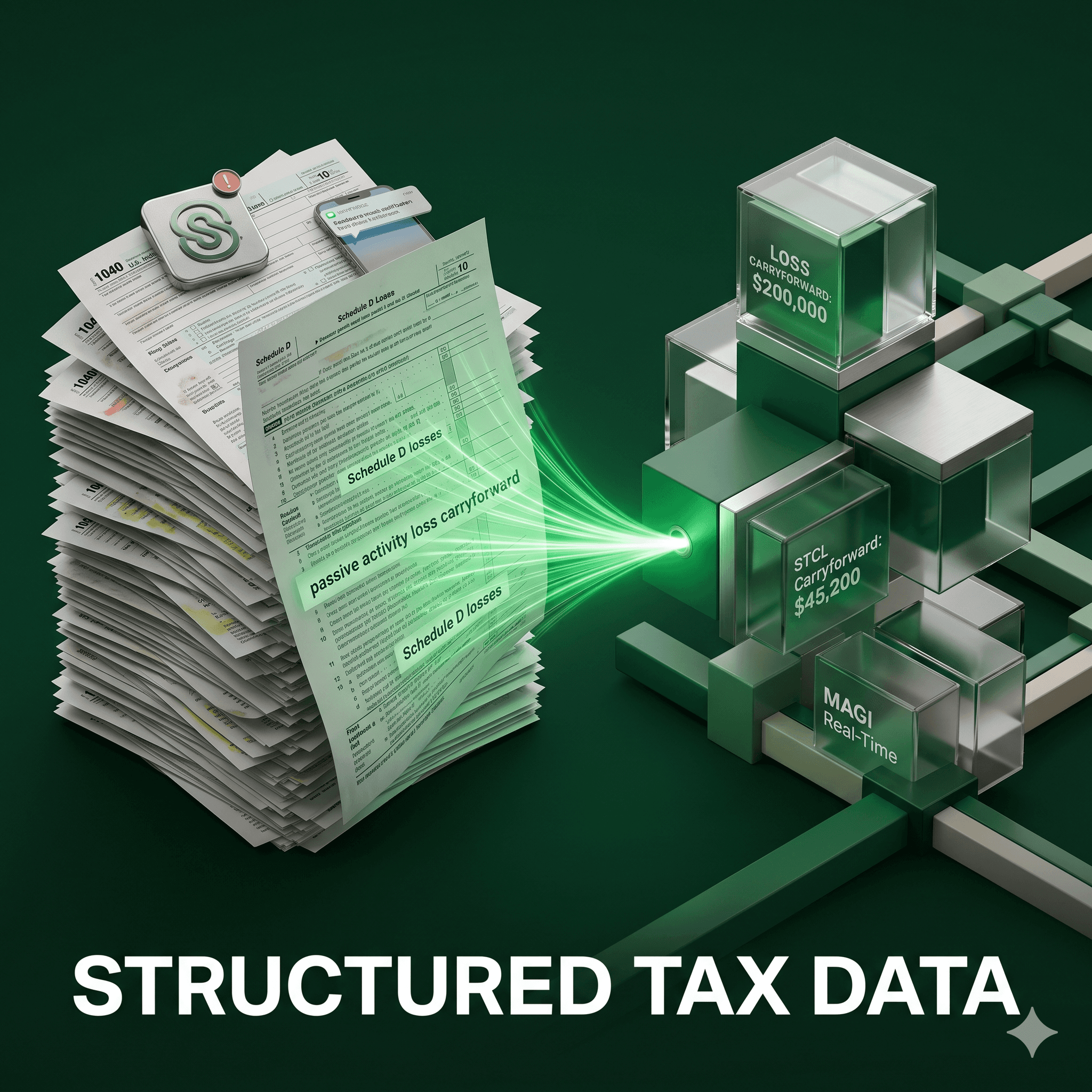
Then you have industry-specific tools. Platforms like FP Alpha and Holistiplan are genuinely valuable. They have proven that using AI to extract data from estate documents or tax returns saves massive amounts of time.
But here is the structural flaw: They are isolated silos.
When an operations associate uses an off-the-shelf tax tool, they still have to manually download the PDF from the client portal, manually upload it to the SaaS tool, wait for the extraction, download the resulting report, and then manually re-key those insights into your financial planning software (like eMoney) and your CRM.
The AI solved the reading problem, but it did not solve the workflow problem. The "swivel-chair" operational friction remains.
Firms are discovering that buying five different AI point-solutions creates tech-stack exhaustion. Advisors try the tools for three weeks, realize it takes more clicks to use the AI than to do the task manually, and quietly abandon the software. The firm is left paying thousands in annual SaaS licenses for shelfware.
The Build vs. Buy Framework — 4 Dimensions
How do you avoid the shelfware trap? You evaluate the problem before you evaluate the software.
When deciding whether to subscribe to a commercial AI tool ("Buy") or design an automated workflow tailored to your firm ("Build"), CXOs should run the specific use-case through this four-dimension framework.
1. Workflow Specificity
Does your firm handle this process exactly like every other RIA, or is your methodology a competitive differentiator?
If generic (e.g., standard CRM note-taking): Buy off-the-shelf.
If highly specific (e.g., reconciling alternative investment capital calls for complex multi-generational trusts): Build custom. Commercial software is built for the lowest common denominator. It will break on your edge cases.
2. Data Sensitivity & Control
Who handles the client data, and where does it live?
Buy: You are shipping client PII to a third-party vendor's servers. You must rely on their SOC 2 compliance and hope they aren't using your data to train their internal models.
Build: You use secure, enterprise API endpoints (like Azure OpenAI) with zero-data-retention guarantees. The data never leaves your firm's controlled architecture.
3. Integration Depth
Does the solution need to read from and write to your legacy systems?
Buy: Most SaaS tools have limited, pre-built integrations. If you have a custom-configured instance of Tamarac or Addepar, the SaaS tool will likely act as a walled garden.
Build: Custom orchestration platforms can connect to any system with an API, moving data seamlessly from an inbox, through an AI extraction node, directly into your bespoke CRM fields.
4. Total Cost of Ownership (TCO)
Are you paying for utility or paying for seats?
Buy: SaaS models scale aggressively. A $100/user/month tool costs a 50-person firm $60,000 every single year, regardless of how often the tool is used.
Build: Custom automation requires an upfront capital expenditure to architect the workflow, but the ongoing operational costs are pennies on the dollar (you only pay raw API compute costs and basic server hosting).
Dimension | Off-the-Shelf AI (SaaS) | Custom Workflow Automation |
Ideal Use Case | Universal, generic tasks (email, meeting transcription). | Firm-specific operations (alt reporting, complex onboarding). |
Data Security | Vendor-controlled. High third-party risk. | Firm-controlled. Zero-retention enterprise APIs. |
System Integration | Walled garden. Relies on manual uploads/downloads. | Deep. Reads/writes across your existing tech stack via API. |
Economic Model | OpEx heavy. Per-seat licensing scales linearly with headcount. | CapEx heavy. Fixed build cost + minimal compute/maintenance. |
The Compliance and Data Privacy Reality
For a wealth management COO or CCO, the conversation about AI begins and ends with regulatory compliance. The SEC and FINRA have made it abundantly clear: the use of AI does not absolve a firm of its fiduciary duty or its obligations under Regulation S-P (privacy of consumer financial information).
If you allow your advisors to copy and paste a client's financial situation into a public web browser version of ChatGPT, you are committing a massive compliance breach.
When you buy an off-the-shelf AI tool, you are outsourcing your compliance to a software startup. You must rigorously audit their terms of service to ensure they are not training their foundational models on your clients' proprietary data.
When you architect custom AI workflows, you retain structural control. You utilize enterprise-grade LLM APIs (from OpenAI, Anthropic, or Google) that are legally bound by zero-data-retention policies. The AI processes the data in memory, returns the structured output, and instantly forgets the interaction.
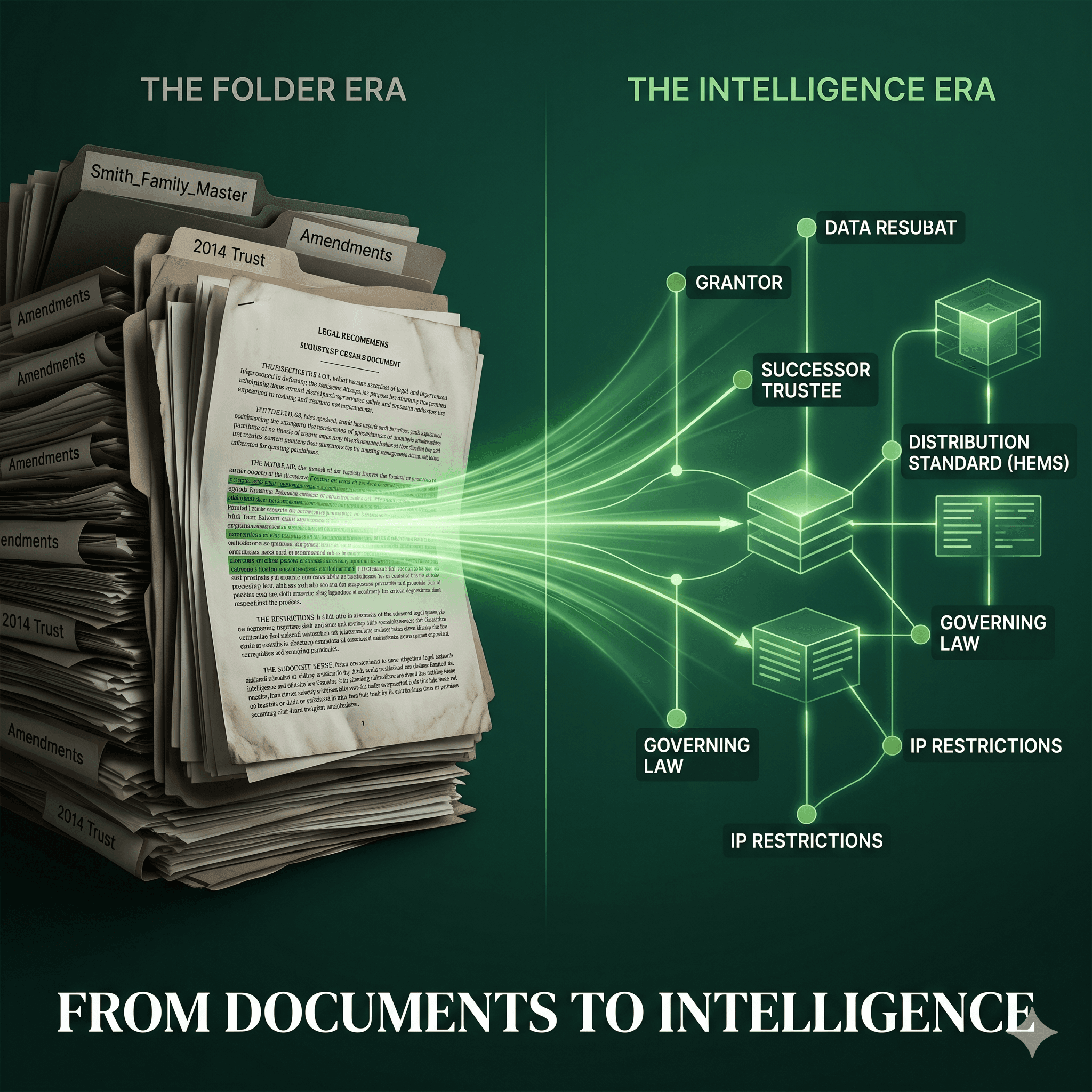
Furthermore, custom workflows allow you to mandate "Human-in-the-Loop" (HITL) checkpoints. Regulators do not want autonomous AI making unreviewed decisions. A custom architecture ensures that an AI agent might parse a 100-page trust document and suggest a summary, but a licensed professional must click "Approve" before that data enters your CRM or impacts a client portfolio. You design the compliance directly into the workflow.
What "Custom" Actually Means (And What It Doesn't)
When CXOs hear "custom AI workflow RIA," they often recoil. They imagine a multi-year IT disaster involving a dozen expensive software engineers trying to build an app from scratch.
That is an outdated definition of custom technology.
In 2025, building custom AI workflows does not mean writing millions of lines of code. It means orchestration.
Firms are partnering with specialized AI integration agencies to utilize enterprise orchestration platforms like n8n. These platforms act as the central nervous system of your firm. They use visual logic to connect the APIs of the software you already use (Outlook, Salesforce, Black Diamond, Box) with the intelligence of advanced LLMs.
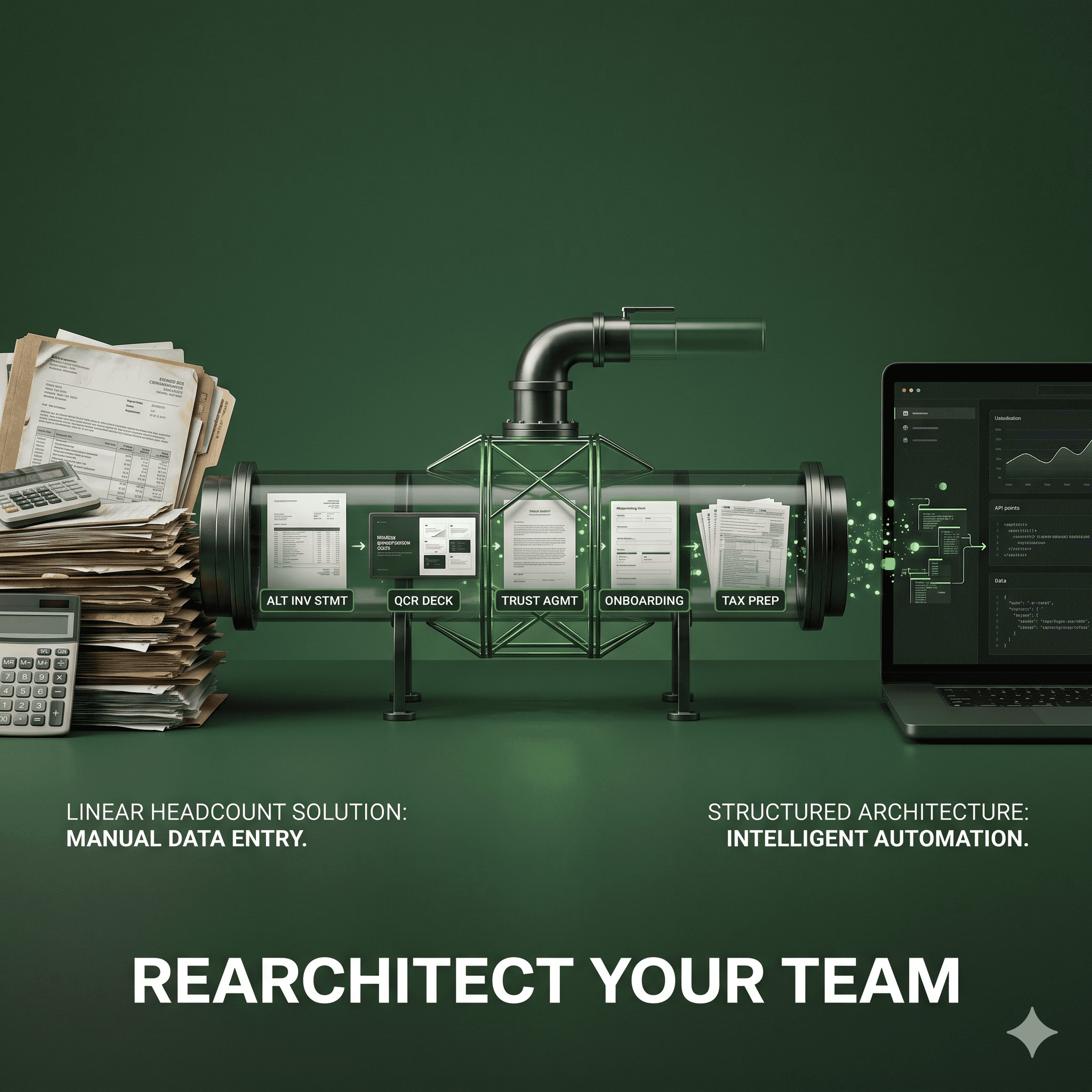
Here is what a custom orchestration build looks like in practice for an alternative investment reporting workflow:
The Trigger: A client's private equity fund emails a Q3 Capital Account Statement (a 15-page PDF) to a shared inbox.
The Routing: An n8n orchestration node instantly detects the email, strips the PDF, and securely routes it to a private, vision-capable LLM.
The Intelligence: The AI reads the PDF, locates the ending NAV, capital calls, and distributions, and formats them into a structured JSON dataset.
The Execution: The n8n platform takes that structured data, verifies the math, and pushes it directly into your portfolio management system via API.
The Review: It pings your operations associate on Slack or Teams with a link: "Q3 Statement processed for Smith Family. Click here to approve."
No manual downloading. No dual-monitor data entry. No switching between five different software interfaces.
This type of highly specific, production-grade automated workflow can typically be scoped, built, tested, and deployed in 6 to 8 weeks. It solves the exact operational bottleneck your firm is facing, without changing the software your advisors already know how to use.
The Questions a Smart CXO Should Ask Before Any AI Decision
Whether you are evaluating a $100,000 annual contract with a massive SaaS vendor, or considering bringing in an automation agency to build a custom n8n workflow, you must strip away the marketing language.
Demand specific answers to these diagnostic questions:
For Software Vendors:
“Will your system use our firm’s proprietary data or client PII to train or fine-tune your foundational models? Show me the exact clause in the enterprise agreement that explicitly forbids this.”
“If your AI extracts data incorrectly and it results in a reporting error to a client, whose E&O insurance covers that liability?”
“Can your platform push structured data directly into our specific, custom fields in Salesforce/Wealthbox via API, or do our teams have to export a CSV and upload it manually?”
For Your Internal Teams:
4. “If we buy this tool, exactly how many hours per week will it save our operations team? Show me the math.”
5. “Will this tool eliminate a workflow step, or is it just adding a new dashboard that our team has to learn to log into?”
6. “Are we trying to solve an isolated task (e.g., writing better emails) or a systemic data flow problem (e.g., onboarding new clients across four different systems)?”
Stop Buying Software. Start Building Leverage.
The wealth management industry is obsessed with buying the "next big thing" in technology. But the firms that will dominate the next decade are not the ones with the most software subscriptions. They are the firms that treat their operational workflows as proprietary intellectual property.
Off-the-shelf AI tools are a great starting point for individual productivity. But if you want to fundamentally change the unit economics of your firm—if you want to double your AUM without incrementally doubling your operations headcount—you must move beyond point solutions and start orchestrating your architecture.
We don't sell software. We are an implementation partner. Chronexa designs and builds custom AI workflows specifically for the operations teams at mid-market companies.
If you want a second, unvarnished opinion on where AI will actually create enterprise value in your firm—before you commit six figures to an off-the-shelf tool—let's talk. Book a 30-minute Workflow Scoping Call with our engineering team. We will look at your messiest operational bottleneck and show you exactly what it takes to automate it.
About author
Ankit is the brains behind bold business roadmaps. He loves turning “half-baked” ideas into fully baked success stories (preferably with extra sprinkles). When he’s not sketching growth plans, you’ll find him trying out quirky coffee shops or quoting lines from 90s sitcoms.

Ankit Dhiman
Head of Strategy
Subscribe to our newsletter
Sign up to get the most recent blog articles in your email every week.