When a $5M Trust Distribution Depends on Finding the Right Clause in the Right PDF
It is 10:15 AM on a Thursday. Your Director of Trust Services has a Zoom call with a third-generation client in forty-five minutes. The client wants to pull $350,000 from their grandfather’s generation-skipping trust to fund a seed-stage venture capital investment.
The trust officer needs to know, definitively, if the trust’s distribution provisions allow for this type of discretionary disbursement, or if it is strictly limited to Health, Education, Maintenance, and Support (HEMS).
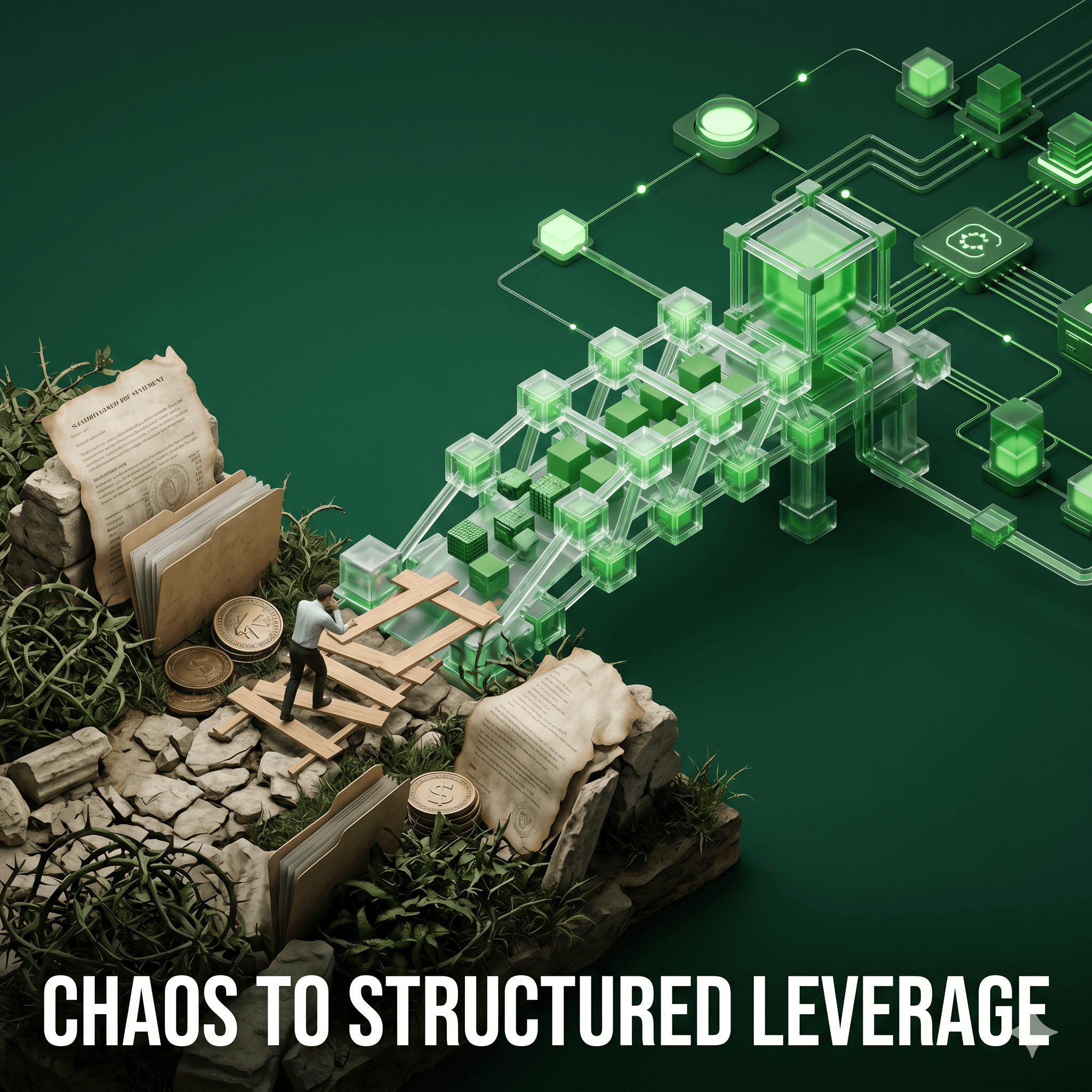
To answer this simple question, your highly paid professional logs into Egnyte. They open a folder titled “Smith_Family_Master.” Inside are fifty subfolders. They find the 2014 Irrevocable Trust agreement—a 75-page scanned PDF. They open it and begin scrolling, reading dense legalese. But wait, there is another folder titled “Amendments_and_Correspondence.” It contains three unsearchable PDFs named “Smith_Amnd_v2_Final_Signed” and “Letter_from_Counsel_2018.” For the next forty minutes, your trust officer plays amateur detective, cross-referencing disjointed PDFs to ensure that an amendment from six years ago didn’t alter the successor trustee provisions or the distribution standards. They walk into the client meeting stressed, rushed, and hoping they didn't miss a critical clause buried on page 42 of a misnamed file.
You are paying senior fiduciaries hundreds of thousands of dollars a year to act as human search engines for your shared drives.
If you are a Managing Partner or Chief Operating Officer at a wealth management firm or trust company, this scenario should keep you awake at night. The wealth management document management infrastructure at most mid-market firms is fundamentally broken. It is a system built on hope, memory, and folder hierarchies. And in the era of complex family offices and escalating regulatory scrutiny, relying on folder structures is no longer just an operational bottleneck—it is an active liability.
The Scale of the Problem: A Mountain of Unstructured Risk
To understand why this is a systemic failure rather than a minor inconvenience, we must look at the sheer volume of data involved in high-net-worth (HNW) wealth management.
When you onboard an ultra-high-net-worth family, you are not just opening a brokerage account. You are inheriting a financial ecosystem. A typical UHNW household brings with it revocable living trusts, irrevocable life insurance trusts (ILITs), family limited partnerships (FLPs), LLC operating agreements, pour-over wills, investment policy statements (IPS), and decades of K-1s.
Over a ten-year relationship, a single complex household can easily generate 300 to 500 critical legal and financial documents.
Now, multiply that by a firm managing $5 Billion in AUM across 300 families. You are suddenly responsible for a repository of roughly 150,000 unstructured documents.
Currently, 90% of the intelligence contained within those documents is locked away. It is "dark data." Your portfolio management system knows the exact daily valuation of the client's Apple stock. Your CRM knows their dog's name and their birthday. But neither system knows who the successor trustee is, what the governing state law of the trust is, or whether the client's IPS prohibits investments in private real estate.
A document stored in a subfolder without extracted metadata is not a business asset; it is a liability waiting for a lawsuit.
Every time an advisor needs to understand the parameters of a client relationship, they have to start from scratch. They download the PDF, read it, interpret it, and hopefully write an accurate summary in a Salesforce note. If they leave the firm, that contextual knowledge leaves with them, forcing the next advisor to re-read the exact same 75-page document. This is the definition of unscalable architecture.
Why This Isn't Just an Inconvenience — It's a Fiduciary Risk
When operations teams complain about document retrieval, COOs often view it as an efficiency problem. They calculate the hours lost and try to implement stricter naming conventions in NetDocuments or SharePoint.
But for trust companies and RIAs acting in a fiduciary capacity, document management is not an efficiency problem. It is a risk management crisis.
Fiduciary duty requires acting strictly in accordance with the governing documents. If your team executes a discretionary distribution that violates a restrictive spending clause, the firm can be held liable. If an advisor allocates a portfolio into alternatives when a deeply buried IPS amendment explicitly forbid it, you have breached your duty of care.
When your entire system relies on human beings remembering to check the "Amendments" folder, errors of omission are a statistical certainty.
Consider the risk of advisor transitions. A senior partner retires after managing a family’s wealth for twenty years. The new advisor steps in. The old advisor knew, from a conversation in 2017 and a subsequent legal letter, that the terms of a specific generation-skipping trust had been modified. But that letter is sitting in a PST email archive, completely disconnected from the main trust document in Egnyte. The new advisor acts on the original document. The firm faces a surcharge.
When your operational truth exists solely in the minds of your senior advisors, you do not have a scalable business; you have a fragile collection of individual practices.
Trust document automation is not about saving an hour of reading time. It is about creating a structural safeguard that prevents your firm from making decisions based on incomplete, outdated, or legally superseded information.
What "Document Intelligence" Actually Means
To solve this, we must look beyond traditional document storage. Moving files from a local server to a cloud-based SharePoint drive does not solve the problem; it merely relocates the chaos.
The solution requires moving from document storage to AI document intelligence.
In the context of financial services, document intelligence does not mean basic OCR (Optical Character Recognition). OCR simply turns a picture of a document into searchable text. If you search an OCR’d trust document for "distribution," you will get 85 highlights, and you still have to read them all to understand the context.
Modern AI document intelligence wealth management platforms utilize a combination of Large Language Models (LLMs), Vector Databases, and Retrieval-Augmented Generation (RAG).
Here is what happens when you apply this architecture to a trust document:
Ingestion: The document is uploaded to a secure, private environment.
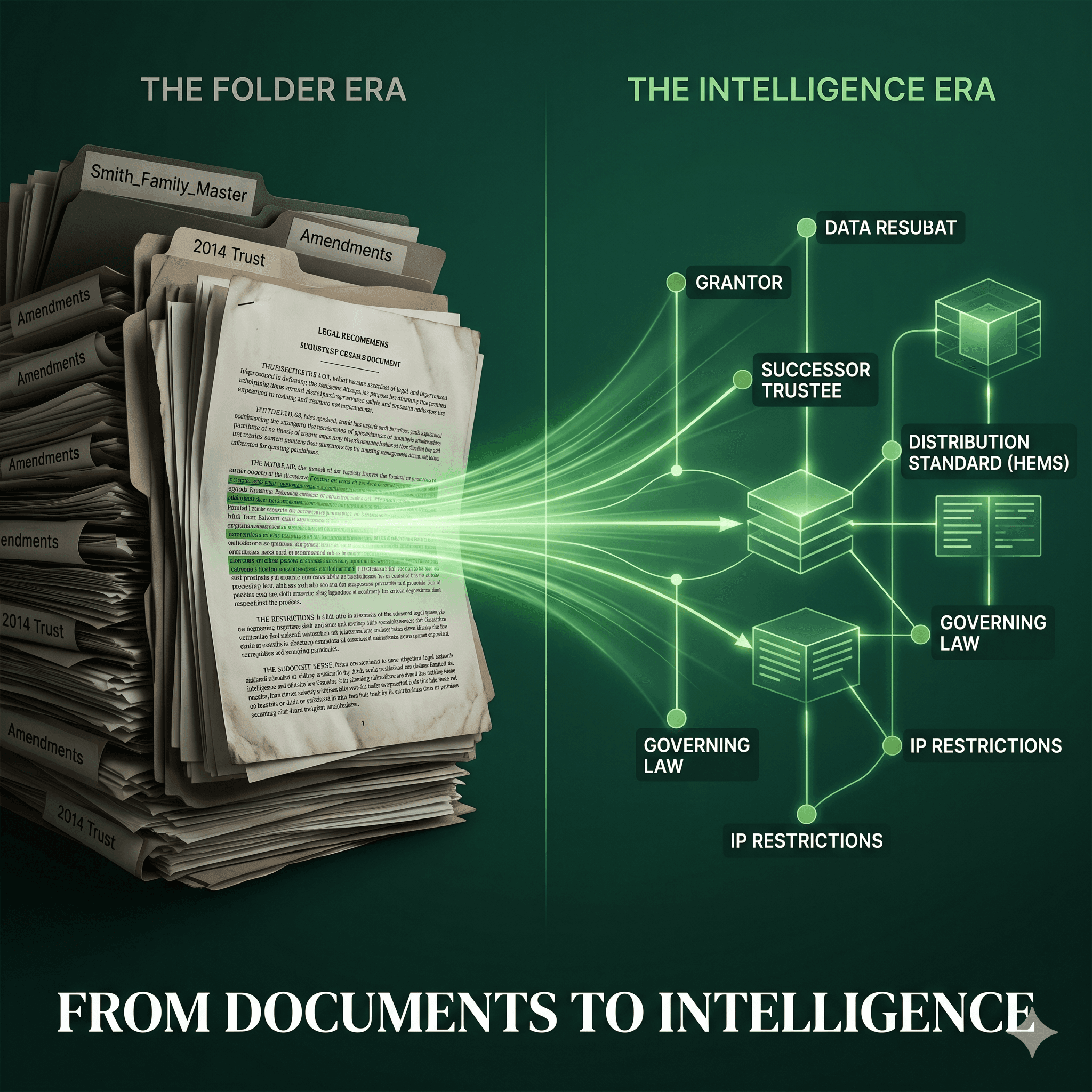
Semantic Parsing: A specialized AI model reads the document exactly as a trust attorney would. It understands the context, the defined terms, and the legal hierarchy of the clauses.
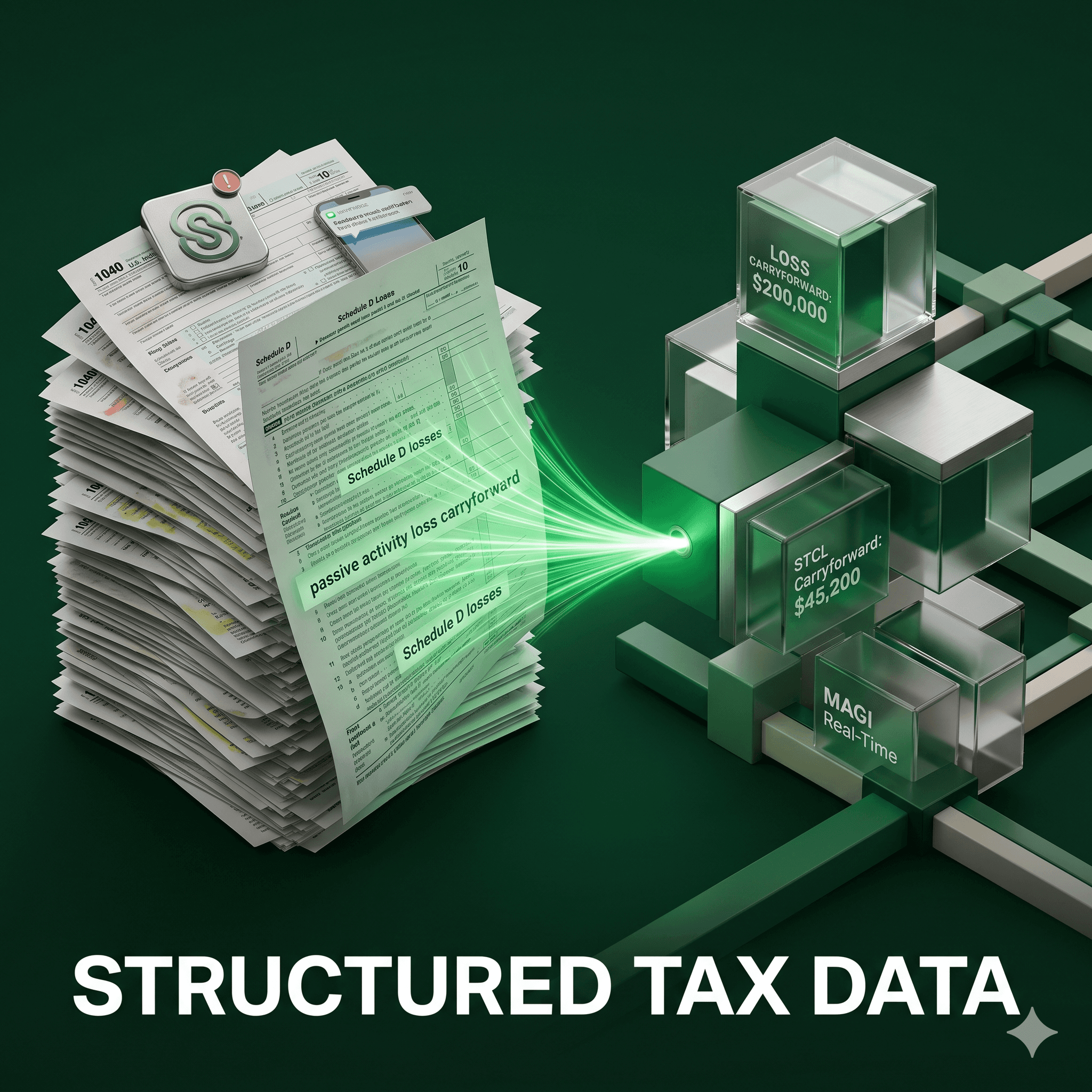
Entity Extraction: The system automatically identifies and extracts critical key-value pairs. It pulls out the Grantor, the current Trustee, the Successor Trustee lineup, the Beneficiaries, the age of majority for distributions, the governing state law, and the exact distribution standards (e.g., "sole and absolute discretion" vs. "HEMS").
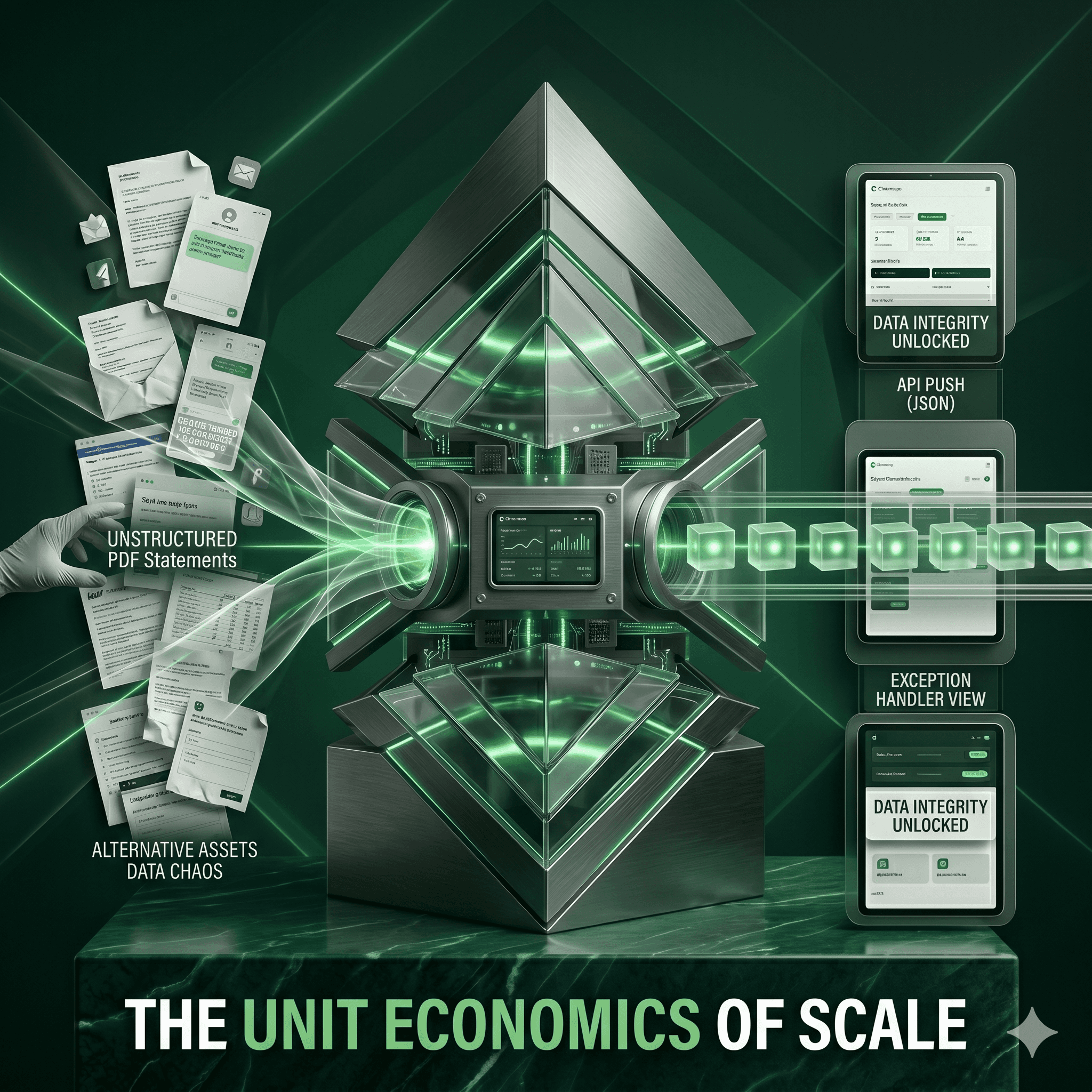
Structuring: These extracted data points are converted into structured data (JSON) and pushed directly into your CRM (like Salesforce or Wealthbox).
Indexing: The full text is embedded into a vector database, creating a semantic index. You no longer search for keywords; you search for concepts.
The document is no longer a static PDF. It is an active, queryable database of rules that governs the client relationship.
True document intelligence turns a 100-page legal contract into an instant, queryable API for your advisors.
Before/After — One Workflow, Two Worlds
To understand the operational leverage this creates, let’s look at a specific trust officer workflow automation: Preparing for a Quarterly Client Review where a distribution request is expected.
The "Before" Workflow (The Folder Era)
The Hunt: The advisor logs into Egnyte, navigates five folders deep, and downloads the original trust agreement, two amendments, and the latest IPS.
The Scan: They open all four PDFs on their second monitor. They spend 35 minutes re-reading the distribution clauses to remind themselves of the exact HEMS language.
The Cross-Reference: They realize the second amendment might supersede the original clause. They spend another 15 minutes parsing the legalese to ensure they are interpreting it correctly.
The Summary: They manually type a summary of their findings into a Word document or a Salesforce note to bring into the meeting.
Total Time: 60 to 90 minutes. High cognitive load. Moderate risk of missing a contradictory clause.
The "After" Workflow (The Intelligence Era)
The Query: The advisor opens their firm's secure AI interface (connected to their document repository) and types: "What is the distribution standard for the Smith Generation-Skipping Trust, and who must approve requests over $100k?"
The Synthesis: The AI document extraction financial services system instantly cross-references the original trust and all amendments.
The Answer: Within 5 seconds, the system outputs: "Distributions are limited to Health, Education, Maintenance, and Support (HEMS). However, per the 2019 Amendment, any discretionary distribution exceeding $100,000 requires written sign-off from the Trust Protector, currently John Doe." 4. The Proof: Crucially, the system provides direct, clickable citations to page 14 of the original trust and page 2 of the 2019 amendment. The advisor clicks the link and verifies the exact source text instantly.
Total Time: 3 minutes. Zero cognitive fatigue. Near-zero risk of omission.
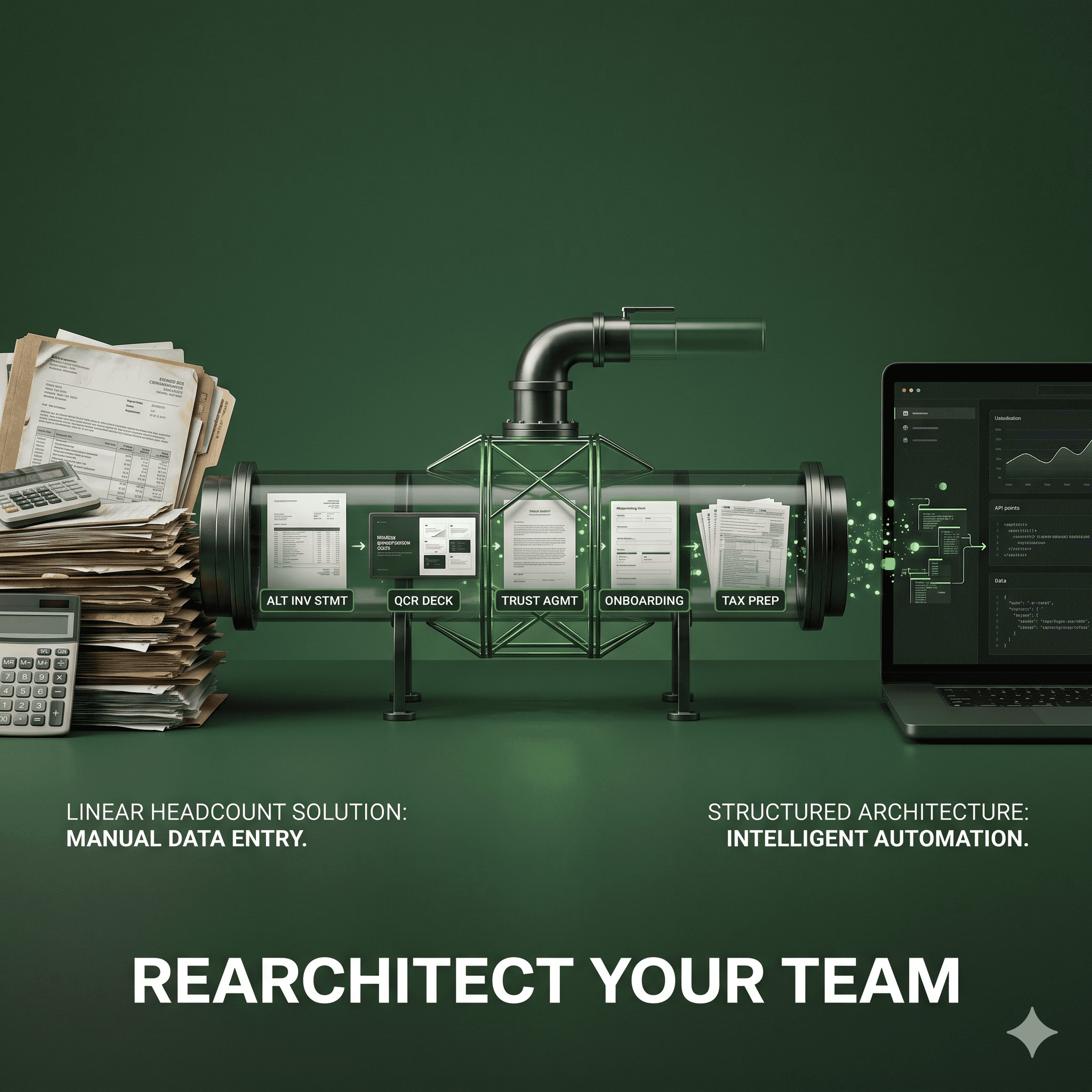
This is not science fiction. This architecture is currently being deployed by forward-thinking multi-family offices and trust companies to fundamentally decouple their headcount from their AUM growth.
What CXOs Should Be Asking Their Teams
If you want to understand the true state of your firm’s operational infrastructure, stop asking your IT provider if your servers are backed up. Start asking your operations and advisory teams these three diagnostic questions:
"If our lead advisor for our largest client relationship gets hit by a bus tomorrow, how many hours would it take a new advisor to fully reconstruct the family’s entity structure and distribution rules?" (If the answer is more than an hour, your firm's intelligence is trapped in human memory, not institutional infrastructure).
"If Delaware changes its trust laws next month, how quickly can we identify every single client document in our entire firm that is governed by Delaware law?" (If the answer involves "having the associates open every folder," your data architecture is broken).
"Do our trust officers spend more of their day reading old legal documents to find answers, or strategically advising our clients on their future?" (If your highly compensated talent is doing administrative retrieval, your margins are bleeding).
The answers to these questions will reveal the hidden tax you are paying for unstructured document management.
Stop Searching. Start Orchestrating.
The wealth management industry is rapidly bifurcating. On one side are legacy firms that continue to manage complexity by throwing expensive human capital at chaotic folder structures. On the other side are modern firms that treat their client documents as structured, queryable datasets.
Every day you delay modernizing your document infrastructure, you are cementing technical debt, frustrating your best advisors, and carrying an unacceptable level of fiduciary risk.
If you're not sure whether your document infrastructure can support the clients you're trying to serve—or if you suspect your team is wasting hundreds of hours a month just trying to find the right clause—that's worth a 30-minute conversation.
Let's spend half an hour mapping out your specific document retrieval workflows. We will show you exactly where AI extraction can eliminate risk, recover advisor capacity, and build an operational foundation that actually scales.
About author
Ankit is the brains behind bold business roadmaps. He loves turning “half-baked” ideas into fully baked success stories (preferably with extra sprinkles). When he’s not sketching growth plans, you’ll find him trying out quirky coffee shops or quoting lines from 90s sitcoms.

Ankit Dhiman
Head of Strategy
Subscribe to our newsletter
Sign up to get the most recent blog articles in your email every week.