Why 75% of SaaS Trial Users Churn in Week One (And How to Fix It)
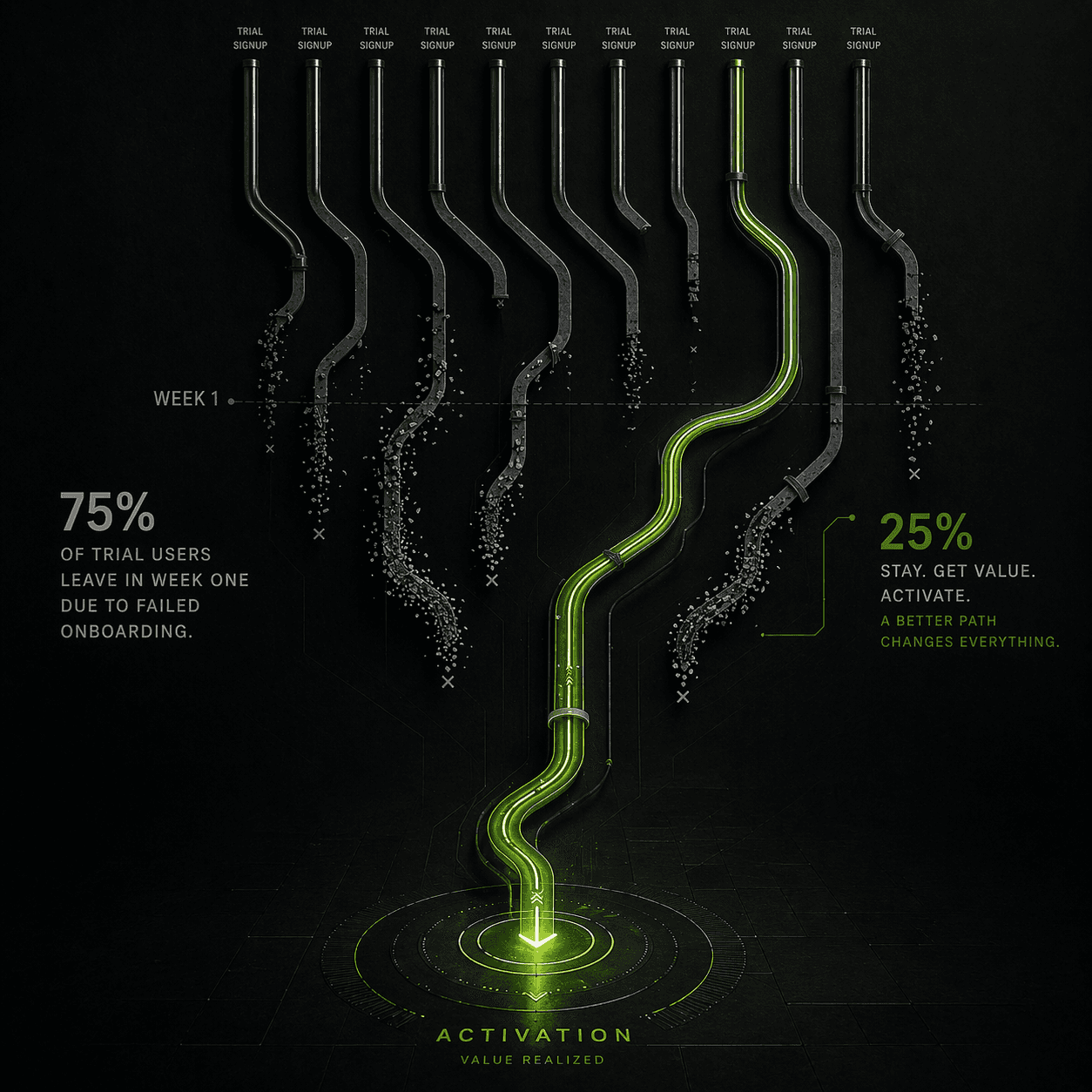
You have spent months, perhaps years, perfecting your product. Your engineering team has ironed out the bugs, your UI is clean, and your marketing is finally starting to work. You look at your dashboard on a Monday morning and see a beautiful spike in signups. But as the week progresses, you watch a familiar and painful pattern unfold: the "Green Line" of new trials is met with a brutal "Red Line" of inactivity. By Friday, 75% of those new users have ghosted. They logged in once, poked around for three minutes, and never came back. It is soul-crushing for a founder because it feels like a rejection of your vision, but the truth is much more mechanical: it’s not your product that failed them—it’s your onboarding system.
The 75% Statistic: What It Actually Means for Your Business
In the SaaS world, we often talk about churn as a long-term problem. We look at annual retention rates and lifetime value (LTV) as if they are distant metrics. But for the vast majority of software companies, the war is won or lost in the first seven days. Statistics show that 75% of users who churn do so within the first week of signing up. Even more telling is that 68% of all SaaS churn is attributed to poor onboarding. These aren't just "lost users"; they are lost opportunities that you already paid for through your marketing budget and your sales team’s time.
Let’s translate this into a business impact that hits your bottom line. Suppose your SaaS company generates 500 trial signups per month. Currently, your conversion rate from trial to paid is 8%. That means you are landing 40 new paying customers each month. Now, imagine if you could fix the "leaky bucket" of your first-week onboarding. If you could improve that conversion rate to just 15%—which is well within the realm of possibility for an automated system—you would be landing 75 new customers per month.
With zero additional marketing spend and zero increase in your cost per acquisition (CAC), you have nearly doubled your growth. For a founder, this is the highest-leverage move you can make. It is the difference between a company that is struggling to stay cash-flow positive and a company that is ready to scale toward an exit. The stakes of week-one churn aren't just "unhappy users"; it is the literal velocity of your business.
The Real Reason Users Churn in Week One (It's Not the Product)
When a user signs up for a trial and disappears, founders often retreat into a room with their product team and ask, "What features are we missing?" This is almost always the wrong question. Users don't churn in week one because your software lacks a specific reporting filter or a dark mode. They churn because of three root systemic failures.
1. No Immediate Value Moment
We live in an era of extreme cognitive load. When someone signs up for your trial, you have a window of roughly 5 to 10 minutes before they get a Slack notification, a phone call, or simply lose interest. If they log in and are met with an "Empty State"—a blank dashboard with no data and no direction—they feel the weight of the "work" they have to do to make your software useful. If they don't find their "Aha Moment"—the moment they see the software actually solve a problem—within that first session, the likelihood of them returning drops by 50% every 24 hours.
2. No Human Touchpoint at the Critical Moment
There is a "Golden Window" for conversion. It typically happens between Hour 1 and Hour 24. This is when the user’s problem is still fresh in their mind and they are actively looking for a solution. In a perfect world, a Customer Success Manager (CSM) would call them, walk them through their specific use case, and answer their questions. But as you scale, that becomes impossible. Most companies settle for "doing nothing" or sending a generic automated email three days later. By then, the user has already moved on to a competitor who actually acknowledged their existence.
3. Generic Sequences That Ignore User State
The most common sin in SaaS onboarding is the "Drip Campaign." This is a sequence of 5 emails sent over 10 days, regardless of what the user does. If a user signs up, connects their first integration, and invites three team members, they should not receive an email the next day titled "How to connect your first integration." It makes your company look robotic, disconnected, and—frankly—unintelligent. When your communication doesn't reflect the user's actual behavior in the product, they stop reading your emails. And when they stop reading, they stop logging in.
What "Good Onboarding" Actually Means for a Founder
As a founder, you have to reframe your definition of onboarding. It is NOT a "product tour" with little purple bubbles pointing at buttons. That is a distraction. Good onboarding is a behavioral engineering project designed to get the user to their first measurable outcome as fast as possible.
You must identify your "Aha Moment." For Slack, it was when a team sent 2,000 messages. For Dropbox, it was when a user put one file in one folder on one device. For your SaaS, there is a specific action that correlates with long-term retention. Maybe it’s "User creates their first invoice," or "User uploads their first 50 contacts," or "User connects their first API key."
Everything in your first 7 days—every email, every SMS, every notification—should be ruthlessly engineered toward that single moment. If the user hasn't hit that milestone, your system should be focused on nothing else. If they have hit that milestone, the system should immediately pivot to the next level of value. Good onboarding is about momentum. It is about removing the friction between "I have a problem" and "This software solved it."
Why Manual Onboarding Doesn't Scale
For a mid-market SaaS company with hundreds or thousands of customers, the instinct is often to "throw bodies at the problem." You hire a team of CSMs to do "Onboarding Calls." On paper, this makes sense. A human touch increases conversion. But when you look at the economics, the math is brutal.
A mid-level CSM in the US or Europe costs between $80,000 and $120,000 per year in total compensation and overhead. If that CSM spends 45 minutes on an onboarding call and another 15 minutes on prep and follow-up, each "onboarding" costs the company roughly $150 to $300 in staff time.
If you have 500 trial signups a month, and you want to provide a human touch to the 60% of them who show real intent, you are looking at a cost of $45,000 to $90,000 per month just to get users started. Most mid-market SaaS companies cannot sustain this. It crushes your gross margins and makes your business "un-scalable" in the eyes of investors. Because of this cost, most founders choose the "Low Touch" model, which is really just a "No Touch" model disguised as automation. This is precisely why the 75% churn rate exists—because the gap between a $300 human call and a $0 generic email is a chasm that most users fall into.
The Automated Onboarding System: What It Looks Like
The solution isn't to hire more people; it is to build an AI-orchestrated onboarding system that mimics the intelligence of a CSM but operates with the scale of software. This is what we build at Chronexa. We move away from "emails on a timer" and toward "actions on a trigger."
Imagine a workflow that looks like this:
1. The Intelligent Signup
The moment a user signs up, the system doesn't just send a "Welcome" email. It triggers an enrichment workflow (using tools like Clearbit or Apollo) to identify the user's role, their company size, and their industry. An AI agent then categorizes them: "This is a Head of Marketing at a 50-person company looking for lead generation."
2. The Hyper-Personalized First 5 Minutes
Within 5 minutes, the user receives a message (Email or SMS, depending on your stack) that isn't generic. "Hi Sarah, I saw you're leading marketing at [Company Name]. Most marketing leaders use us to solve [Problem X]. Here are the 3 steps to get that set up in the next 10 minutes."
3. The Behavior-Based Nudge (Day 1)
The system watches the user's product analytics. If Sarah hasn't hit "Activation Step 1" within 24 hours, the system doesn't send a generic "Check us out" email. It sends a specific nudge: "Hey Sarah, I noticed you started the integration but didn't finish the API connection. Is the documentation for [Specific Tool] confusing, or can I help you troubleshoot?"
4. The Milestone Celebration (Day 2)
If Sarah has completed the first step, the system immediately triggers a "success" sequence. "Great job on the integration! You're already ahead of 60% of our users. The next step to seeing ROI is to [Action Y]. Click here to start."
5. The Human Escalation (Day 3)
If a user has high potential (based on their company profile) but is "stuck" (no activity for 48 hours), the system escalates to a human. It pings your CSM in Slack with a full dossier: "Sarah at [Company] is stuck on Step 2. Here is exactly what she’s done so far. Give her a call or send this specific video." This ensures your expensive human talent only spends time on the leads that actually need it.
6. The First-Week Summary (Day 7)
Regardless of status, the system sends an automated summary. For active users, it’s a "Look how much you've achieved." For inactive users, it’s a "Here is the value you’re missing out on," with a clear path back in.
7. The Re-Engagement Play (Day 14)
If the trial is expiring and the user hasn't converted, the system triggers a final AI-driven offer based on their behavior. If they used the product a lot but didn't pay, it might offer a 15-minute "Expert Consultation." If they never used it, it offers a "Trial Reset" with a new guide.
The Difference Between a Drip Email Sequence and a Real Onboarding System
Most SaaS founders think they have an onboarding system because they have a "Drip Sequence" in HubSpot or Intercom. They are mistaken. A drip sequence is a linear path that ignores reality. It is a map that doesn't account for the fact that the driver might have taken a wrong turn or stopped for gas.
A real onboarding system is branching and responsive. It uses tools like n8n and AI orchestration to create a "Flight Controller" for your users.
Drip Sequence: Sends Email 1 (Day 1), Email 2 (Day 3), Email 3 (Day 5).
Onboarding System: Sees the user logged in 3 times in 4 hours but didn't invite a team member. It immediately triggers a pop-up or email specific to team collaboration. It "listens" to the product and "speaks" only when relevant.
Drip sequences are set-and-forget marketing tactics. Onboarding systems are operational infrastructure. One is designed to "keep in touch"; the other is designed to force activation.
What This System Returns: ROI for SaaS Founders
Let’s look at the cold, hard numbers for a mid-market SaaS company. If you are doing $5M to $10M in ARR, your valuation is likely tied to your growth rate and your net revenue retention (NRR). Improving your trial conversion is the fastest way to impact both.
The ROI Math:
Monthly Trial Signups: 500
Current Conversion: 8% (40 new customers/month)
Current MRR Added: 40 customers x $200 = $8,000/month
With Automated AI Onboarding:
Target Conversion: 15% (75 new customers/month)
New MRR Added: 75 customers x $200 = $15,000/month
Net Gain: $7,000 in additional MRR added every single month.
In year one, that system has added $84,000 in annualized revenue. But SaaS is about compounding. Because these users were onboarded correctly, their churn rate is lower, and their LTV is higher. Over a 3-year period, that 7% increase in conversion could represent millions of dollars in enterprise value.
If a custom automation build with Chronexa costs you $35,000, your payback period is less than 5 months. After that, the system continues to generate an extra $7,000 of MRR every month for as long as you run the business. This is why we tell founders: your onboarding isn't a "marketing cost"—it is a capital asset.
What Chronexa Builds for SaaS Onboarding
We don't sell you a "tool." We build you a bespoke orchestration layer. Chronexa specializes in connecting your existing tech stack—your product analytics (Mixpanel, Amplitude), your CRM (HubSpot, Salesforce), and your communication tools (Intercom, Customer.io)—using n8n and agentic AI.
We don't ask you to change your product. We build the "intelligence layer" that sits on top of it. We map out your "Aha Moments," identify where users are falling off the cliff, and build the automated workflows to catch them.
Our delivery is fast because we use professional automation frameworks, not custom-coded slogs. We go from "Scoping" to "Live System" in 30 to 60 days. And because we are a specialist implementation partner, not a SaaS product, we don't charge you a per-user fee. You own the workflows. You own the logic.
We back every engagement with a 90-day ROI guarantee. If the system we build doesn't hit the agreed-upon activation or conversion targets within the first three months, we refund your setup costs. We believe in "Performance-Based Operations." If we don't move your "Red Line," we don't deserve your capital.
Your 75% churn rate isn't a sign that your product is bad. It is a sign that your users are getting lost in the "Empty State" of your trial. They are looking for a guide, and right now, you aren't giving them one. You are losing tens of thousands of dollars in MRR every month to a problem that has a technical, automated solution.
If you are ready to stop watching trial users disappear and start scaling your conversion rates, we invite you to book a free 45-minute Automation Audit with the Chronexa team. We will look at your current signup-to-activation flow, identify the exact "Conversion Gaps" where you’re losing users, and deliver a written system design with a clear ROI projection—whether you hire us or not. Stop guessing why they’re leaving and start building the system that makes them stay.
About author
Ankit is the brains behind bold business roadmaps. He loves turning “half-baked” ideas into fully baked success stories (preferably with extra sprinkles). When he’s not sketching growth plans, you’ll find him trying out quirky coffee shops or quoting lines from 90s sitcoms.

Ankit Dhiman
Head of Strategy
Subscribe to our newsletter
Sign up to get the most recent blog articles in your email every week.