Real Estate Leads Go Cold in 5 Minutes: How to Respond to Every Inquiry Instantly
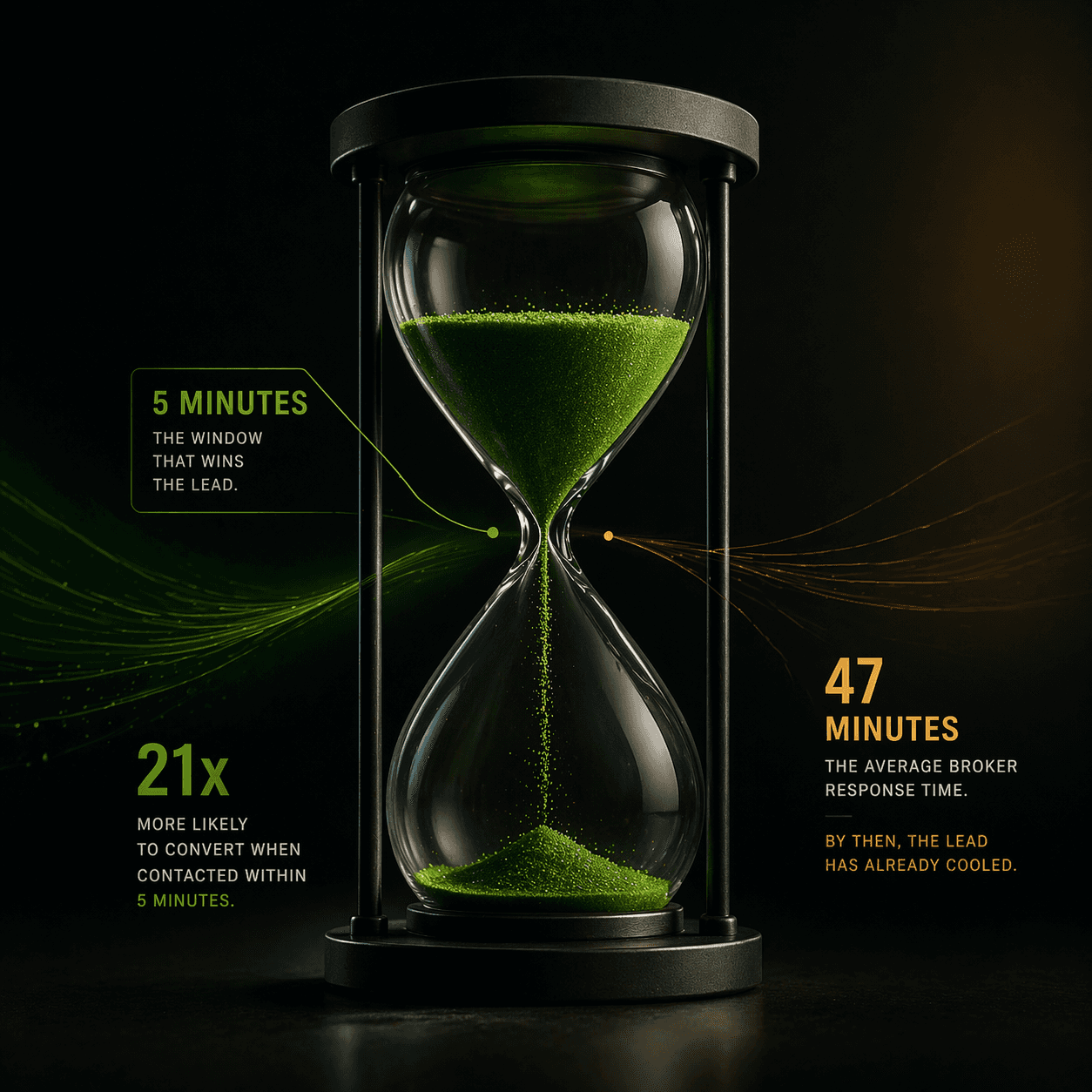
If you are a real estate broker or an agency owner, you are likely presiding over a massive, invisible leak in your company’s revenue. Research from the Harvard Business Review and LeadSimple has confirmed a brutal reality for the property industry: a lead is 21 times more likely to convert when contacted within the first 5 minutes of their inquiry compared to just 30 minutes later. Yet, despite millions spent on Zillow, Realtor.com, and social media advertising, the average real estate team takes 47 minutes to respond to a new inquiry. By the time your agent picks up the phone or hits "send" on an email, that prospect has already contacted three other agencies and is likely already scheduling a showing with the first person who actually answered.
The money isn't leaving your business because you have bad agents. It isn't leaving because the leads are "low quality." It is leaving because you are attempting to solve a high-velocity digital problem with a manual, human-centric system. You are essentially trying to catch a waterfall with a thimble. In a market where every basis point of conversion can represent hundreds of thousands of dollars in Gross Commission Income (GCI), the "47-minute gap" is the single most expensive operational failure in your brokerage. The only way to win is to move the response time from 47 minutes to under 60 seconds, and you cannot do that by simply telling your agents to "work harder."
The 5-Minute Window: Why It's Real and Why It Matters
To understand why your conversion rates may be stagnating, you have to understand the psychology of the modern property buyer or seller. When a prospect submits an inquiry—whether it’s on a specific listing or a general "contact us" form—they are in a state of peak intent. They have likely spent the last 45 minutes browsing, comparing, and finally reaching the emotional threshold where they are ready to talk to a professional. In that moment, their urgency is at its maximum.
Every minute that passes after they hit "Submit" is a minute where that intent decays. At minute 1, they are waiting by their phone. At minute 6, their attention has already drifted; they’ve gone back to the search results page and clicked on a competitor’s listing. By minute 30, they have likely moved on with their day, and your eventual phone call is no longer a "helpful response"—it is an "interruption."
The 21x conversion multiplier exists because the first responder defines the relationship. When you respond instantly, you are providing the prospect with a dopamine hit of validation. You are telling them that their inquiry matters and that your brokerage is more professional and more responsive than anyone else they’ve seen. If you wait 47 minutes, you have signaled that you are disorganized or uninterested. In the mind of a high-value buyer or seller, "If they take an hour to answer a simple email, how long will they take to negotiate my $2M closing?" The speed of your response is the first and most powerful proxy for the quality of your service.
Why Most Real Estate Teams Can't Hit the 5-Minute Window
Most brokers react to these statistics with a mix of frustration and guilt. They hold sales meetings, they show the charts, and they demand that their agents "stay on top of their phones." But the 5-minute window is not a discipline problem; it is a structural problem. Even the most motivated, high-performing agent in the world cannot hit a 5-minute response time consistently because of the nature of their work.
First, consider source fragmentation. Your leads don't come from one place. They come from Zillow, Realtor.com, your website’s IDX search, Facebook Lead Forms, Instagram DMs, and direct emails. Each of these platforms has a different notification system. An agent might see a text from one but miss an email from another. When you have 4 to 6 different lead sources, the chance of a human missing a notification in those first critical minutes is nearly 100%.
Second, there is the operational reality of an agent's day. Your agents are out in the field. They are in showings, they are sitting through three-hour inspections, they are in the middle of high-stakes negotiations, or they are driving between appointments. You cannot expect an agent to stop a listing presentation to respond to a "tire-kicker" inquiry from a website form. Because your agents are busy doing the work that actually generates revenue, they are structurally unavailable to handle the "intake" work that qualifies that revenue.
Third, the manual routing bottleneck kills speed. In many brokerages, a lead comes into a central inbox or a "round-robin" system that requires a human admin or a team leader to see it, evaluate it, and manually assign it to an agent. This adds a layer of "human latency" that guarantees you will miss the 5-minute window. By the time the admin assigns the lead and the agent sees the notification, 15 minutes have already passed.
Finally, there is the off-hours gap. Leads don't stop coming in at 5:00 PM on Friday. In fact, most property searches happen on weekends and evenings—exactly when your agents are at dinner, at their kids' soccer games, or sleeping. If a lead comes in at 9:30 PM on a Saturday and your team doesn't see it until 9:00 AM on Monday, that lead isn't just "cold"—it’s dead.
The Real Cost of a 47-Minute Response Time
Let’s look at the financial impact of this operational friction. Every broker knows their "Leads-to-Closings" ratio, but few have quantified the "Speed Tax" they are paying.
Imagine a mid-market brokerage receiving 100 inbound leads per month.
Current industry averages suggest that with a typical 47-minute response time, your team might be closing 5% of those leads.
100 Leads x 5% Conversion = 5 Closings per month.
At an average GCI of $10,000 per transaction, that is $50,000 in monthly revenue.
Now, let’s look at what happens when you fix the response time to under 5 minutes. By capturing the lead at peak intent, you move from a 5% conversion rate toward an 8% or 10% rate. This is not an optimistic guess; it is the natural result of being the first agent to secure the appointment.
100 Leads x 9% Conversion = 9 Closings per month.
9 Closings x $10,000 GCI = $90,000 in monthly revenue.
By closing that 42-minute gap, you have recovered $40,000 per month in revenue that was already yours. That is $480,000 per year in "lost" money that was simply leaking out because the system wasn't fast enough. You didn't have to buy more leads. You didn't have to hire more agents. You simply had to stop letting the leads you already paid for go cold. For most brokerages, this recovered revenue represents pure profit because the fixed costs (office, software, marketing) are already covered.
The Wrong Fix: Telling Agents to Be Faster
The natural instinct for a broker is to buy a better CRM or to implement stricter "Lead Response" rules. This almost always fails.
Buying a more expensive CRM doesn't solve the problem if the data still requires a human to enter it or act on it. Most CRMs are just "fancy filing cabinets"—they are great for storing data, but they aren't "active" systems that do the work for you. And as for "stricter rules," you cannot "policy" your way out of a logistical impossibility. If an agent is in a closing, they cannot call a new lead. Telling them to "be faster" only creates resentment, increases burnout, and leads to agents "skimming" leads—only responding to the ones that look easy and ignoring the ones that require actual work.
A culture of "hustle" is not a substitute for a robust system. The only durable solution is to decouple initial response from agent availability. You need a system that responds immediately regardless of what any individual agent is doing at that exact moment.
What an Instant Lead Response System Actually Looks Like
When we talk about an automated lead response system, we are not talking about a basic "auto-responder" email that says, "Thanks for your inquiry, we'll get back to you soon." Those are useless; they don't stop the lead from calling your competitor.
A professional-grade AI orchestration system—the kind Chronexa builds—is a series of interconnected, intelligent workflows that act like a digital concierge. Here is the anatomy of a system that actually converts:
1. Multi-Source Capture
The system is connected via API to every single one of your lead sources. Whether it’s a Zillow notification, a Facebook Lead Form, or a "Request a Tour" button on your site, the data is captured in real-time. There is no "waiting for the email to arrive."
2. Immediate Personalized Acknowledgement
Within 60 seconds, the lead receives a personalized response. Using agentic AI, this isn't just a template. The system looks at the listing they inquired about and sends a message like: "Hi Sarah, I just saw your inquiry for 123 Maple Street. It’s a beautiful property—I actually have the floor plan and the recent inspection report ready to send over. Are you looking to see it this weekend, or do you have a few quick questions first?" This starts a conversation while the intent is at its peak.
3. Intelligent Lead Scoring and Categorization
As the lead responds (via SMS or email), an AI agent "reads" the response. It identifies signals: Are they a first-time buyer? What is their price range? Are they looking to move in 30 days or 6 months? The system scores the lead so your agents know exactly who to call first when they are out of their meetings.
4. Intelligent Routing Based on Real-Time Rules
The system doesn't just "round-robin" the lead. It routes based on logic. If the lead is for a luxury listing in a specific zip code, it goes to the agent who specializes in that area. More importantly, it checks availability. If Agent A is currently in a scheduled showing (according to their calendar), the system bypasses them and routes to Agent B, who is available to talk now.
5. The 5-Minute Escalation Alarm
If the assigned agent does not acknowledge the lead or initiate a phone call within 5 minutes, the system triggers an escalation. It sends a "Stale Lead" alert to the team leader or broker. This ensures that no lead is ever left "swinging in the wind."
6. Automatic CRM Logging and Audit Trail
While all of this is happening, the system is silently updating your CRM. It creates the contact, logs the inquiry source, attaches the listing details, and records the initial AI interaction. Your agents never have to do "manual data entry." When they finally pick up the phone, the "filing" is already done.
7. Automated Long-Term Nurture
If the lead doesn't book an appointment immediately, they aren't forgotten. The system automatically places them into a personalized follow-up sequence—Day 1, Day 3, Day 7, Day 14. This ensures that the 95% of leads who don't buy today are still your clients when they are ready to buy next month.
This is not a "chatbot" that gets stuck in a loop. It is an orchestrated workflow that handles the operational "grunt work" of intake and routing, freeing your agents to do what they do best: build relationships and close deals.
The Leads You're Losing That You Don't Know About
When I speak to brokers, they often tell me, "Oh, my team is actually pretty fast. We respond to almost everything."
The problem is that you only see the leads you do respond to. You have a massive "Selection Bias." You don't have visibility into the leads that came in at 9:00 PM on a Friday, waited 12 hours for a response, and then unsubscribed or blocked your number because they already found another agent.
Most brokerages are losing 20% to 30% of their potential lead volume to "Ghost Leads"—inquiries that never even made it into the CRM because the response was so slow the lead completely disengaged. A proper automated system provides you with a full audit trail. You can finally see your true "Speed-to-Lead" metric across every source and every agent. You can't manage what you can't measure, and most brokers are currently managing their lead flow in the dark.
What This System Returns in ROI
Let's look at the investment required to build a system like this versus the return. At Chronexa, we don't believe in "forever costs." We build custom systems for a fixed implementation fee.
A typical lead response and routing automation system for a mid-market brokerage might cost between $15,000 and $25,000 to scope, build, and deploy.
Compare that to our previous math:
Recaptured Revenue: $40,000 per month.
Build Cost: $20,000 (one-time).
Payback Period: 2 weeks.
After the first month, that system is generating pure margin. You have essentially bought an "employee" that works 24/7/365, never takes a vacation, speaks perfect English (and other languages if needed), and never forgets to log a lead in the CRM. The ROI on "Speed-to-Lead" automation is often the highest of any investment a brokerage can make, including buying more leads or increasing your marketing spend.
The 3 Things a Lead Response System Must Include to Work
If you are evaluating automation partners or looking to build this yourself, there are three non-negotiable features you must have:
Multi-Source Capture: If the system only works for your website but doesn't capture Zillow or Realtor.com leads in real-time, it is useless. You need a "unified intake" layer that sees everything.
Real-Time Routing Logic: Round-robin is for amateurs. You need a system that understands context (zip code, price point) and availability (agent calendars). Sending a $5M lead to an agent who is currently on a plane to Hawaii is a waste of money.
Automatic CRM Logging with an Audit Trail: If the system doesn't write the data to your CRM automatically, you are just trading "lead response friction" for "data entry friction." The system must do the paperwork for you.
How Chronexa Builds Lead Response Systems for Real Estate Teams
At Chronexa, we are not a SaaS product. We don't charge you a monthly fee per user for a generic tool that only does 60% of what you need. We are a specialist implementation partner.
We build custom AI orchestration systems using tools like n8n and agentic AI that sit on top of your existing tech stack. We don't replace your CRM; we make it work the way it was supposed to. We don't replace your agents; we give them a "superpower" that allows them to be in ten places at once.
Our process is direct and results-oriented:
Fixed Price, Fixed Scope: You know exactly what you are paying before we start.
30–60 Day Delivery: We don't drag projects out for months. We go from kick-off to a live, production-ready system in weeks.
90-Day ROI Guarantee: If the system doesn't hit the agreed-upon conversion or response-time targets within the first 90 days, we refund your setup costs. We are a business-outcome partner, not a software vendor.
We understand the real estate business. We know that a lead is a perishable asset. We know that your agents are your most expensive resource and that their time shouldn't be spent on data entry or chasing "dead" leads. We build the infrastructure that allows you to scale your brokerage without scaling your overhead.
Every 5 minutes that you wait to fix your response time is another deal that is walking across the street to your competitor. You have already paid for the leads; now it’s time to actually close them.
We invite you to book a free 45-minute Automation Audit with the Chronexa team. We will map your current lead sources, identify the exact "Speed-to-Lead" gaps in your current process, and give you a written scope and ROI projection for a system that fixes it permanently. Whether you hire us or not, you will leave the call with a clear understanding of exactly how much money is leaking out of your brokerage and how to stop it.
Book your free Automation Audit at chronexa.io
Frequently Asked Questions
How do I respond to real estate leads within 5 minutes if my team isn't available 24/7?
Automation handles initial contact instantly through AI-powered responses that qualify leads, ask qualifying questions, and schedule showings without human involvement. Chronexa sets up workflows that engage every inquiry the moment it arrives—whether it's 2 AM or during business hours—so you never miss the conversion window. Your team then follows up with hot, pre-qualified leads instead of cold prospects.
What's the ROI of implementing instant lead response in real estate?
With a 21x higher conversion rate when contacted within 5 minutes versus 30 minutes, cutting response time from 47 minutes to under 60 seconds directly impacts close rates and revenue per lead. Most real estate agencies see 30-40% improvement in lead-to-showing conversion within the first 30 days of automation implementation.
How is instant automated response different from traditional CRM follow-up?
Traditional CRMs notify your team that a lead came in—but they still require manual action, which introduces the 47-minute delay. Instant automation actually engages the prospect immediately with personalized, intelligent responses that move the conversation forward before your team even sees the notification. Your CRM then becomes a hub for managing warm, pre-qualified opportunities instead of a record of missed windows.
Is automated lead response appropriate for high-touch luxury real estate?
Yes—automation handles the speed component (qualifying, fact-gathering, scheduling), while your agents still own the relationship and personalized service that luxury clients expect. In fact, luxury prospects appreciate fast acknowledgment and immediate scheduling options; automation removes friction without removing the human expertise that closes high-value deals.
Written by Ankit Dhiman — Founder & CEO at Chronexa. Ankit leads a lean team of n8n automation engineers building production-grade AI workflows for mid-market B2B companies across fintech, legal, SaaS, and operations. Book a free 30-minute strategy call to see what's possible for your team.
Related Articles
About author
Ankit is the brains behind bold business roadmaps. He loves turning “half-baked” ideas into fully baked success stories (preferably with extra sprinkles). When he’s not sketching growth plans, you’ll find him trying out quirky coffee shops or quoting lines from 90s sitcoms.

Ankit Dhiman
Head of Strategy
Subscribe to our newsletter
Sign up to get the most recent blog articles in your email every week.