E-Commerce Order Operations Automation: How D2C Founders Scale Fulfillment Without Scaling Headcount
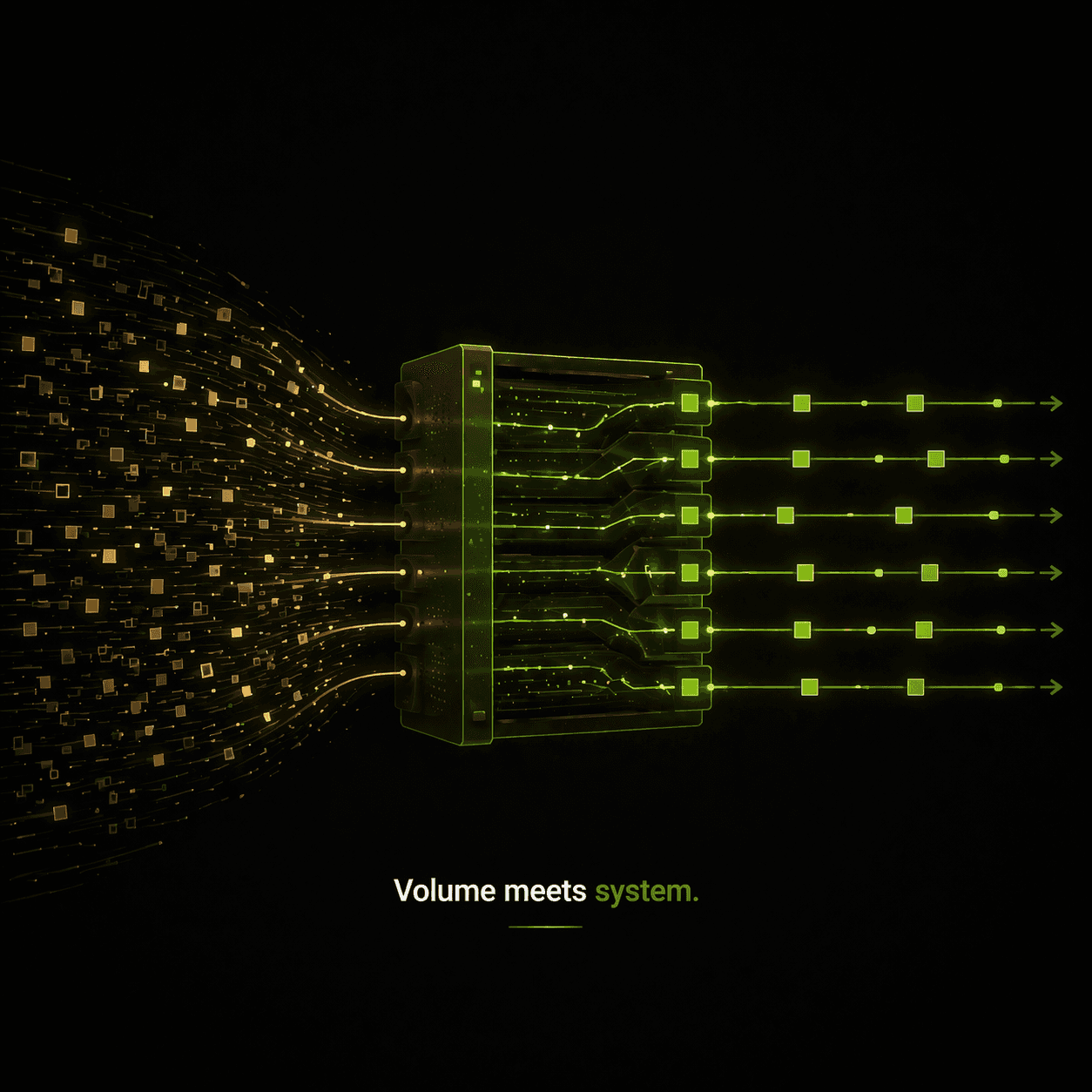
E-commerce order operations automation is the programmatic orchestration of a brand’s post-purchase lifecycle, connecting storefronts, warehouses, and customer support systems into a single intelligent workflow. It replaces manual data entry, inventory syncing, and order routing with autonomous logic that executes tasks without human intervention. The primary outcome is the ability to scale order volume infinitely while maintaining a flat operational headcount.
The $2M–$5M Fulfillment Wall: Why Growth Breaks Operations
For most Direct-to-Consumer (D2C) founders, the first $1M in annual recurring revenue (ARR) is a triumph of marketing and product-market fit. At this stage, operations are "scrappy." The founder or a small team of 2–3 people manages orders through the Shopify backend, tracks inventory in a Google Sheet, and handles customer support via a shared inbox. It is manual, but it is manageable because the volume is low enough that human attention can act as the "glue" between systems.
However, as a brand scales toward the $2M–$5M revenue wall, this human-centric model begins to fracture. The volume of orders increases from 10 a day to 150 or more. Suddenly, the manual tasks that took 30 minutes each morning now take five hours. This is the "Fulfillment Wall."
At this stage, the standard response from founders is to hire more people. You hire an "Operations Coordinator" to manage the 3PL relationship. You hire "Support Agents" to answer the growing pile of "Where is my order?" (WISMO) tickets. You hire a "Data Analyst" to help you understand your inventory levels. But because the underlying system is still a fragmented mess of manual spreadsheets and disconnected tools, you have entered the Headcount Trap. You are now paying for a linear increase in payroll to support a linear increase in revenue. Your margins begin to shrink precisely when they should be expanding due to economies of scale.
The wall is not a headcount problem; it is a systems architecture problem. To scale past $5M toward $30M and beyond, you must move from "Human-Operated Workflows" to "AI-Orchestrated Systems." You must build a foundation where the software handles the logistics so your people can handle the brand.
The 7 Order Operations Workflows to Automate First (With Benchmarks)
To dismantle the fulfillment wall, you must automate the high-frequency, low-judgment tasks that are currently draining your team's capacity. Here are the seven critical workflows that provide the highest return on investment for D2C brands.
1. Order Routing to Warehouse/3PL
The Manual State:
Every morning, an operations manager logs into Shopify, exports the previous day's orders to a CSV, filters them by SKU or shipping zone, and emails the list to the warehouse or uploads it to a 3PL portal. They then spend the afternoon chasing the warehouse for confirmation that the orders were received and processed.
The Automated State:
Orders route automatically from your storefront to the correct fulfillment center based on pre-set logic gates. The system checks inventory availability at multiple locations, identifies the optimal shipping zone to reduce transit time, and handles "Split Shipments" automatically if one item is on backorder. The human step is eliminated for 98% of orders; the system only flags "Exceptions" (e.g., an unverified address or a high-risk fraud alert) for a 30-second human review.
Time saved: 1–2 hours per day for an operations manager.
ROI Benchmark: Eliminates the need for a dedicated "Warehouse Coordinator" until you hit $15M+ ARR.
Operational Benefit: Reduces the "Order-to-Ship" latency by 12–24 hours.
2. Inventory Sync Across Channels
The Manual State:
You sell on Shopify, Amazon, and perhaps through a wholesale channel. A manager manually updates inventory counts across these platforms every afternoon. If a product sells out on Amazon, there is a 4-hour lag before the Shopify store reflects it, leading to "Overselling." This results in disgruntled customers, "Out of Stock" apology emails, and manual refund processing.
The Automated State:
A real-time inventory synchronization engine serves as the single source of truth. Every time an order is placed on any channel—or a return is processed at the warehouse—the stock levels are instantly updated across all sales channels via API. The system accounts for "Safety Stock" buffers, automatically hiding a product when it hits a threshold of 5 units to prevent overselling during high-traffic periods.
Time saved: 3–5 hours per week of manual data entry.
Stockout reduction: 40–60% improvement in inventory accuracy.
ROI Benchmark: Prevents the loss of $5,000–$15,000 in annual revenue caused by overselling and subsequent cancellations.
3. "Where Is My Order?" (WISMO) Support
The Manual State:
As volume grows, 40–60% of all support tickets become "Where is my order?" queries. A customer emails; a support agent must then manually copy the order number, log into the shipping carrier’s site, find the status, and draft a manual reply. It is repetitive, low-value work that prevents your support team from handling complex product questions.
The Automated State:
A customer query containing "order" or "tracking" triggers an automated lookup. Using an AI agent integrated with your shipping data (e.g., ShipStation or AfterShip), the system identifies the status and sends a personalized, real-time response: "Hi Sarah, your order #1234 is currently in Newark and is expected to arrive by Thursday at 4 PM. Here is your live tracking link."
Time saved: 40–60% of support ticket volume eliminated.
ROI Benchmark: In the AutoPartsCo Case Study, support volume tripled while headcount stayed flat, saving the company $110,000 annually in operational costs.
Customer Experience: Instant responses lead to higher Net Promoter Scores (NPS) and repeat purchase rates.
4. Returns and Refunds Processing
The Manual State:
The "Reverse Logistics" nightmare. A customer wants to return an item. They email support. An agent reviews the request, checks eligibility, manually generates a return label, and emails it back. Once the warehouse receives the item, the agent must manually initiate the refund in Shopify and notify the customer. Each return consumes 15–20 minutes of staff time.
The Automated State:
A self-service returns portal allows customers to initiate their own returns. The system automatically verifies eligibility based on your return policy (e.g., "within 30 days," "not a final sale item"). If eligible, it generates a shipping label instantly. Once the carrier scans the return package, the system can trigger an automatic "Instant Credit" or "Refund" according to your rules.
Time saved: 8–15 minutes per return.
ROI Benchmark: For a brand with a 10% return rate on 2,000 orders/month, this recovers 25–50 hours of staff time monthly.
Financial Impact: Reduces "Customer Friction," making people more likely to take a risk on a first-time purchase.
5. Supplier/PO Reorder Triggers
The Manual State:
Inventory management is reactive. Someone notices a SKU is low when it’s already too late. They manually create a Purchase Order (PO) in an Excel sheet and email it to the supplier. Lead times are ignored, resulting in 14–21 days of lost revenue while waiting for a restock.
The Automated State:
The system calculates "Days of Inventory Remaining" based on your trailing 30-day velocity. When a SKU hits a defined threshold (e.g., 21 days of stock remaining), the system automatically drafts a PO and pings the founder or ops manager for a "One-Click Approval." Once approved, the PO is sent to the supplier via email or API automatically.
Time saved: 2–4 hours per week on manual monitoring.
ROI Benchmark: Reduces "Out-of-Stock" periods by 70%, ensuring you never stop the "Revenue Engine" due to procurement delays.
6. Post-Purchase Communication
The Manual State:
Most brands stop talking to the customer the moment the "Order Confirmed" email is sent. There is no structured follow-up, or if there is, it is a generic, un-timed sequence that doesn't account for whether the product has actually arrived.
The Automated State:
An orchestrated post-purchase journey is triggered by shipping events, not just time.
Order Confirmed -> Shipping Update -> Out for Delivery -> Delivered!
3 Days Post-Delivery: Automated "How do you like it?" message with a review request.
14 Days Post-Delivery: Automated repurchase trigger or "How to use" guide based on the specific SKU purchased.
Zero manual effort from the marketing or ops team.
LTV Impact: Brands using event-triggered post-purchase sequences see a 15–20% increase in Lifetime Value (LTV) over 12 months.
7. D2C Operational Reporting
The Manual State:
Every Monday morning, the founder spends 3–5 hours pulling data from Shopify, Amazon, Meta Ads, and their bank account to build a "Weekly Digest." By the time the report is done, it is already out of date, and the founder is too exhausted to actually analyze the numbers.
The Automated State:
A data orchestration layer pulls these metrics automatically. By 7:00 AM every Monday, a "Founder Brief" is delivered via Slack or Email. It contains: Net Revenue, AOV, Contribution Margin, Return Rate, and Top 5 SKUs by Velocity.
Time saved: 3–5 hours per week of high-value founder time.
ROI Benchmark: Recovers $25,000–$40,000 in "Founder-Hour Value" annually.
Strategic Gain: Decisions are made on data, not "gut feeling."
The D2C Operations Automation Stack (Named Framework)
At Chronexa, we implement what we call The FLOW Operations Stack for D2C. This framework is designed to ensure that a brand can triple its volume without adding a single administrative hire.
F — Fulfillment Layer: This is the base of the pyramid. Orders are routed, split, and confirmed across 3PLs automatically. It removes the need for a manual "Warehouse Manager."
L — Live Inventory Layer: This ensures a 100% accurate sync across Shopify, Amazon, TikTok Shop, and wholesale. It eliminates overselling and apology emails.
O — Outbound Communication Layer: This automates the entire post-purchase journey, from the "Out for Delivery" text to the "Review Request," increasing LTV without manual marketing effort.
W — WISMO + Returns Layer: This handles the highest-volume support queries and the complex reverse-logistics of returns, allowing your support team to remain small and specialized.
When these four layers are connected via an orchestration tool like n8n or Make, the agency creates a "Closed-Loop" system. The data flows seamlessly from the customer's click to the warehouse's pick, and back to the customer's doorstep.
What AutoPartsCo Proved (Real Case Study Anchor)
The power of this stack is best illustrated by AutoPartsCo, a high-growth D2C brand that partnered with Chronexa when they hit the $5M "Fulfillment Wall."
The Challenge:
AutoPartsCo was experiencing a surge in demand, but their manual processes were failing. Support tickets were at an all-time high, fulfillment errors were costing them $4,000 a month in re-shipments, and the founder was spending his entire Sunday on reporting. They were about to hire three new full-time employees to manage the chaos.
The Chronexa Solution:
We implemented the FLOW Operations Stack. We built an automated routing system to their two 3PLs, an AI-agent for WISMO support, and a self-service returns portal. We connected their Shopify, ShipStation, and Gorgias accounts into a unified n8n workflow.
The Result:
Over the next 12 months, AutoPartsCo's order volume tripled.
Headcount: Stayed exactly the same. They did not hire the three planned employees.
Support Costs: Decreased by 40% as AI handled the routine queries.
Direct Savings: $110,000 in annual operations costs (salary avoidance + error reduction).
Payback Period: The entire automation build paid for itself in 4.5 months.
AutoPartsCo is no longer an "operations company that sells parts"; they are a "brand company" that has an autonomous operations engine.
The ROI at Three Revenue Levels
Automation is not a cost; it is a capital investment in your company's scalability. Here is how the math breaks down at different stages of growth.
1. The $2M ARR Brand (The "Foundational" Phase)
Scope: Automating the top 4 workflows (Routing, Inventory, WISMO, Post-Purchase).
Capacity Recovered: 15–20 hours per week of founder or early-hire time.
Annual Staff Capacity Gain: $24,000–$32,000.
Typical Build Cost: $20,000–$30,000.
Payback Period: 9–15 months.
The "Why": At this stage, you automate to prevent your first "bad hire" and to keep the founder focused on growth.
2. The $5M ARR Brand (The "Efficiency" Phase)
Scope: Full FLOW Stack implementation + Automated Reporting.
Capacity Recovered: 35–50 hours per week (equivalent to 1 Full-Time Employee).
Annual Staff Capacity Gain: $56,000–$80,000.
Typical Build Cost: $35,000–$50,000.
Payback Period: 6–9 months.
The "Why": You automate to protect your margins and to prepare for a 2x-3x surge in volume without operational collapse.
3. The $10M+ ARR Brand (The "Scale" Phase)
Scope: Full stack + Supplier/PO automation + Advanced AI Exception Handling.
Capacity Recovered: 60–80 hours per week (equivalent to 2 Full-Time Employees).
Annual Staff Capacity Gain: $96,000–$128,000.
Typical Build Cost: $50,000–$75,000.
Payback Period: 5–7 months.
The "Why": You automate to maximize the enterprise value of the company for a future exit. A business with autonomous operations commands a much higher multiple than one reliant on a massive, manual ops team.
FAQ: E-Commerce Order Operations Automation
Q: What is e-commerce order operations automation?
A: It is the use of software and AI to connect your Shopify store, your 3PL, and your customer support tools. It allows data to move and decisions to be made (like routing an order or approving a return) without a human needing to manually process the information.
Q: What is the FLOW Operations Stack?
A: It is a framework designed by Chronexa to cover the four pillars of e-commerce scaling: Fulfillment (routing), Live Inventory (syncing), Outbound (post-purchase communication), and WISMO + Returns (customer support).
Q: How does WISMO automation work?
A: The system uses an AI agent to "listen" for customer inquiries about order status. It then automatically queries your shipping carrier’s API and provides a real-time, personalized update to the customer in seconds, resolving the ticket without a human agent.
Q: At what revenue stage should a D2C brand automate operations?
A: The "Sweet Spot" is between $1M and $5M ARR. This is the stage where manual processes begin to break and the cost of hiring new people starts to outweigh the cost of building a permanent system.
Q: Does automation work with Shopify and 3PLs?
A: Yes. Most modern D2C automations are built to sit on top of Shopify and connect to 3PL systems (like ShipBob, Quiet 3PF, or ShipStation) via API. You don't need to change your existing tools; you just need to connect them.
Q: What is the ROI of automating e-commerce fulfillment?
A: Depending on your scale, the ROI is usually achieved in 6 to 12 months. The return comes from three sources: salary avoidance (not needing to hire), fulfillment error reduction, and increased LTV through better customer communication.
Scaling a D2C brand is a race between your revenue and your complexity. If your complexity grows faster than your revenue, your business will eventually stall. Automation is the only way to ensure that your revenue can climb while your complexity remains manageable. You have already done the hard work of building a product people love; now it is time to build the operations engine that can deliver it at scale.
We invite you to book a free 45-minute Automation Audit with the Chronexa team. We will map your current fulfillment and support workflows, identify the specific "Headcount Traps" in your operations, and deliver a written scope and ROI projection—whether you hire us or not. Stop managing the chaos and start scaling your brand.
Book your free Automation Audit at chronexa.io
Frequently Asked Questions
How much of our order operations team can we actually reduce by implementing automation?
Most D2C brands at $2M–$5M revenue can handle 3–5x order volume with the same headcount by automating order routing, inventory syncing, and fulfillment logic. Chronexa clients typically see 60–70% reduction in manual data entry tasks within 90 days, freeing staff to focus on exceptions and customer issues rather than repetitive processing.
What's the difference between basic order management software and true order operations automation?
Basic software like Shopify or Klaviyo logs orders; automation orchestrates the entire post-purchase lifecycle across storefronts, warehouses, and support systems without human intervention. True automation executes intelligent routing, inventory decisions, and exception handling autonomously—not just displaying data for your team to act on.
How long does it take to implement order operations automation without disrupting our current fulfillment?
Implementation typically takes 4–8 weeks depending on your tech stack and order complexity. Chronexa runs parallel workflows during setup so your existing operations continue uninterrupted while the new automated system is tested and validated before cutover.
Is order operations automation worth the investment for a $2M–$3M D2C brand?
Yes—the $2M–$5M revenue range is exactly when automation becomes critical, as manual scaling becomes prohibitively expensive and error-prone. At this stage, the cost of adding headcount to handle order volume exceeds automation costs within 6–12 months, making it a straightforward ROI play.
Building B2B SaaS? Your RevOps stack should not require a human to run.
Chronexa helps SaaS founders automate CRM hygiene, onboarding sequences, churn signals, and sales ops workflows — so your revenue engine runs without the headcount.
About author
Ankit is the brains behind bold business roadmaps. He loves turning “half-baked” ideas into fully baked success stories (preferably with extra sprinkles). When he’s not sketching growth plans, you’ll find him trying out quirky coffee shops or quoting lines from 90s sitcoms.

Ankit Dhiman
Head of Strategy
Subscribe to our newsletter
Sign up to get the most recent blog articles in your email every week.