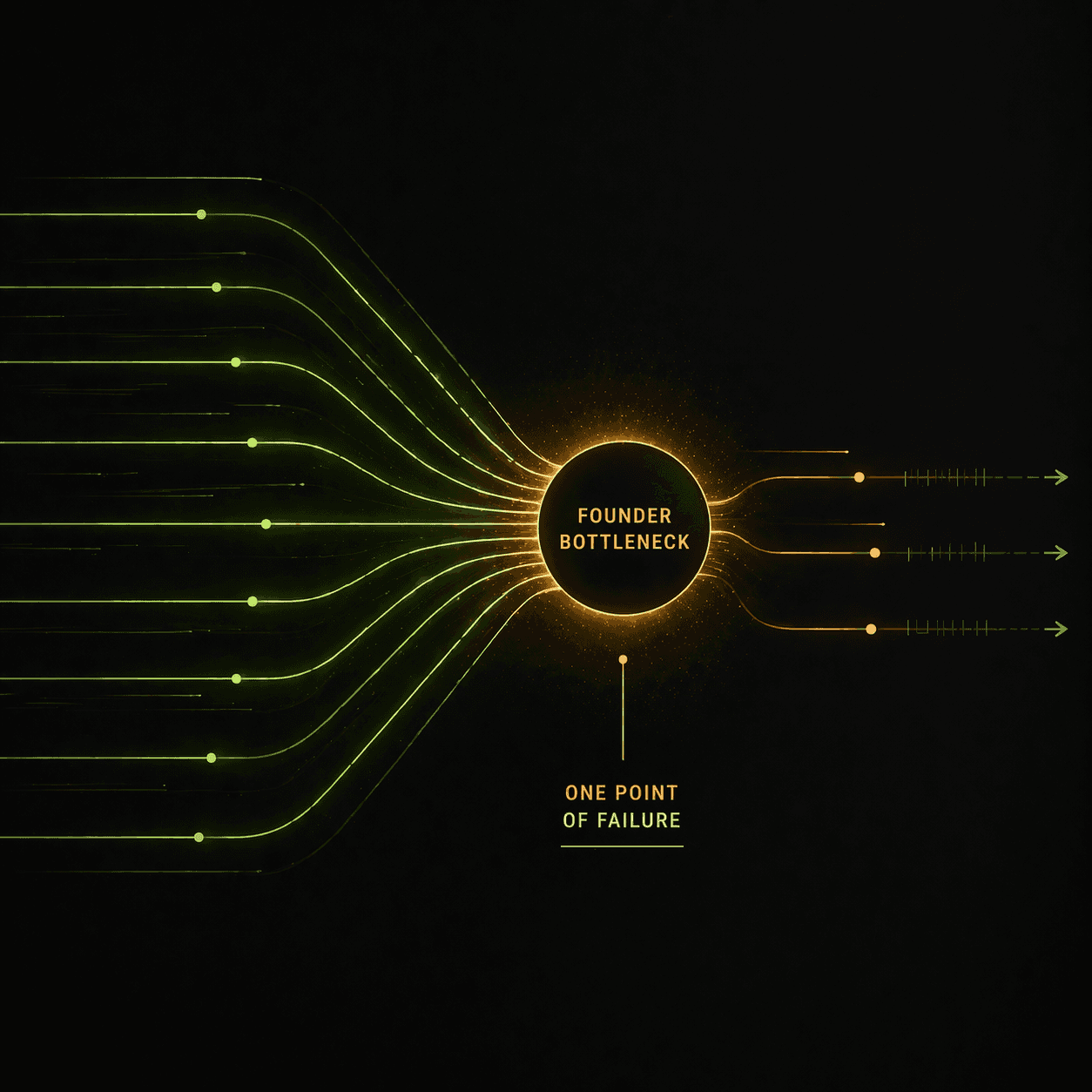
The Founder Bottleneck: How Every Decision Going Through You Is Costing Growth
You are in a high-stakes board meeting, a strategy session, or perhaps just trying to have dinner with your family, but your phone will not stop vibrating. It is a barrage of Slack notifications, "urgent" emails, and text messages asking for your sign-off on a $400 refund, your thoughts on a social media caption, or your approval on a proposal that should have gone out two days ago. In this moment, you might feel a flicker of pride—after all, it feels good to be the person who holds the keys to every door in the building. You tell yourself this is what "active leadership" looks like. The reality is far more damaging: you are the single biggest bottleneck in your company’s growth. Every time a process stops to wait for your attention, your business is losing momentum, and you are effectively paying yourself $2,500 an hour to do $25-an-hour administrative work.
What the Founder Bottleneck Actually Is
We need to stop calling this a "time management" issue. It isn't. You have the same 24 hours as the CEOs of $100M companies who seem to move through their days with a sense of calm and clarity. The "Founder Bottleneck" is a structural condition where the organization’s ability to move, decide, and execute is tethered directly to the founder’s personal bandwidth. It is an architectural failure, not a character flaw.
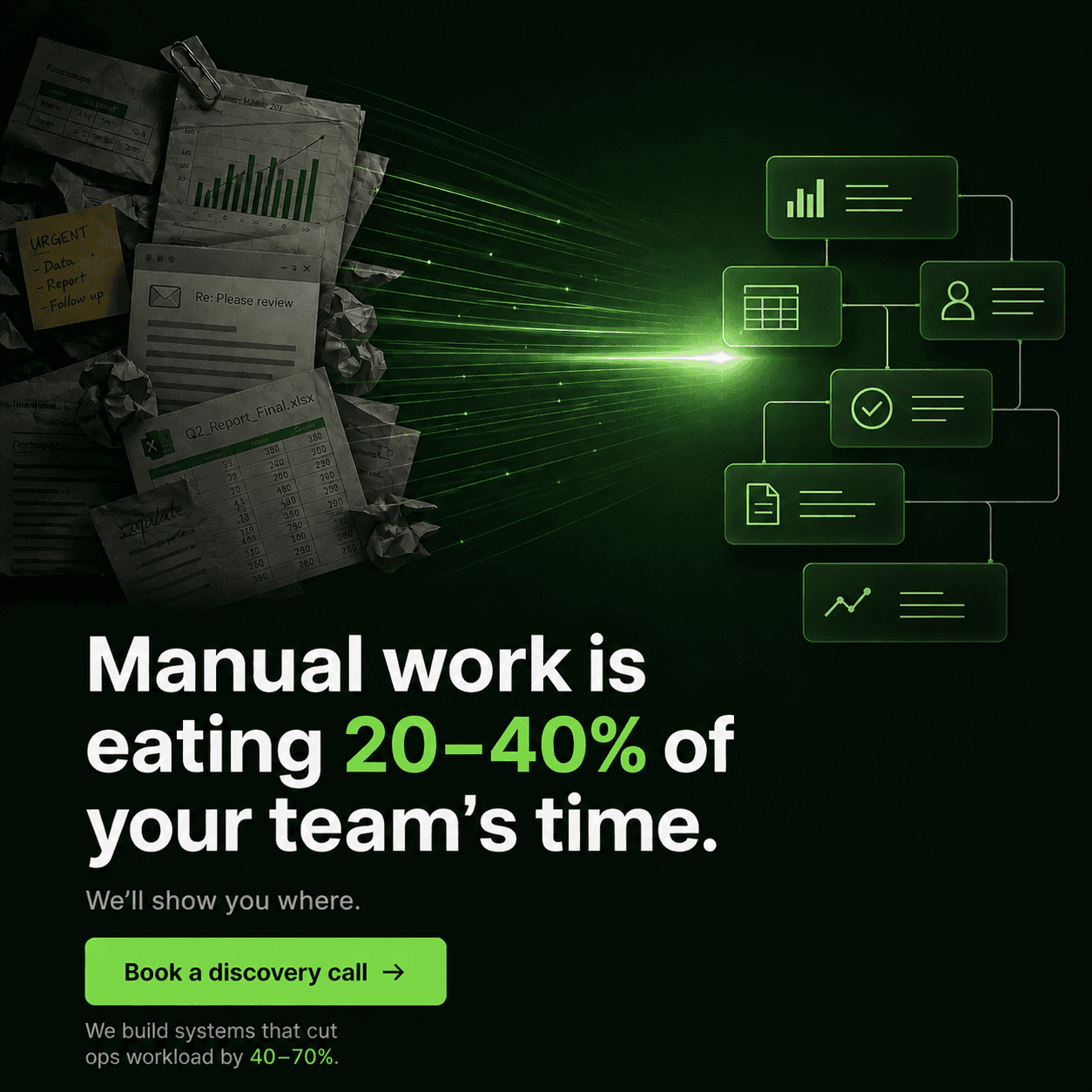
If you were to be removed from your business for 48 hours without warning, what would happen? For most founders in the $1M to $20M range, the answer is "visible degradation." The sales team wouldn't know how to price a non-standard deal. The operations team wouldn't know whether to issue a refund to an angry client. The finance team wouldn't be able to pay a vendor. This means your business is not a self-sustaining machine; it is a series of manual workflows that require your "brain" as the primary CPU. You are not leading a company; you are processing its daily transactions.
The bottleneck occurs because as the business grew, you naturally became the repository of all institutional knowledge. In the early days ($0 to $1M), being the bottleneck was a feature—it ensured quality control. But as you move toward $10M and beyond, that same feature becomes a fatal bug. You cannot scale your own attention. If every decision routes through you, the company’s "clock speed" is limited by your biological capacity to process information. Growth doesn't just slow down; it eventually hits a hard ceiling where you simply can't stay awake long enough to approve the next level of volume.
The Real Cost: What One Founder's Attention Is Worth Per Hour
Most founders think about their time in terms of "salary" or "dividends," but that is the wrong way to calculate the cost of the bottleneck. You must look at the Strategic Opportunity Cost.
Let’s look at the math for a founder of a company generating $5,000,000 in annual revenue.
Assuming you work a standard (though we know it’s higher) 2,000 hours per year, the revenue generated per founder-hour is $2,500.
Every hour you spend in the "critical path" of an operational task—approving an invoice, reviewing a basic proposal, or troubleshooting a routine client complaint—is an hour where you are not doing the work that is actually worth $2,500. You are not thinking about the next acquisition, you are not closing the $500k partnership, and you are not identifying the systemic risk that could wipe out your margins next quarter.
Now, consider how much of your week is spent on these "interrupts." For most bottlenecked founders, it is at least 30%.
30% of 2,000 hours = 600 hours per year.
600 hours x $2,500/hour = $1,500,000.
You are effectively losing $1.5 million in strategic value every single year because your business architecture requires you to be a glorified "clerk of works." When you look at your phone and see an approval request for a $500 software subscription, you aren't just "taking a second to check the box." You are taking your $2,500-an-hour brain and applying it to a problem that a simple automated workflow or a documented decision rule could have solved for zero dollars. This is why you feel exhausted but "unproductive" at the end of the day. You’ve done a lot of work, but you haven't moved the needle.
The 5 Most Common Manifestations of the Founder Bottleneck
The bottleneck is often invisible because it disguises itself as "quality control" or "staying close to the business." If you want to know where your $1.5M is going, look for these five specific symptoms.
1. The Pricing and Proposal Gatekeeper
Every non-standard proposal or pricing decision routes through the founder. Your sales team can’t hit "send" until you’ve "had a quick look" at the margins.
Why it exists: You haven't documented your pricing logic or defined the "Guardrails" within which the team is allowed to discount.
The Cost: Sales velocity drops. Prospects wait 48 hours for a quote and lose interest. Your team never learns how to value your product because you keep doing the "intuition-based" math for them.
2. The Hiring Stranglehold
You are the final interview for every single role, from the VP of Sales down to the junior admin. You personally review the CVs of everyone the recruiter finds.
Why it exists: You don't trust your "Scorecards" or your hiring process to filter for culture and competence, so you rely on your "gut feeling" instead.
The Cost: You miss out on top-tier talent because they get hired by faster-moving competitors while you're "clearing your schedule" for an interview. You become the reason your company isn't growing its headcount.
3. The Escalation Magnet
Whenever a client is slightly unhappy or a project hits a minor snag, the team "escalates to the boss." You are the "Chief Firefighter."
Why it exists: There are no clear delegation boundaries or "SOPs for Exceptions." Your team is afraid of making a mistake, so they default to the safest option: asking you.
The Cost: You are training your team to be helpless. You are also training your clients that they don't need to listen to your staff—they can just "go to the top" to get what they want.
4. The Manual Reporting Ritual
You are the only person who can truly "make sense" of the numbers, so you spend your Sunday evenings pulling data from three different platforms into a spreadsheet to build your weekly dashboard.
Why it exists: Your data flows are fragmented. You haven't built an automated orchestration layer that reconciles your CRM, your bank account, and your project tools into a live source of truth.
The Cost: You are making decisions on Monday based on data that is already decaying. You are also spending your most valuable recovery time doing data entry.
5. The Invoice and Expense Clerk
Every vendor invoice, no matter how small, requires your personal approval in the bank or the accounting software.
Why it exists: You’re afraid of "money leaking out," and you don't have a system that automatically flags discrepancies or auto-approves recurring expenses within a budget.
The Cost: You are spending high-value attention on low-value transactions. You are also annoying your vendors and your team by being the reason they don't get paid on time.
The False Fix: Working Longer and Harder
When founders realize they are the bottleneck, their first instinct is rarely "I need a better system." Instead, they double down on personal productivity. They join the "4 AM Club," they buy a faster laptop, they hire a "Chief of Staff" to help them manage their inbox, or they simply work through their weekends to "clear the backlog."
This is a coping mechanism, not a solution. It is the equivalent of trying to fix a leaking dam by bringing in more buckets. The problem is that as your business grows, the volume of "interrupts" grows exponentially, while your ability to work more hours is strictly linear. If you are the bottleneck at $5M, you will be completely paralyzed at $15M.
Working harder on a broken system only ensures that you will burn out faster. You cannot "out-hustle" a structural design flaw. The backlog will always grow at the same rate as the business. If you don't change how decisions are made and how data moves, you are just building a very expensive cage for yourself. True leadership is not about being the most "needed" person in the room; it is about building an organization that performs at a high level precisely because it doesn't need you for the routine.
The Structural Fix: Decision Systems and Workflow Automation
The only way out of the bottleneck is to move from a "Founder-Centric" model to a "System-Centric" model. This transition has two critical components: Decision Rules and Workflow Automation.
1. Decision Rules (The Policy Layer)
You need to stop managing by "intuition" and start managing by "parameters." A decision rule is a documented guideline that empowers your team to act without your input.
For example:
Manual: "Slack me before you give a client a refund."
System-Centric: "Any account manager can issue a refund up to $500 without approval, provided the client has been with us for 6+ months. If the refund is over $500, it goes to the Department Head. It only reaches the Founder if it is over $5,000."
By setting these boundaries, you instantly remove 70% of the noise from your day. You are no longer "processing" the refund; you are simply the architect of the rule that governs it. Your team becomes empowered, and your "Interrupt Rate" drops significantly.
2. Workflow Automation (The Execution Layer)
Decision rules are great, but they still rely on humans to remember them and act on them. This is where most founders fail—they create the rules, but then they have to spend their time "enforcing" the rules.
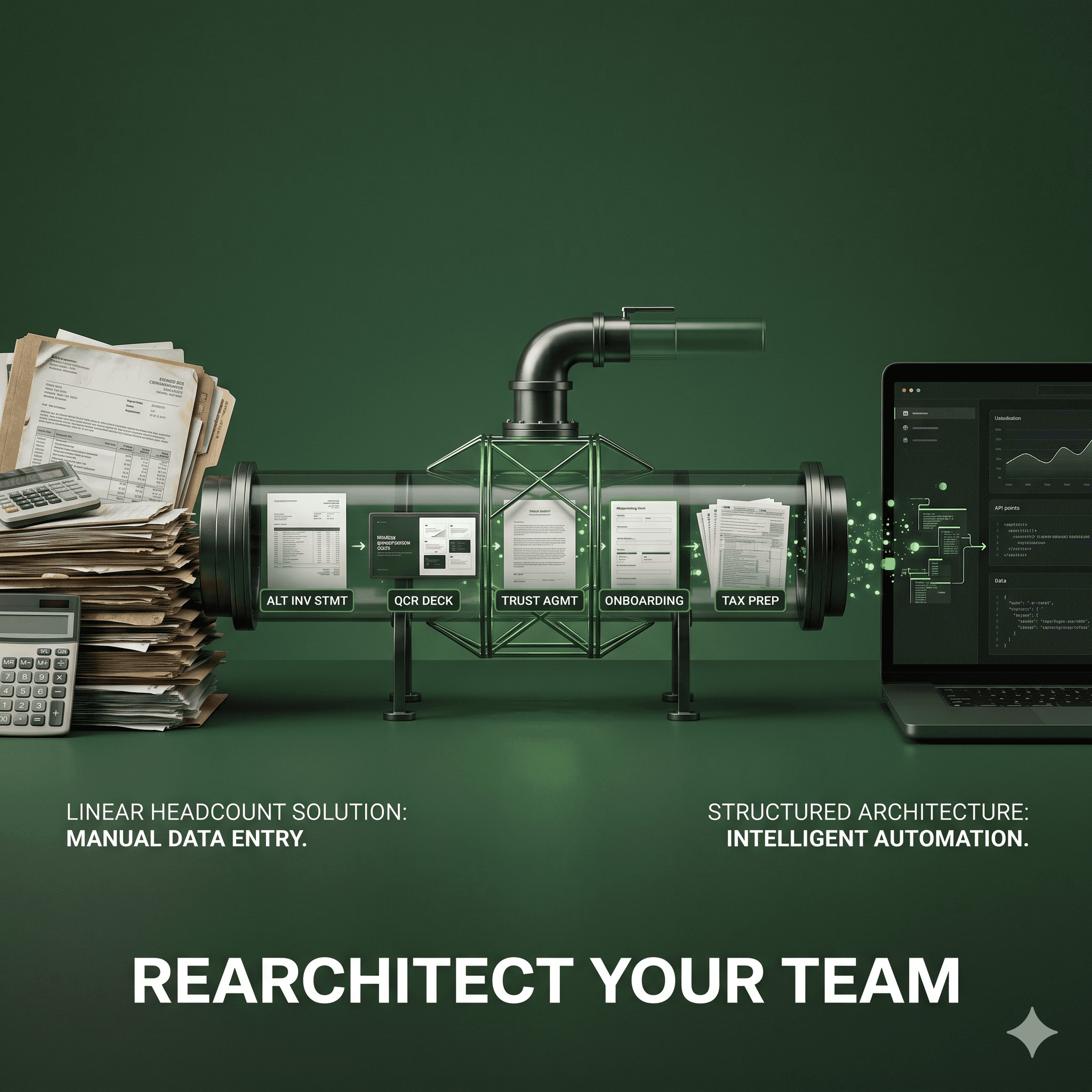
Workflow automation—using tools like n8n, API integrations, and agentic AI—removes the human labor from the rule. An automated system doesn't "forget" to check the refund threshold. It doesn't "miss" an invoice that was $1 over the limit.
At Chronexa, we build the "Digital Nervous System" that enforces your decision rules automatically.
An invoice arrives? The system checks the vendor, checks the amount against the budget, and if it passes, it auto-approves and schedules the payment.
A lead comes in? The system scores it, routes it to the right person, and triggers the first response—all while you are asleep.
A proposal is drafted? The system checks the margins against your pre-set rules. If it’s "Green," the team can send it. If it’s "Red," it flags it for you.
When you combine clear decision rules with automated execution, you are no longer the bottleneck. You are the Orchestrator. You move from being the person who does the work to the person who designs the system that does the work.
The 4-Hour "Bottleneck Audit"
You cannot fix the bottleneck until you name it. I want you to take one morning this week and perform a "Bottleneck Audit." It will take four hours, but it will save you 600 hours this year.
Step 1: The Interrupt Log
For four hours, keep a notepad next to your keyboard. Every single time someone asks you for a "quick look," an approval, a decision, or a status update, write it down. Don't judge it, just log it.
Step 2: The Logic Split
At the end of the four hours, look at your list. Categorize every item into one of two buckets:
Judgment-Based: "Should we pivot our entire product strategy to focus on Enterprise clients?" (This requires your $2,500/hr brain).
Rule-Based: "Is this $300 expense okay?" or "What should I say to this client who wants a discount?" (This requires a logic gate).
Step 3: The Automation Candidate Identification
Look at the Rule-Based bucket. These are your "Leakages." These are the tasks that are currently costing you $1.5M a year in lost strategic value.
For each of these, ask yourself: "What rule could I write today so that my team would know the answer without calling me?" Then, ask: "Could a piece of software or an AI agent handle the routing and enforcement of that rule?"
What the System-Centric Founder Gains
When you move out of the critical path, your relationship with your business changes fundamentally. You stop being the "Chief Everything Officer" and you start being the Chief Architect.
1. Increased Market Value
A business where every decision routes through the founder is "un-sellable" or, at best, worth a fraction of its potential. Investors and buyers want to see a machine that runs without the creator. By automating your decision paths, you are literally increasing the multiple of your company’s valuation.
2. Strategic Velocity
When you aren't spending your day approving invoices and reviewing hiring CVs, you have the "cognitive white space" to actually think. You start noticing market shifts before they happen. You have the time to go to the high-level conferences, meet the high-level partners, and do the "big deals" that take a company from $5M to $50M.
3. Operational Resilience
An automated system doesn't have "off days." It doesn't get distracted by a personal emergency. It doesn't forget the rules when things get busy. By building a system-centric architecture, you are making your business "anti-fragile."
4. Personal Freedom
This is why you started the business in the first place, isn't it? Freedom doesn't come from having "no work to do." It comes from having the choice of what work to do. When the operational logistics are handled by your digital nervous system, you can choose to work on the projects that excite you—or you can choose to take a week off and know that you won't return to a mountain of "pending" approvals.
How Chronexa.io Breaks the Bottleneck
At Chronexa, we don't just "build bots." We help founders redesign their operational architecture. We are a specialist implementation partner that looks at your "Interrupt Log" and builds the custom AI orchestration systems to handle them.
We use professional-grade tools like n8n and agentic AI to create a custom "Digital CEO" layer for your business. We connect your CRM, your financial tools, your project management software, and your communications into a single, intelligent workflow.
We work with you to:
Define the Decision Rules: We help you take the "intuition" out of your head and turn it into code.
Automate the Logistics: We build the systems that handle the routing, the extraction, the validation, and the reporting.
Establish the "Human-in-the-Loop" Guardrails: We ensure that you only see the 5% of decisions that truly require your expertise.
Our engagements are Fixed-Price and Fixed-Scope. We deliver production-ready systems in 30 to 60 days. And we back everything with a 90-day ROI guarantee. If we don't measurably reduce your "Interrupt Rate" and increase your operational capacity, we refund your setup costs. We are here to help you stop processing and start leading.
The bottleneck is a choice. You can choose to remain the most "needed" person in your company, or you can choose to build a business that is bigger than you. Every day you wait to automate your decision paths is another day you are paying the $1.5M "founder tax."
We invite you to book a free 45-minute Automation Audit with the Chronexa team. We will look at your "Interrupt Log," identify your top three bottleneck sources, and deliver a written system design with a clear ROI projection for how to fix them—whether you hire us or not. It is time to step out of the critical path and start building the asset you actually deserve.
About author
Ankit is the brains behind bold business roadmaps. He loves turning “half-baked” ideas into fully baked success stories (preferably with extra sprinkles). When he’s not sketching growth plans, you’ll find him trying out quirky coffee shops or quoting lines from 90s sitcoms.

Ankit Dhiman
Head of Strategy
Subscribe to our newsletter
Sign up to get the most recent blog articles in your email every week.