Beyond ChatGPT: Why Law Firms are Migrating to Private, Self-Hosted AI Infrastructure in 2026
In the legal sector, 2024 and 2025 were the years of "The Great AI Experiment." Attorneys played with ChatGPT, firms tested basic "Black Box" SaaS tools, and the industry collectively braced for a revolution.
But as we move through 2026, the honeymoon phase is over. High-profile data leaks, the "hallucination" sanctions of the previous years, and the tightening of Bar Association ethics guidelines have led to a massive strategic shift.
Top-tier law firms are no longer asking if they can use AI. They are asking: "How do we build an AI infrastructure that we actually own and control?"
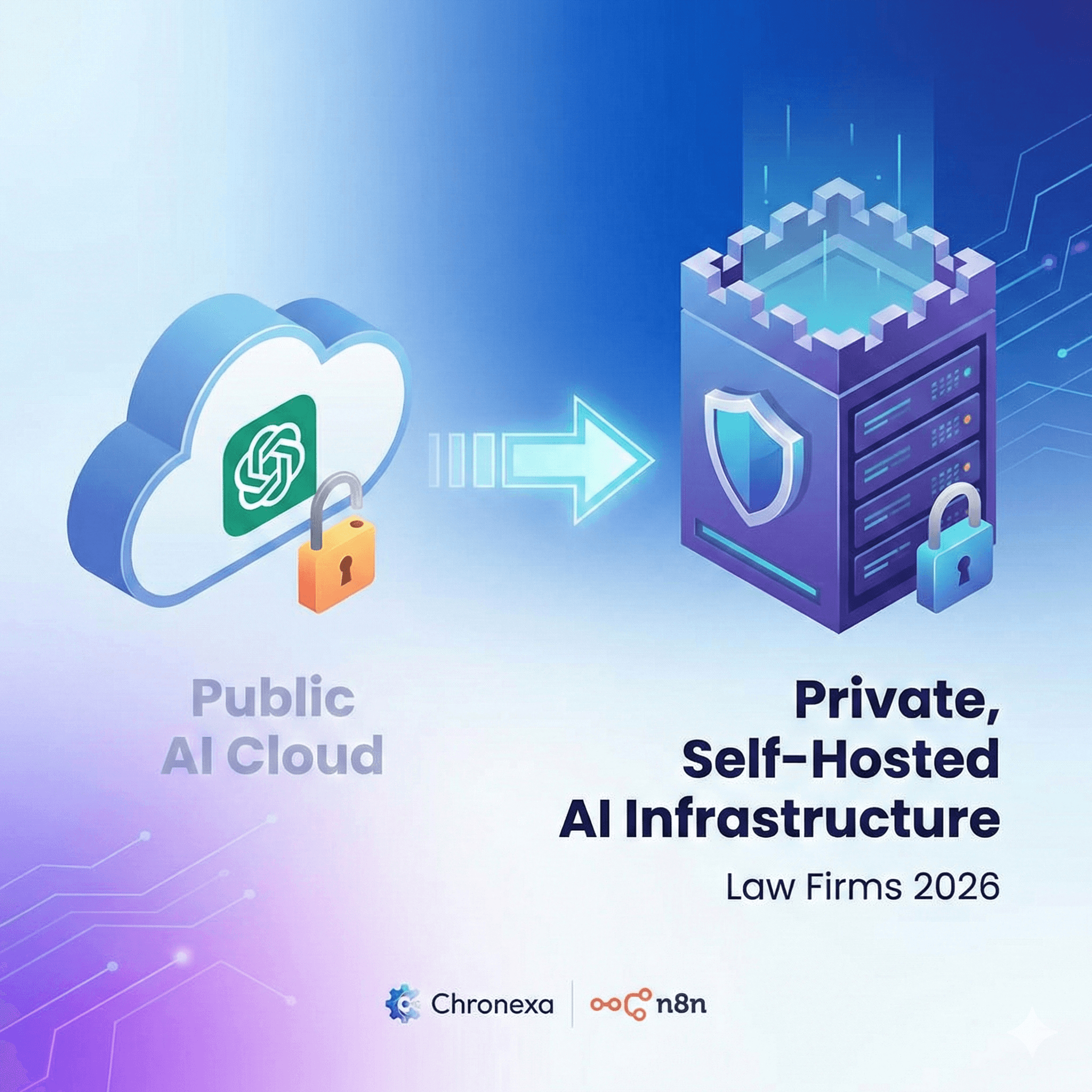
The answer is the move away from public cloud services and toward Private, Self-Hosted AI Infrastructure. At Chronexa, we are at the forefront of this "Sovereignty Shift," helping firms move their intelligence behind their own firewalls.
The "Shadow IT" Liability: Why Public AI is a Risk
For a law firm, your product is your privilege. When an associate pastes a confidential client deposition into a public web interface like ChatGPT or Claude, that privilege is technically at risk.
Even with "Enterprise" tiers, your data is still traveling over the public internet to servers owned by third-party tech giants. For firms handling M&A due diligence, intellectual property, or high-stakes litigation, this "Black Box" model is an unacceptable risk.
The 2026 Legal AI Risks:
Data Residency Breaches: Many public AI providers cannot guarantee that your data stays within specific geographic borders (critical for GDPR or DIFC compliance).
Model Drift: Public models change. A prompt that worked yesterday might fail today, leading to inconsistent legal work product.
Lack of Auditability: If a court asks how an AI arrived at a specific conclusion, a "Black Box" SaaS can’t give you the answer.
The Solution: The "Private Cloud" Legal Stack
At Chronexa, we specialize in building "Glass Box" AI engines. We leverage n8n to orchestrate workflows that live entirely within your firm’s private cloud (AWS, Azure, or Google Cloud VPC).
How Private Infrastructure Works:
Instead of sending your documents to an AI, we bring the AI to your documents.
Self-Hosted n8n: We deploy your automation engine on your own secure servers.
Private LLM Gateways: We use tools like Amazon Bedrock or Azure OpenAI in a "Zero-Retention" configuration, or deploy open-weight models (like Llama 3 or Mistral) directly on your infrastructure.
Encrypted Vector Databases: Your firm’s collective knowledge (past filings, research, case outcomes) is stored in a private, encrypted database that only your internal agents can access.
[Image: A diagram of a Private Legal AI Stack showing data staying within the firm's VPC, using n8n for orchestration, and private LLM endpoints.]
3 Reasons Law Firms are Choosing Self-Hosted n8n
As an n8n agency, we’ve seen why this specific platform has become the standard for the modern "Legal Engineer."
1. Total Data Sovereignty
With a self-hosted n8n instance, you own the logs. You know exactly who accessed which document, what the AI was asked, and where the data was sent. This creates an immutable audit trail that satisfies even the most rigorous compliance standards.
2. "Glass Box" Logic
We don't hide the "brain" of your automation. In n8n, every step of a legal workflow is visible on a canvas. If the engine is summarizing a contract, you can see exactly which nodes are extracting the text and which logic gates are checking for "red flag" clauses.
3. No "Success Tax"
Traditional legal tech SaaS companies charge you per user or per document. As your firm grows, your "AI bill" becomes a major line item. With a custom build from Chronexa, you own the engine. Whether you process 100 documents or 100,000, your software costs remain flat and predictable.
Case Study: Automating M&A Due Diligence
We recently partnered with a mid-market firm to automate their initial M&A document review.
The Problem: Junior associates were spending 60+ hours per deal manually identifying "Change of Control" clauses and "Non-Compete" traps.
The Custom Solution: A private n8n workflow that uses OCR (Google Vision) and a Private LLM to scan thousands of pages in minutes.
The Result: Initial review time dropped by 85%. More importantly, the data stayed entirely within the firm's Azure environment, maintaining 100% client confidentiality.
The Future: Agentic Legal Assistants
We are moving beyond "document drafting." The next phase is the Autonomous Legal Agent. These are systems built in n8n that can:
Triage Intake: Automatically screen new leads against conflict-of-interest databases.
Draft Discovery: Research thousands of emails and Slack messages to find "smoking gun" evidence based on specific legal theories.
Monitor Regulations: Watch for changes in specific statutes and automatically alert the relevant partners.
Build Your Sovereign AI Infrastructure
The competitive divide in the 2026 legal market is clear: Firms that "rent" their AI from public clouds will struggle with security and rising costs. Firms that build and own their AI infrastructure will lead the market in efficiency and client trust.
Ready to move your firm’s intelligence into a secure, private environment?
Book a 30-minute Legal Infrastructure Audit with Chronexa — We will review your current tech stack and provide a roadmap for a self-hosted, compliant AI engine.
About author
Ankit is the brains behind bold business roadmaps. He loves turning “half-baked” ideas into fully baked success stories (preferably with extra sprinkles). When he’s not sketching growth plans, you’ll find him trying out quirky coffee shops or quoting lines from 90s sitcoms.

Ankit Dhiman
Head of Strategy
Subscribe to our newsletter
Sign up to get the most recent blog articles in your email every week.