UAE Wealth Management Is Entering Its AI Inflection Point
The numbers are unambiguous. According to BridgeWise's State of AI for Wealth in 2026 study—spanning 2,100 investors across 19 countries—78.3% of respondents already use AI in investment decisions, and 65.1% plan to replace traditional investment research with AI-driven workflows within the next 12 months. The UAE ranks first globally for momentum in this shift and second overall on the Global Wealth AI Optimism Index. The Middle East, led by the UAE and Saudi Arabia, tops every regional ranking for AI adoption intent.
This is not a trend to monitor. For wealth management firms operating in Dubai, Abu Dhabi, and across the GCC, it is an operational imperative.
Yet the challenge isn't enthusiasm—it's execution. Generic enterprise AI platforms weren't designed for the structural complexity of Gulf wealth management: Securities and Commodities Authority (SCA) robo-advisory compliance, DIFC and ADGM regulatory frameworks, Shariah-compliant portfolio governance, and UHNW client relationships that demand both speed and discretion. Deploying the wrong platform doesn't just fail to deliver efficiency gains—it introduces regulatory and reputational risk.
This post evaluates what separates purpose-built AI agent platforms in the UAE from generic alternatives, identifies the operational use cases where automation generates the clearest ROI, and outlines a framework for selecting the right architecture for your firm. Firms that get this right are reducing operational overhead by 30–40% while improving client response times and satisfaction metrics.
The Unique Operational Demands of UAE Wealth Management
Before evaluating platforms, you need a precise map of the problem. UAE wealth managers face a convergence of pressures that no generic SaaS stack handles adequately.
Regulatory complexity across multiple jurisdictions. Firms operating in or from the UAE must simultaneously navigate SCA conduct-of-business rules, DIFC's independent regulatory framework, ADGM's financial services regulations, and federal AML/KYC requirements. The SCA's newly approved robo-advisory framework adds another layer: only entities already licensed for portfolio management can deploy automated investment advice. Unlicensed technology vendors must partner with regulated institutions—they cannot provide advice directly. This means your AI platform must be architected around regulatory boundaries, not retrofitted to comply with them.
Shariah-compliant product requirements. A significant portion of GCC client assets must be managed within AAOIFI-compliant parameters. This isn't a checkbox—it's a live constraint on portfolio construction, rebalancing logic, and product selection. Vault22's UAE launch demonstrated this reality directly: the platform launched with 52 diversified portfolios, of which 26 are Shariah-compliant, screened to AAOIFI standards and overseen by an independent Shariah Supervisory Board. Any AI agent handling portfolio recommendations or automated rebalancing must incorporate these constraints natively.
Multilingual client communications at UHNW standards. Dubai's DIFC alone hosts more than 1,500 fintech, AI, and innovation firms and serves a client base spanning dozens of nationalities. UHNW clients expect communications in their preferred language—Arabic, English, Russian, Mandarin, and Hindi are all common in Gulf wealth management—without any degradation in personalization quality or response latency.
Cross-border asset visibility. GCC wealth is rarely contained within a single jurisdiction. Clients hold assets across regional banks, international custodians, real estate holdings, and alternative investments. Manual reconciliation across these positions is both operationally expensive and a source of reporting errors. AI platforms that cannot aggregate across multi-currency, multi-institution positions create blind spots in portfolio analytics and compliance reporting.
The generational transition in client expectations. BridgeWise's data shows that younger investors (18–35) are adopting AI at a rate of 57.8%, compared to 26.9% for those over 50. As wealth transfers to the next generation of Gulf UHNW families, firms operating on manual or semi-automated workflows will face accelerating client attrition to digitally native competitors.
What the SCA Robo-Advisory Framework Means for Platform Selection
The UAE's federal robo-advisory framework—approved under the broader We the UAE 2031 digital economy agenda—establishes the compliance baseline that any AI agent platform operating in this market must meet. Understanding these requirements is not optional; it is the first filter for platform evaluation.
The framework mandates the following operational controls that directly affect platform architecture:
Technology resilience and independent IT audits: Platforms must demonstrate documented system reliability, with independent third-party audits of algorithms and infrastructure. This rules out black-box AI systems that cannot produce auditable decision trails.
Algorithm governance and bias monitoring: Ongoing model testing, bias detection, and documented change control processes are required. Platforms must support version-controlled model governance, not ad hoc prompt engineering.
Fee and risk transparency: Mandatory disclosure of all cost layers—management fees, platform fees, transaction costs—alongside clear risk warnings. AI-generated client communications must incorporate these disclosures without degrading the client experience.
Discretionary vs. non-discretionary service distinction: Robo-advisory can operate under either model, but the platform must enforce the correct execution logic for each client mandate. Discretionary clients have automated execution under a mandate; non-discretionary clients require explicit approval before execution. These workflows are fundamentally different and must be configurable at the platform level.
Data security and cybersecurity standards: Platforms must meet robust data protection requirements aligned with UAE federal standards and, where applicable, DIFC and ADGM data protection frameworks.
The practical implication: any AI agent platform you deploy for client-facing or compliance-critical workflows must support explainability, auditability, and role-based governance as core architecture features—not add-ons. Platforms that cannot produce a clear decision log for a regulatory examiner are not viable in this market regardless of their feature set.
Key Automation Use Cases That Deliver Measurable ROI
Platform selection should be driven by use case specificity. The following automation categories represent the highest-ROI deployment targets for UAE wealth management operations, and they define the capability requirements your platform evaluation should prioritize.
Automated client reporting and portfolio analytics. Generating bespoke portfolio reports for UHNW clients is among the most labor-intensive recurring tasks in wealth management. An AI orchestration layer connected to custodian data feeds, market data APIs, and CRM records can produce personalized, compliance-ready reports at scale—reducing the time-per-report from hours to minutes. Platforms like Vault22 demonstrate this at the infrastructure level: their AI advisor aggregates bank accounts, investments, liabilities, and goals into a single dashboard, generating behavioral insights and portfolio monitoring alerts continuously. For institutional-grade implementations, the same architecture can be white-labeled and integrated directly into existing advisory workflows.
KYC/AML workflow automation. Compliance onboarding in the UAE involves layered documentation requirements across SCA, DIFC/ADGM, and federal AML regulations. AI agents can automate document extraction, cross-reference against sanctions lists and PEP databases, flag anomalies for human review, and generate audit-ready onboarding records. This eliminates the most repetitive compliance burden while maintaining the human oversight that regulators require for final approval decisions.
Multilingual client communication management. AI agents can handle tier-one client communications—appointment scheduling, document requests, standard portfolio queries, and regulatory disclosure delivery—in multiple languages simultaneously. This is not about replacing relationship managers; it is about ensuring that no client communication falls through the cracks during high-volume periods, and that response times meet UHNW expectations regardless of staff availability.
Portfolio rebalancing triggers and alerts. Discretionary mandates require ongoing monitoring against agreed parameters. AI agents can monitor positions continuously, generate rebalancing recommendations when thresholds are breached, route these recommendations through the appropriate approval workflows (discretionary vs. non-discretionary), and log all actions for regulatory audit trails. This replaces a process that currently requires daily manual review by senior staff.
Compliance monitoring and regulatory reporting. Ongoing transaction monitoring, suspicious activity detection, and periodic regulatory reporting are rule-based processes that generate significant operational cost. AI orchestration workflows can handle the routine monitoring layer continuously, escalating only genuine anomalies for human review. This is where the 30–40% overhead reduction becomes achievable: not through a single automation, but through the compounding effect of eliminating manual steps across the entire compliance monitoring pipeline.
Evaluating AI Agent Platforms: A Gulf-Specific Framework
The UAE's fintech sector is projected to grow from $3.16 billion in 2024 to $5.71 billion by 2029, with AI embedded into core financial services infrastructure rather than operating as peripheral tooling. This growth is creating a crowded vendor landscape. The following evaluation framework separates platforms that are genuinely fit for purpose in the Gulf wealth management context from those that are marketing AI capabilities built on generic foundations.
1. Regulatory alignment by design, not by retrofit. The platform must support configurable compliance workflows that map directly to SCA, DIFC, and ADGM requirements. Ask vendors specifically: How does your platform handle discretionary vs. non-discretionary execution logic? Can you produce algorithm audit logs for SCA examination? What is your independent IT audit history? Platforms that cannot answer these questions precisely are not ready for this market.
2. Shariah-compliant workflow support. For any platform handling portfolio construction, rebalancing, or product recommendation, Shariah screening must be a native capability—not a manual post-processing step. Verify whether the platform integrates AAOIFI-compliant screening data and whether Shariah supervisory governance can be documented within the platform's audit trail.
3. Multi-system integration depth. Gulf wealth managers operate across core banking systems, multiple custodians, CRM platforms, and market data providers—often across jurisdictions. A platform's value is directly proportional to its integration depth. Evaluate API coverage, pre-built connectors for regional banking infrastructure, and the vendor's documented experience integrating with UAE-specific systems. White-label wealth infrastructure providers like Vault22 demonstrate this with their Wealth-as-a-Service model, which is designed from the ground up for multi-institution, multi-currency aggregation.
4. Explainability and auditability of AI decisions. Every AI-generated recommendation, communication, or compliance flag must be traceable to its inputs and logic. This is both a regulatory requirement under the SCA framework and a UHNW client expectation—no sophisticated investor will accept "the algorithm decided" as an explanation for a portfolio action. Platforms built on large language models without structured decision logging fail this test.
5. Multilingual capability without quality degradation. Test the platform's Arabic language performance specifically. Many platforms that claim multilingual support demonstrate significant quality degradation in Arabic-language financial communications. For Gulf wealth management, Arabic-language output must meet the same standard as English-language output across all client-facing workflows.
6. Orchestration architecture vs. point solutions. The most common implementation failure in Gulf wealth management AI deployments is purchasing multiple point solutions—one for reporting, one for compliance, one for client communications—that don't share data models or workflow logic. The result is a more fragmented stack than the one being replaced. The correct architecture is an orchestration layer that coordinates specialized AI agents across all use cases through a unified workflow engine, with a single data model and audit trail. This is the architecture that delivers compounding efficiency gains rather than isolated automation islands.
Why Custom AI Orchestration Outperforms Off-the-Shelf Platforms
The platforms reviewed above—whether Vault22's Wealth-as-a-Service infrastructure, BridgeWise's research automation capabilities, or white-label wealth management builders—each address specific segments of the operational challenge. None addresses the full stack, and none can be configured out-of-the-box to match the specific workflow logic of an individual wealth management firm operating under a specific combination of SCA, DIFC, and ADGM obligations.
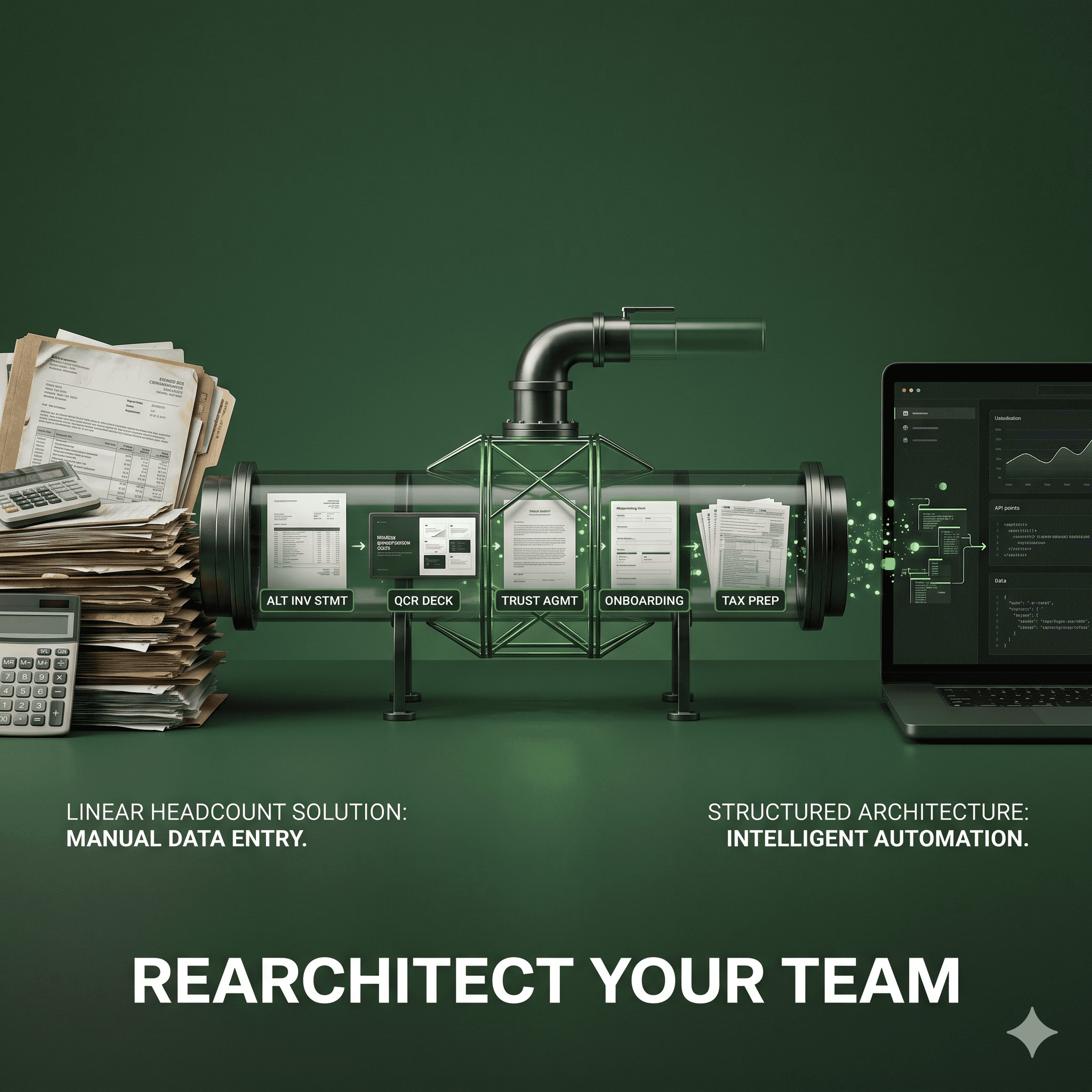
This is the operational gap that custom AI orchestration fills. Built on flexible workflow automation infrastructure—specifically n8n for enterprise-grade, self-hosted orchestration—a custom AI agent architecture can connect your existing systems, enforce your specific compliance logic, operate in your required languages, and scale individual workflow components without replacing the entire stack when requirements change.
The distinction matters operationally. An off-the-shelf platform forces your workflows to conform to its data model and logic. A custom orchestration layer is built around your actual regulatory obligations, your specific custodian integrations, your client segmentation, and your advisory model. The result is not just efficiency—it is a defensible operational advantage that generic platforms cannot replicate.
For mid-market Gulf wealth managers managing between $500M and $5B AUM, this is the architecture tier where the 30–40% overhead reduction is realistically achievable. The firms capturing it are not the largest institutions deploying enterprise AI budgets—they are operationally disciplined firms that have mapped their manual workflows precisely, identified the highest-cost automation targets, and built orchestration architectures around those specific constraints.
Build the Right Foundation Before the Market Moves Further
The BridgeWise data is directional and unambiguous: the UAE leads global momentum in AI adoption for wealth management, its fintech infrastructure is scaling rapidly, and younger UHNW clients are arriving with AI-native expectations already formed. The regulatory framework is in place. The market infrastructure is building. The question is no longer whether to deploy AI agent workflows—it is whether your firm builds a defensible, compliant, integrated architecture now or spends the next two years retrofitting fragmented point solutions.
Chronexa builds custom AI orchestration workflows for mid-market wealth management operations across the Gulf—replacing fragmented SaaS stacks with purpose-built automation on n8n. We design for your specific regulatory environment, your existing systems, and your UHNW client standards. If you're evaluating AI agent platforms for your UAE operations and want an architecture assessment grounded in Gulf-specific compliance requirements, speak with our team. We'll map your highest-value automation opportunities and show you exactly what a 30–40% overhead reduction looks like in your specific operational context.
About author
Ankit is the brains behind bold business roadmaps. He loves turning “half-baked” ideas into fully baked success stories (preferably with extra sprinkles). When he’s not sketching growth plans, you’ll find him trying out quirky coffee shops or quoting lines from 90s sitcoms.
Ankit Dhiman
Head of Strategy
Subscribe to our newsletter
Sign up to get the most recent blog articles in your email every week.