Before You Hire Anyone Else: The Checklist Every Founder Needs to Run First
When your business starts to scale past the $1 million mark toward the $10 million or $30 million range, you eventually hit a wall where everything feels harder than it used to be. The systems that worked when you were a team of five are now groaning under the weight of more customers, more data, and more complexity. Your default response to this pain is likely the same one shared by almost every successful founder in history: "We need to hire someone." It is an intuitive, fast, and decisive move that feels like progress, but if the underlying process that person is coming in to manage is fundamentally broken, you aren't actually fixing the problem. You are simply adding a person to manage a broken system, effectively subsidizing operational inefficiency with your payroll.
The Real Source of Most Operational Bottlenecks
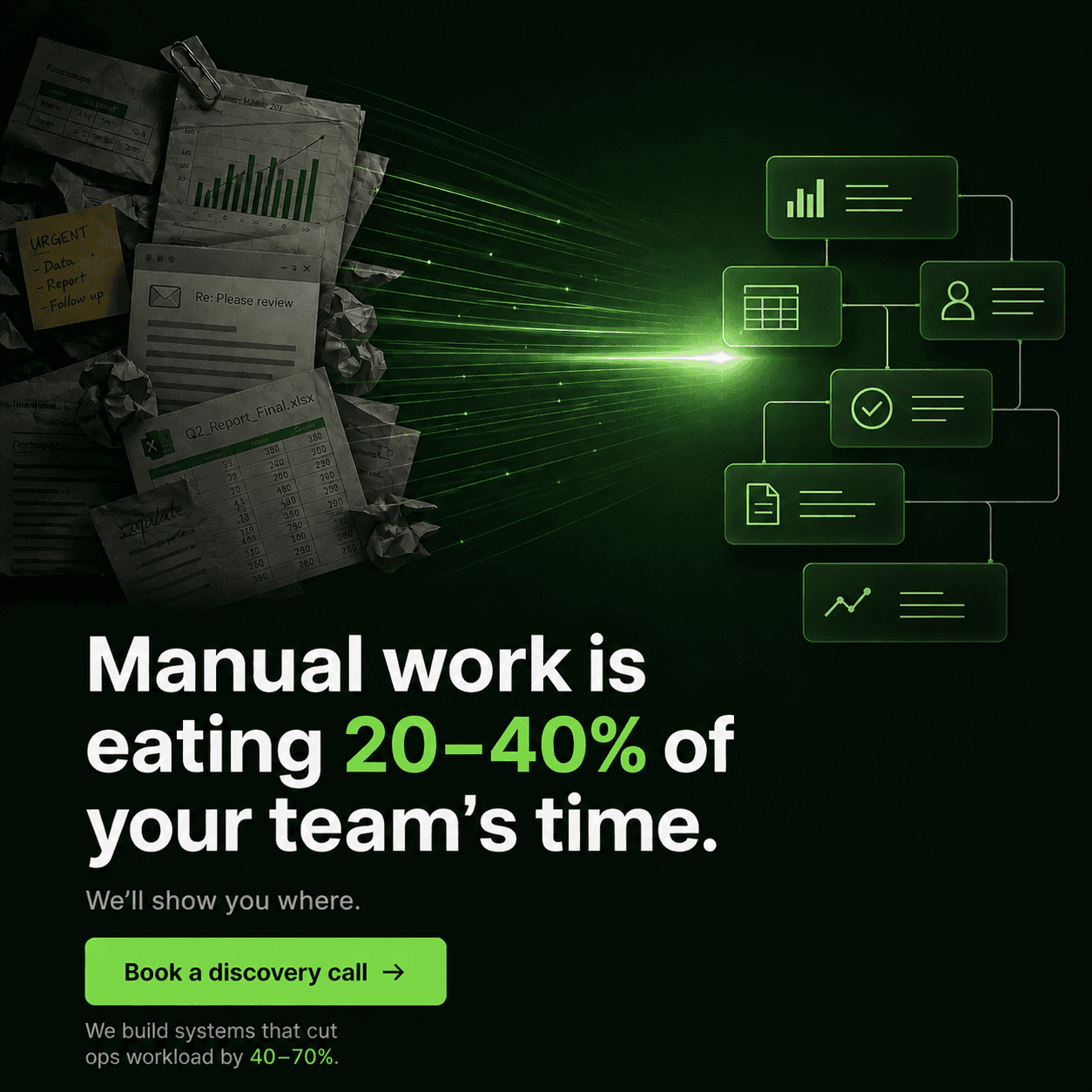
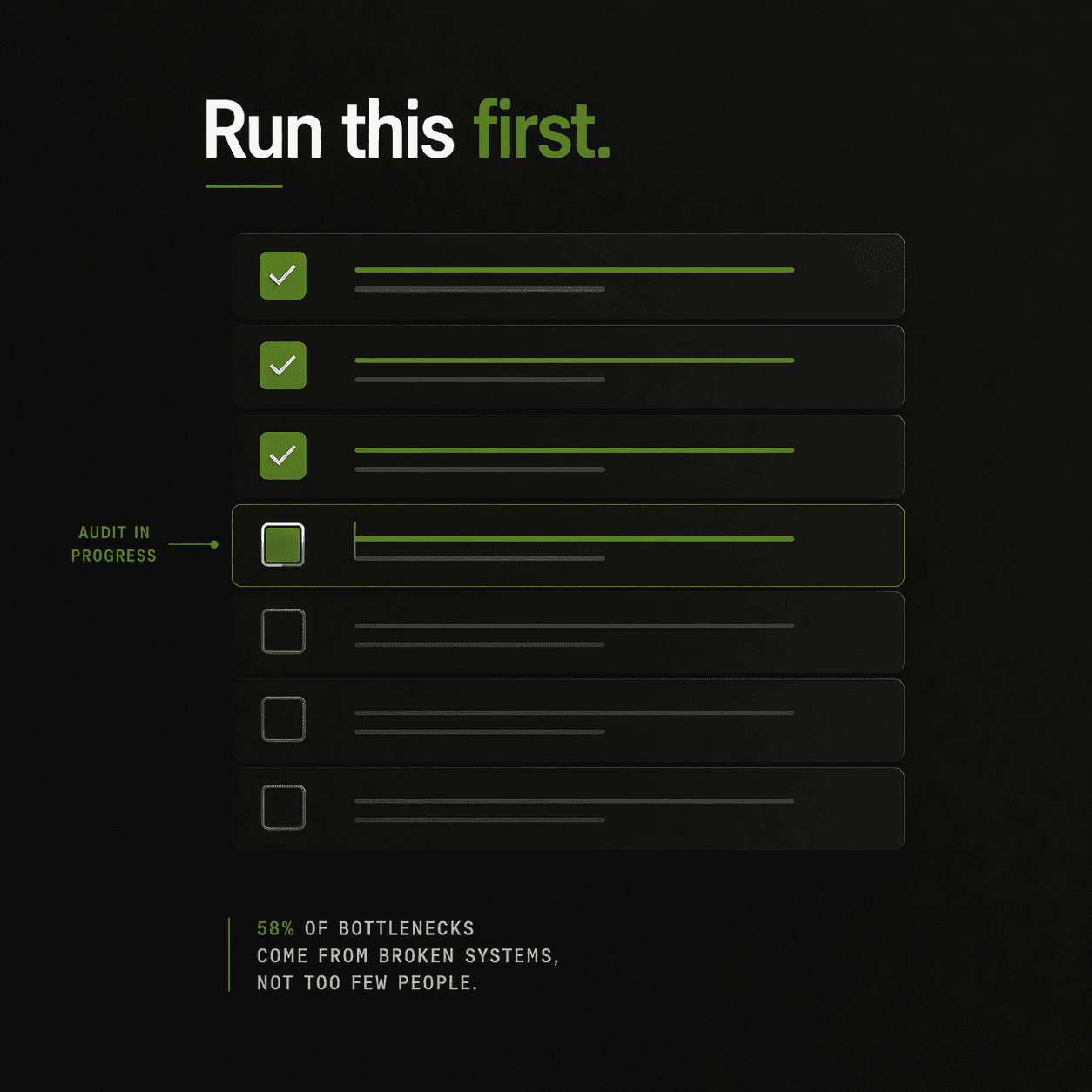
The urge to hire is often a symptom of "Capacity Blindness." As a founder, you see your team working late, you see emails going unanswered, and you see projects stalling in the "pending" stage. Your brain interprets this as a resource shortage. However, research into mid-market operational efficiency consistently shows that roughly 58% of operational bottlenecks come from inefficient systems, not a lack of people. When you add headcount to a manual, fragmented workflow, you don't get a faster workflow; you get a more expensive, more complex version of the same broken process.
This creates a dangerous pattern that we see in companies across every industry. You hire a new operations coordinator to handle the "squeeze." You feel a moment of short-term relief as they take over the manual tasks that were bogging everyone else down. But because the process itself hasn't changed, the bottleneck eventually returns the moment your volume grows by another 15% or 20%. Before you know it, you are looking at the job boards again, preparing to hire a second or third person for the exact same role. You are trapped in a cycle where growth necessitates an ever-expanding payroll, which eventually crushes your margins and makes your business "unscalable."
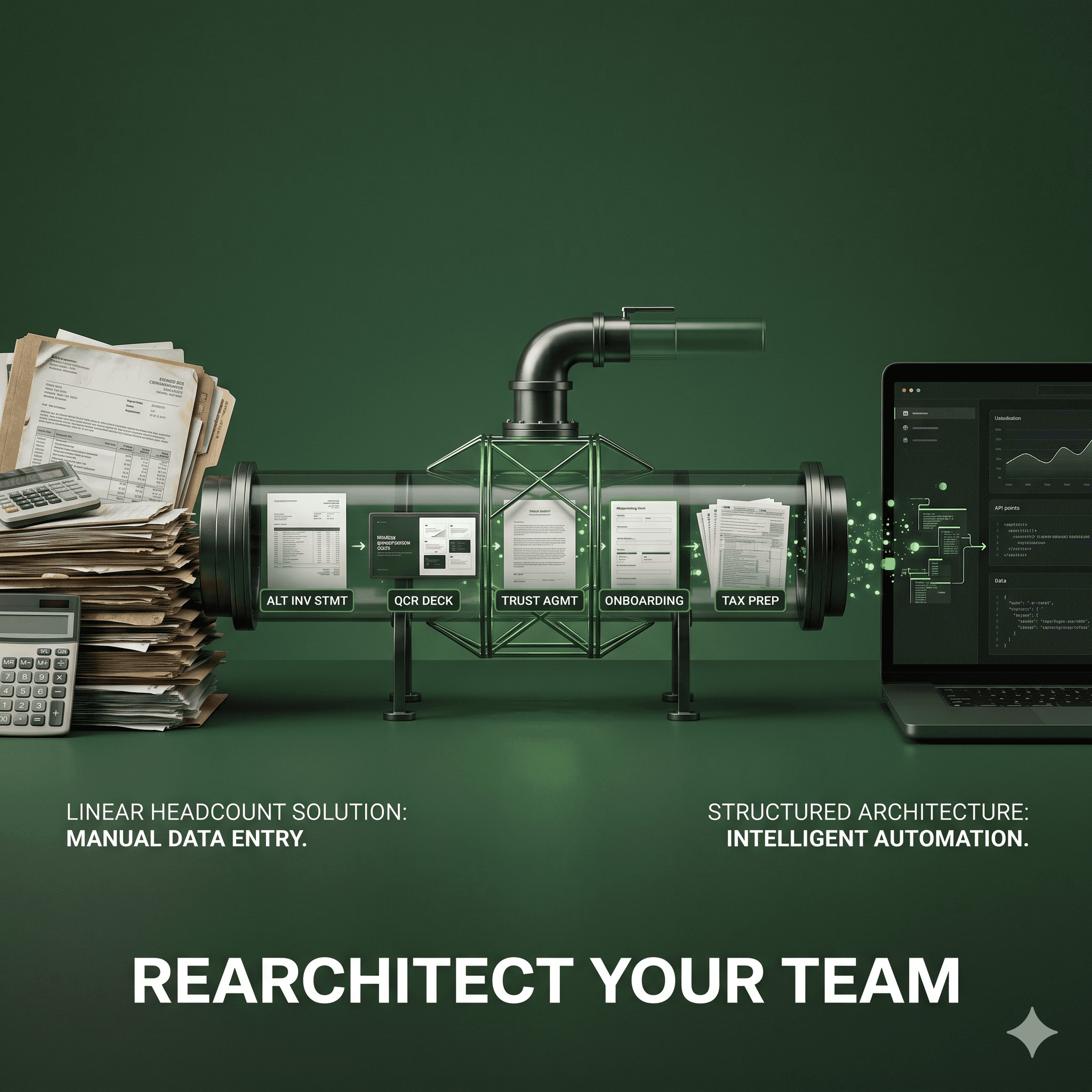
The alternative is to realize that most growth pain is actually "Data Friction." It is the resistance created when information has to be manually moved, checked, or acted upon by a human being. If you can remove that friction with an automated orchestration layer, you don't just solve the current bottleneck—you build a system that can handle 10x the volume without requiring a single new hire.
The Cost of Hiring vs. Fixing
Before you post that job ad on LinkedIn, you need to look at the cold, hard math of what a new hire actually costs your business in the first year. Most founders look at the annual salary and think that is the number, but that is just the tip of the iceberg.
Let’s look at the "Fully Loaded Cost" of a mid-level operational hire:
Annual Salary: $60,000–$90,000
Benefits and Payroll Costs: Taxes, health insurance, 401k matching, and workers' comp typically add 25–35% on top of the salary. That is an additional $15,000–$30,000.
Recruiting: Between job board fees, your time (or your team's time) spent interviewing, and potential headhunter fees, you are looking at $5,000–$15,000.
Onboarding and Ramp Time: It takes most new hires 2–4 months to reach full productivity. During that time, you are paying 100% of their salary for roughly 50% of the output, while also draining the time of the senior team members who have to train them.
When you add it all up, the total first-year cost of a $75,000 employee is often between $85,000 and $140,000. And that is a recurring cost. You have to pay it next year, and the year after that, usually with a 3–5% increase for inflation and performance.
Compare this to a well-scoped, custom automation system built to handle the same workflow. A professional implementation partner like Chronexa might charge between $15,000 and $40,000 for a one-time build that permanently fixes the bottleneck. There is no annual salary, no health insurance, no "bad days," and no resignation letters. You are trading a massive, recurring liability for a one-time capital investment in an asset.
The 10-Question Checklist: Should You Hire or Automate?
To help you decide whether your current pain is a "People Problem" or a "System Problem," run every potential new role through this checklist before you sign off on the budget.
1. Is the work you're hiring for primarily repetitive and rule-based?
If you can write down exactly how the job is done in a series of "If This, Then That" statements, it is not a job for a human. Humans are best at nuance, creativity, and empathy. If the role is just following a checklist, a machine can do it 100x faster and with 0% errors.
2. Does the task involve moving data from one place to another?
Copying data from an email into a CRM, or from a spreadsheet into an invoicing tool, is "Human Middleware." This is the most expensive and least efficient way to move data. If this is more than 20% of the job description, you have an automation problem.
3. Would the output of this role be the same 90% of the time regardless of who does it?
If the "secret sauce" of the role is just staying organized and following the process, then the person isn't adding unique value—the process is. Automation allows you to institutionalize that process so it never leaves when an employee does.
4. Is the bottleneck caused by volume or by missing judgment?
If you have "too much work" for your current team, that is a volume problem (Automate). If your team is making bad decisions because they don't have the expertise, that is a judgment problem (Hire). Most founders confuse the two.
5. Would the work still need to be done if you had 5x more customers?
If your volume quintuples, does this role need to be performed 5x more often? If so, you are building a linear-cost business. Automation turns that into a logarithmic-cost business, where your overhead stays flat while your revenue climbs.
6. Is the person you'd hire primarily managing a process, not creating strategy?
"Managers of Process" are the easiest roles to replace with AI orchestration. If they aren't tasked with changing the direction of the company or inventing new products, their daily tasks are likely candidates for workflow automation.
7. Does the work require reading documents, filling forms, or sending standard communications?
Modern AI agents can now "read" unstructured data, extract the key points, and draft perfect responses. If the role is about "handling paperwork," it is a role that has already been disrupted by AI.
8. Have you hired for this role before and still hit the same bottleneck?
This is the ultimate red flag. If you’ve already tried "throwing a person at it" and the bottleneck is still there, the person wasn't the solution. The system is the constraint.
9. Do you have a process document for this role, or is it in someone's head?
If the process is well-documented, it is ready to be automated. If it’s "all in someone’s head," you can't even hire for it effectively yet—you need to map the workflow first, at which point you’ll likely see the automation potential.
10. If this person left tomorrow, would the work stop or just slow down?
If the work would stop because the "knack" is gone, you have a high-risk "Key Man" dependency. Automation removes that risk by making the "knack" part of your company's permanent software infrastructure.
If you answered "yes" to 6 or more of these questions, the work you are considering hiring for is a strong candidate for automation. You should fix the system before you add the person.
The 3 Roles Founders Most Commonly Hire for That Are Actually Automation Problems
In our experience at Chronexa, we see founders make the "hiring mistake" most frequently in three specific areas. These are the roles that feel essential but are almost entirely composed of automatable tasks.
1. The Operations Coordinator or Admin
This is the "Catch-All" hire. They are brought in to handle scheduling, document filing, basic client follow-ups, and "keeping the trains running on time." While they are often helpful, their day is usually spent being a "Human API." They take data from a phone call, put it in a Slack channel, and then move it to a project management tool.
The Automation Fix: An AI orchestration system can handle the scheduling, automatically file documents based on content analysis, and trigger follow-up sequences based on client behavior. You don't need a person to "watch" the system; you need a system that "does" the work.
2. The Reporting Analyst
As you grow, you need better data. Most founders hire an analyst to pull numbers from Facebook Ads, Google Analytics, Stripe, and their CRM to build weekly dashboards. This person spends 80% of their time "cleaning data" and only 20% analyzing it.
The Automation Fix: We can build automated data pipelines that aggregate this data in real-time. Instead of a weekly report that is already five days old by the time you see it, you get a live dashboard that updates every hour. You don't need a "Reporting Analyst"; you need "Automated Reporting."
3. The Lead Handler or SDR (Sales Development Representative)
This role is often hired to respond to inbound leads, qualify them, and book them onto a closer's calendar. It is a high-volume, repetitive role with high turnover.
The Automation Fix: An AI-agentic lead response system can answer an inquiry in under 60 seconds, qualify the lead using natural language, and book the call directly into your CRM. It does this 24/7, across all time zones, with perfect persistence. A human SDR can't compete with that speed or consistency.
When You Should Absolutely Hire
We are not an agency that tells you never to hire. In fact, automation is the best way to ensure that when you do hire, the new employee is set up for success. There are four clear situations where a human hire is the only correct answer.
Client-Facing Relationship Work: If the role requires building deep trust, navigating high-stakes emotions, or managing complex human politics, you need a person. AI can assist, but a human must lead.
Strategic Decision-Making: If you need someone to look at the market, look at your competitors, and decide on a three-year pivot for your product, that requires a level of synthesis and risk-taking that machines don't have.
Creative Output: If you are hiring a Head of Content or a Creative Director to define your brand’s "voice" and visual identity, you are paying for their unique perspective and taste.
Novel Situations: If the role involves solving problems that have never happened before and don't follow a set of rules, you need the flexibility of the human brain.
If you are hiring for these roles, automation serves you by removing the "grunt work" from their desks so they can spend 100% of their time on the high-value tasks you hired them for.
The Hybrid Strategy: Automate the Workflow, Hire a Smaller Role
The choice doesn't have to be "Automation vs. Human." The most successful mid-market companies use a Hybrid Strategy.
Instead of hiring a full-time operations coordinator at $85,000 a year, you automate the 70% of the role that is process-driven—the data entry, the filing, the standard emails. This leaves roughly 30% of the work that actually requires human judgment or a "personal touch."
You can then fill that role with a part-time assistant, a fractional manager, or a more junior employee who is supported by the automation. You get the same (or better) operational output, but with a 40–50% lower annual cost. You’ve built a "Cyborg Role" where the human is the pilot and the AI is the engine. This is how you build a lean, highly profitable company that can out-compete larger, more bloated competitors.
What the Math Looks Like Over 3 Years
To truly understand the impact of this decision, you have to look past the first quarter and look at a three-year horizon.
Option A: The Default Hire
You hire a full-time Operations Coordinator today.
Year 1 Cost: $85,000
Year 2 Cost (with raise/benefits): $90,000
Year 3 Cost: $95,000
Total 3-Year Investment: $270,000
Risk: They might quit in year 2, and you have to spend another $15,000 to replace them.
Option B: The Automation + Hybrid Hire
You build a custom Chronexa automation system and hire a part-time assistant.
Year 1 Cost: $25,000 (Build) + $20,000 (Part-time salary) = $45,000
Year 2 Cost: $20,000 (Salary only)
Year 3 Cost: $20,000
Total 3-Year Investment: $85,000
The Result: $185,000 in savings over three years.
That is $185,000 in pure profit that stays in your business. It is money that can be used for marketing, for your own salary, or for a strategic acquisition. And the best part? The automated system is actually more reliable than the human hire. It doesn't get sick, it doesn't make typos, and it scales instantly when you have a big month.
How Chronexa Helps Founders Make This Decision
At Chronexa, we are not just "developers." We are operational architects. We understand that as a founder, you are often "too close" to the pain to see the system clearly. You just want the problem to go away so you can get back to growing the company.
That is why we start every potential engagement with a deep-dive Automation Audit. We don't just ask what you want to build; we look at the role you are considering hiring for and we "reverse-engineer" the job description. We map out every task, every data point, and every decision gate.
At the end of the audit, we give you a written recommendation that tells you exactly:
Which parts of the role can be 100% automated today.
Which parts require a human-in-the-loop.
The exact ROI comparison between hiring and automating.
Our goal is to give you clarity. Sometimes, we tell founders that they actually should hire because the role requires more judgment than a machine can provide. But more often, we show them how a one-time investment in a custom system can save them six figures in recurring payroll.
Before you post that job ad and commit your business to another $100,000 a year in fixed overhead, give us 45 minutes. We will map your current workflow, show you exactly where a system fix could replace a human hire, and deliver a written cost-benefit analysis. The audit is free, it’s designed for founders, and there is no obligation to hire us. Whether you end up building with Chronexa or hiring a new team member, you will make the decision with your eyes wide open and the data in your hand.
About author
Ankit is the brains behind bold business roadmaps. He loves turning “half-baked” ideas into fully baked success stories (preferably with extra sprinkles). When he’s not sketching growth plans, you’ll find him trying out quirky coffee shops or quoting lines from 90s sitcoms.

Ankit Dhiman
Head of Strategy
Subscribe to our newsletter
Sign up to get the most recent blog articles in your email every week.