SEO Automation with n8n: From Keyword Research to Publishing
The modern SEO content bottleneck is no longer about the quality of ideas, but the friction of execution. From initial keyword research to the final WordPress click, a single high-quality article typically requires 6–8 hours of manual labor across different tools. In 2026, n8n SEO automation is transforming this linear struggle into a continuous pipeline.
This guide explores how technical marketers are using automate SEO with n8n to handle everything from SERP scraping to AI-driven drafting, reducing manual overhead by 80% while maintaining the "human-in-the-loop" quality control necessary for high rankings.
The Complete SEO Automation Pipeline
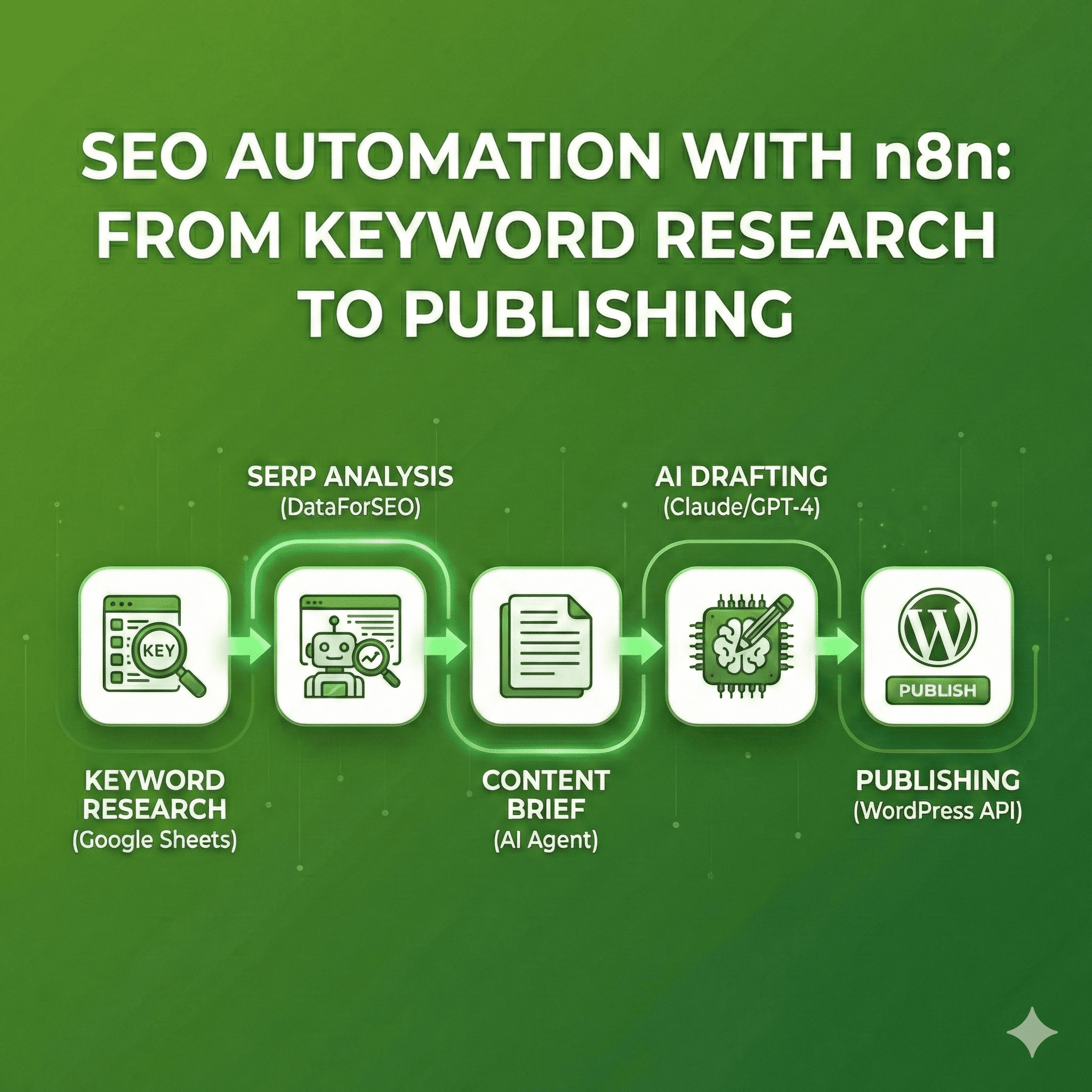
To automate SEO with n8n, we build a modular engine that connects disparate tools into a single source of truth. The goal is to move from a raw keyword to a "Ready for Review" draft in WordPress without a human touching a spreadsheet.
The Stack for 2026:
Orchestration: n8n (Self-hosted for data privacy).
Data Source: Google Sheets or Airtable.
Search Intelligence: DataForSEO or SerpAPI.
The Brain: Claude 3.5 Sonnet or GPT-4o.
The Destination: WordPress (via REST API).
Stage 1: Keyword Research and Prioritization
Set Up Keyword Intake System
Every n8n SEO workflow starts with a trigger. Instead of a manual upload, we use a Google Sheets node that monitors a "Keywords" tab.
Trigger: Google Sheets (On Row Added/Updated).
Logic: Only trigger if the "Priority" column is empty.
Columns Needed:
Keyword,Search Volume,Difficulty,Intent,Status.
Fetch Search Volume and Competition Data
We connect the HTTP Request Node to the DataForSEO API. This provides real-time metrics that are more accurate than stagnant exports.
API Action:
keywords_data/google/search_volume/task_postn8n Logic: If the Keyword Difficulty is < 40 and Volume > 500, set the status to "Quick Win" and proceed to the next stage.
Stage 2: SERP Analysis and Competitive Research
Scrape Top 10 Results
To rank, you must understand what is already working. We use a SerpAPI Node to fetch the current top 10 results for our target keyword.
Extracted Data: Title tags, Word counts, and the full Header (H1-H3) structure.
Data Transformation: Use a Code Node to calculate the average word count of the top 3 results to set a "Target Length."
Analyze Content Gaps with AI
We pass the competitive header structure to an LLM node to find what your competitors are missing.
Example Prompt: > "Analyze the header structures of these top 10 ranking articles for the keyword '[Target Keyword]'. Identify three unique angles or 'content gaps' not covered by these competitors that would provide more value to a technical audience."
Stage 3: Generate Content Brief
Structure the Article Outline
A brief is the roadmap for n8n content automation. We use an AI Agent to generate a structured JSON object containing the article's skeleton.
Title: SEO-optimized but click-worthy.
H2 Structure: Based on SERP analysis + content gaps.
Key Points: Bullet points for what must be covered in each section.
Add Research and Data Points
In 2026, "thin" AI content is penalized. We integrate the Perplexity API within n8n to fetch recent statistics, citations, or news related to the topic. These are appended to the brief as "Evidence Points."
Stage 4: AI Content Generation
Write the Article
Using n8n WordPress automation doesn't mean "one-click" garbage. We use a Claude 3.5 Sonnet node (preferred for its nuanced, human-like tone) to write the article in sections.
JavaScript
Optimize for SEO
Before the draft is finalized, a specialized "SEO Auditor" node checks the content:
Internal Linking: Query your own site's sitemap (stored in a database) to find relevant existing URLs to link to.
Featured Snippet: Generate a concise 45–60 word paragraph at the top of the article targeting the main query.
Meta Description: Generate a high-CTR description under 160 characters.
Stage 5: Review Queue and Publishing
Send to Airtable for Manual Review
No SEO workflow automation should be 100% autonomous. The final draft is pushed to an Airtable Review Dashboard.
Fields:
Headline,Word Count,Draft Body (HTML),SEO Score.Status: "Needs Review."
Slack Alert: n8n notifies the editor that a new draft is ready.
Auto-Publish to WordPress
Once the editor changes the Airtable status to "Approved," a separate n8n workflow triggers the final step.
WordPress Node: Creates a new post using the HTML body.
Visuals: Use a DALL-E 3 or Midjourney node to generate a featured image based on the H1.
Cleanup: Update the original Google Sheet with the live
Live URL.
Cost and Time Savings
Metric | Manual Process | n8n Automated (2026) |
Research Time | 90 Minutes | 2 Minutes |
Drafting Time | 180 Minutes | 5 Minutes |
Formatting & SEO | 60 Minutes | 30 Seconds |
Total Human Labor | ~6 Hours | ~45 Minutes (Review only) |
Estimated Cost | $150–$300 (Writer/Editor) | <$5 (API Credits) |
[Internal Link: The Cost-Benefit Analysis of Self-Hosting n8n]
Advanced Enhancements
Auto-Submit to Search Console: Once published, use the Google Search Console Node to request instant indexing.
Social Distribution: Automatically generate 3 LinkedIn posts and a Twitter thread summarizing the article.
Internal Link Updating: When a new post goes live, have n8n find older posts and automatically add a link to the new one.
Conclusion
By building an end-to-end n8n SEO automation pipeline, you aren't just saving time; you are creating a scalable competitive advantage. In a world where search engines prioritize depth and freshness, the ability to rapidly research, draft, and publish high-quality content is the only way to maintain rankings.
Whether you are an agency managing 50 sites or a solo founder scaling a SaaS blog, n8n SEO workflow tools give you the power of a full content team at the cost of a single server.
Written by Ankit Dhiman — Founder & CEO at Chronexa. Ankit leads a lean team of n8n automation engineers building production-grade AI workflows for mid-market B2B companies across fintech, legal, SaaS, and operations. Book a free 30-minute strategy call to see what's possible for your team.
Related Articles
About author
Ankit is the brains behind bold business roadmaps. He loves turning “half-baked” ideas into fully baked success stories (preferably with extra sprinkles). When he’s not sketching growth plans, you’ll find him trying out quirky coffee shops or quoting lines from 90s sitcoms.

Ankit Dhiman
Head of Strategy
Subscribe to our newsletter
Sign up to get the most recent blog articles in your email every week.