

Moving from Reactive to Predictive Yield Management in Precision Cultivation
A precision cultivation operation with sophisticated indoor facilities struggled to capitalize on the massive volume of data generated by its sensor networks. While the facility tracked critical variables— including CO2, light intensity, humidity, and active compound concentrations—the data lived in silos. Staff were forced to manually log sensor readings into spreadsheets, a process that was slow, prone to transcription errors, and fundamentally retrospective.
- IndustryAgriculture Technology — Controlled Environment Cultivation
- Year2025
- ServicesIoT Data Orchestration, Predictive Modeling, n8n Workflow Automation, AI Analysis
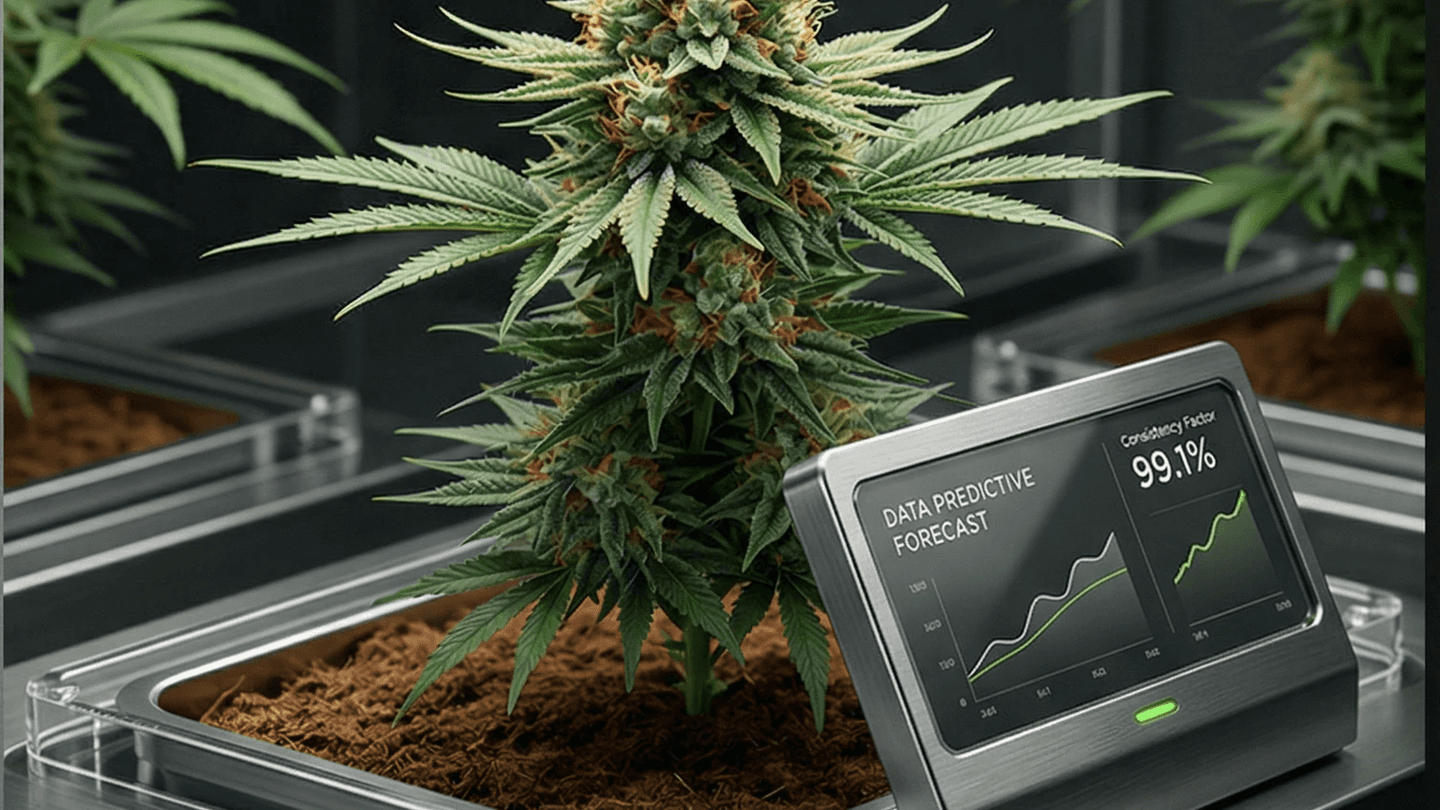
Chronexa designed an end-to-end IoT automation for agriculture pipeline that unified these disparate data streams. Using n8n for orchestration, we built a system that ingests real-time environmental data and quality measurements into a centralized data layer. By applying an AI analysis engine to this unified dataset, we enabled the firm to identify hidden correlations between environmental inputs and final crop quality that were previously invisible to human analysts.
The transformation replaced manual logging with a predictive intelligence layer. Instead of discovering environmental deviations after they had already impacted a crop cycle, the facility now operates on a proactive footing. Cultivation managers receive AI-generated forecasts and optimization recommendations based on current trajectories, allowing for micro-adjustments that protect crop consistency and maximize active compound yields.
The Challenge
Labor-Intensive Manual Data Capture
The facility’s sensor network generated thousands of data points daily, but capturing this information required staff to physically check monitors and manually update logs. This redirected specialized cultivation talent away from plant care and toward repetitive administrative entry, creating an operational bottleneck as the facility expanded.
Entirely Reactive Management Model
Without a real-time data pipeline, management only realized environmental conditions had drifted once a batch failed to meet quality standards or after a significant hardware malfunction. This lack of visibility meant that problems were addressed only after they had already incurred biological or financial costs.
Invisible Correlations Between Inputs and Quality
The operation measured complex outputs like terpene levels and compound concentrations, but they couldn't systematically link these to specific environmental fluctuations. Because the data wasn't unified, the facility was unable to determine exactly which micro-climatic conditions led to the highest quality yields, preventing them from standardizing their most successful grow protocols.
Scaling Constraints and Data Silos
As the operation added more grow rooms, the manual data management burden increased linearly. Each new room required more staff hours for logging, and the lack of a centralized dashboard meant that comparing performance across different zones or facilities was nearly impossible without days of manual spreadsheet consolidation.
The operation required a system capable of:
- Automating the ingestion of all sensor and lab data into a single source of truth.
- Identifying real-time anomalies in environmental conditions before they reached critical thresholds.
- Predicting final crop quality based on environmental trajectories during early growth stages.
- Generating actionable adjustment recommendations for cultivation managers.
The Solution: Real-Time Sensor Intelligence and Predictive AI Pipeline
Automated Sensor Data Ingestion Pipeline
We utilized n8n to interface directly with the facility’s sensor APIs, creating a persistent data stream that captures temperature, humidity, CO2, and light intensity in real time. This eliminated the need for manual logging entirely, ensuring that every fluctuation is recorded with 100% accuracy and millisecond timestamps. The workflow cleans and structures this raw data, preparing it for immediate analysis or archival without human intervention.
Unified Data Layer and Semantic Analysis
Chronexa built a centralized repository that merges environmental sensor data with lab-verified quality measurements. An AI analysis engine processes this unified dataset to find patterns—such as the specific humidity-to-light ratios that correlate with peak terpene production. This move from disparate spreadsheets to a single structured model allows the operation to treat their grow environment as a programmable and optimizable system.
Predictive Intelligence and Forecast Modeling
By applying predictive modeling to the live data stream, the system forecasts the likely quality outcomes of current batches weeks before harvest. If the AI detects a trajectory that deviates from the "Gold Standard" profile, it flags the risk to management. This predictive capability allows cultivators to make preemptive adjustments to lighting or nutrient delivery, effectively "steering" the crop toward its optimal chemical profile.
Automated Alerting and Recommendation Engine
The system doesn't just alert managers to problems; it provides context. When a sensor deviates from the optimal range, the AI generates a specific recommendation—such as a 5% increase in CO2 or a specific temperature adjustment—based on the historical data of the most successful past harvests. These alerts are pushed via internal messaging channels, ensuring that the right person receives the right information at the right time.
Following deployment, the cultivation team no longer manages data; they manage the AI's recommendations, with human experts approving all final environmental adjustments.
Results
100% Elimination of Manual Data Logging
The staff hours previously dedicated to manual sensor checks and spreadsheet updates have been completely reclaimed. Cultivators now focus exclusively on technical plant management and high-level strategy.
Shift to Predictive Crop Management
Management now receives alerts about potential quality drops 10–14 days before they would have been visible under the old manual system. This lead time has significantly reduced the frequency of sub-standard batches.
Tighter Environmental Control and Consistency
The automated monitoring system has reduced the variance in grow room conditions by over 30%. This tighter control has led to a measurable improvement in the consistency of active compound concentrations across different harvest cycles.
Zero Data Management Overhead for Expansion
The system architecture allows new grow rooms to be added to the monitoring network instantly. The firm can now scale its physical footprint without needing to hire additional administrative or data-entry staff.
Enhanced Correlation Insights
For the first time, the operation has identified three specific environmental "stressors" that were inadvertently lowering terpene production. Correcting these has led to a directionally significant increase in final product quality and market value.
Why This Project Matters
Precision agriculture is entering a phase where the volume of IoT data exceeds human processing capacity. This project illustrates that AI for precision agriculture is not just about "better charts," but about creating a closed-loop system where data drives immediate, actionable intelligence. For any data-heavy physical operation, Chronexa’s ROI-first approach proves that orchestration is the key to turning raw sensor noise into a measurable competitive advantage.