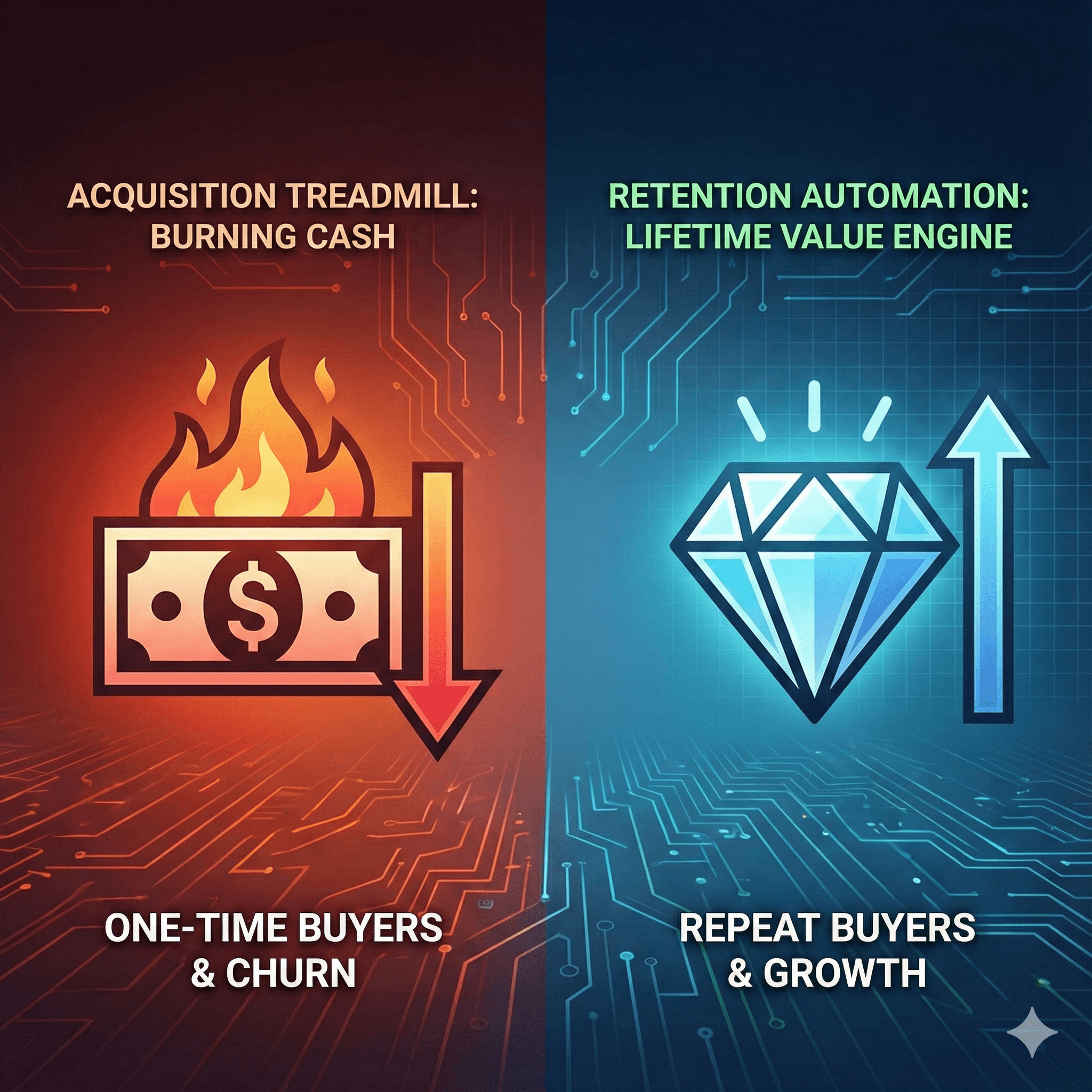
Customer Acquisition Cost (CAC) on platforms like Meta and TikTok has nearly doubled in the last three years. The "arbitrage" era is over. If your business model relies on buying a customer for $40 to sell them a $50 product once, you don't have a business; you have a donation funnel for Mark Zuckerberg.
The most terrifying statistic for US-based D2C brands today is the "One-and-Done" rate. Industry benchmarks show that 75% of e-commerce customers never make a second purchase.
They buy, they experience your product, and then they vanish.
For a growth team, this is a crisis. It means you have to replace three-quarters of your customer base every single month just to stay flat. It is an exhausting, expensive treadmill that inevitably leads to burnout or bankruptcy.
The only way off the treadmill is customer retention automation. But we aren't talking about a generic "Subscribe and Save" button. We are talking about a data-driven, automated infrastructure designed to maximize Customer Lifetime Value (LTV) by delivering the right message exactly when the customer is ready to buy again.
What "Retention" Actually Means (It’s Not Just Loyalty Points)
When we audit D2C brands, the first thing they show us is their "Loyalty Program." They have a widget in the corner of the screen that offers 50 points for following them on Instagram.
Let’s be clear: Loyalty points are not a retention strategy. They are a passive incentive.
True retention is behavioral automation. It is the proactive use of data to anticipate a customer’s needs before they even realize them. It is about shifting your mindset from "How do we get them to buy?" to "How do we help them succeed with what they bought?"
If you sell a skincare regimen, retention isn't sending a 10% coupon every Friday. Retention is knowing that the customer received the product on Tuesday, sending a tutorial video on Wednesday, checking in on their progress on Day 14, and reminding them to restock on Day 45 because the bottle is 90% empty.
Generic email blasts are easy. But they train customers to tune you out. To drive a repeat purchase rate of 40% or higher, you need a system that feels personal, timely, and helpful.
The 4-Part Automated Retention System
At Chronexa, we build retention engines using n8n to orchestrate data between Shopify, your email platform (Klaviyo/Omnisend), and AI models. This allows for logic far more complex than standard "out of the box" flows.
Here is the 4-part architecture required to automate LTV growth.
1. The "Honeymoon" Post-Purchase Nurture
The most critical moment in the customer relationship is the 14 days after the first purchase. This is where "Buyer's Remorse" fights against "Brand Affinity."
Most brands send a transaction receipt and a shipping notification. That’s it.
The Automated Upgrade:
We build workflows that trigger based on shipping status (via webhooks from tools like AfterShip or ShipStation).
Day 0 (Delivery): "It’s Here!" email. Not just a notification, but a guide. "Here is exactly how to open the package and the first thing you should do."
Day 3 (Education): "Pro Tips." Content that adds value. If you sold a cast-iron skillet, send a video on how to season it. If you sold supplements, send a guide on the best time of day to take them.
Day 7 (Check-in): A plain-text email from the founder (automated). "How is it going? Reply to this email if you have issues." (We route replies to CX).
The Goal: Consumption. You cannot get a repeat purchase if the first product sits unopened in a drawer.
2. The Usage-Based "Smart Replenishment"
Standard replenishment flows are dumb. They send a "Time to Restock!" email 30 days after purchase, regardless of what was bought.
The Automated Upgrade:
We use n8n to calculate the specific "Burn Rate" of a SKU.
The Logic:
Customer buys: 60-count bottle of vitamins.
Dosage: 2 per day.
Duration: 30 days.
Shipping Time: 5 days.
Trigger Date: Day 25.
The Workflow: n8n watches Shopify orders. When this SKU is bought, it calculates the precise reorder date and schedules the email trigger.
The AI Twist: If the customer bought two bottles, the system intelligently pushes the reminder to Day 55. Standard flows miss this nuance and annoy customers by asking them to buy when they are fully stocked.
3. Engagement Scoring & Pre-Churn Detection
Most brands wait until a customer has been inactive for 6 months to try and win them back. By then, the relationship is dead. You need to detect the drift before the churn.
The Automated Upgrade:
We build a "Health Score" system in your Customer Data Platform (or even Airtable).
Inputs: Email Open Rate (last 30 days), Site Visits, SMS Clicks.
The Trigger: If a customer’s Health Score drops below 40 (e.g., they stopped opening emails and haven't visited the site in 60 days), an automated "Pulse Check" sequence is triggered.
The Content: "Is everything okay?" Not a sales pitch. A genuine inquiry or a request for feedback. This often wakes up dormant users before they unsubscribe.
4. The "Root Cause" Winback Campaign
For customers who have officially churned (no purchase in >120 days), generic "We Miss You" emails have a low success rate.
The Automated Upgrade:
We segment churned customers by their last purchased item and offer a specific alternative.
Scenario: Customer bought "Level 1 Face Cream" and never returned.
Hypothesis: It might have been too weak, or they didn't see results.
The Winback: "Ready to level up? A lot of people switch from Level 1 to Level 2 when they want faster results. Here is a free sample of Level 2."
The Logic: Instead of discounting the product they already rejected (by not buying it again), we pivot them to a new solution.
Results: The Economics of Retention
Implementing this d2c retention strategy fundamentally changes the unit economics of a brand.
We recently deployed this full stack for a US-based wellness brand. Before automation, their Repeat Purchase Rate (RPR) was stuck at 18%.
The 6-Month Results:
Repeat Purchase Rate: Increased to 34%.
Customer LTV: The average 12-month value of a customer rose from $68 to $115.
Revenue Impact: For a business doing $2M a year, this improvement in LTV represented an additional $350,000 in high-margin revenue (no ad spend required).
Churn Reduction: The "Smart Replenishment" flows converted at 14%, compared to 4% for their previous generic reminders.
The Cost:
The infrastructure to run this (n8n, Shopify, Email API) costs roughly $600/month. Compare that to the $20,000/month they were spending on Meta Ads just to replace the customers they were losing.
Implementation: Crawl, Walk, Run
You cannot build this entire system in a week. We recommend a phased rollout.
Phase 1: The Post-Purchase Fix (Weeks 1-2)
Stop the bleeding. Revamp your post-purchase flow to focus on education and consumption. Ensure customers actually use what they bought.
Phase 2: The Replenishment Math (Weeks 3-4)
Identify your top 5 best-selling consumable SKUs. Calculate their average usage rates. Build the n8n workflows to trigger reminders based on logic, not just a 30-day timer.
Phase 3: The Scoring (Month 2+)
Once the basics are running, implement the Engagement Scoring to catch at-risk customers early.
Conclusion: From Hunting to Farming
The era of "growth at all costs" is over. The brands that survive the next decade will be the ones that master ecommerce repeat purchase automation.
You have already paid the high price to acquire the customer. You have done the hard part. Now, you need a system that honors that investment by treating the second sale with as much importance as the first.
Stop treating your customer list like a static spreadsheet and start treating it like a living ecosystem that needs automated care.
Get a Retention Automation Audit We’ll analyze your current repeat rates and identify exactly where your leaky bucket is biggest.
See how a 5% increase in retention impacts your profitability over 12 months.
Written by Ankit Dhiman — Founder & CEO at Chronexa. Ankit leads a lean team of n8n automation engineers building production-grade AI workflows for mid-market B2B companies across fintech, legal, SaaS, and operations. Book a free 30-minute strategy call to see what's possible for your team.
Related Articles
About author
Ankit is the brains behind bold business roadmaps. He loves turning “half-baked” ideas into fully baked success stories (preferably with extra sprinkles). When he’s not sketching growth plans, you’ll find him trying out quirky coffee shops or quoting lines from 90s sitcoms.

Ankit Dhiman
Head of Strategy
Subscribe to our newsletter
Sign up to get the most recent blog articles in your email every week.