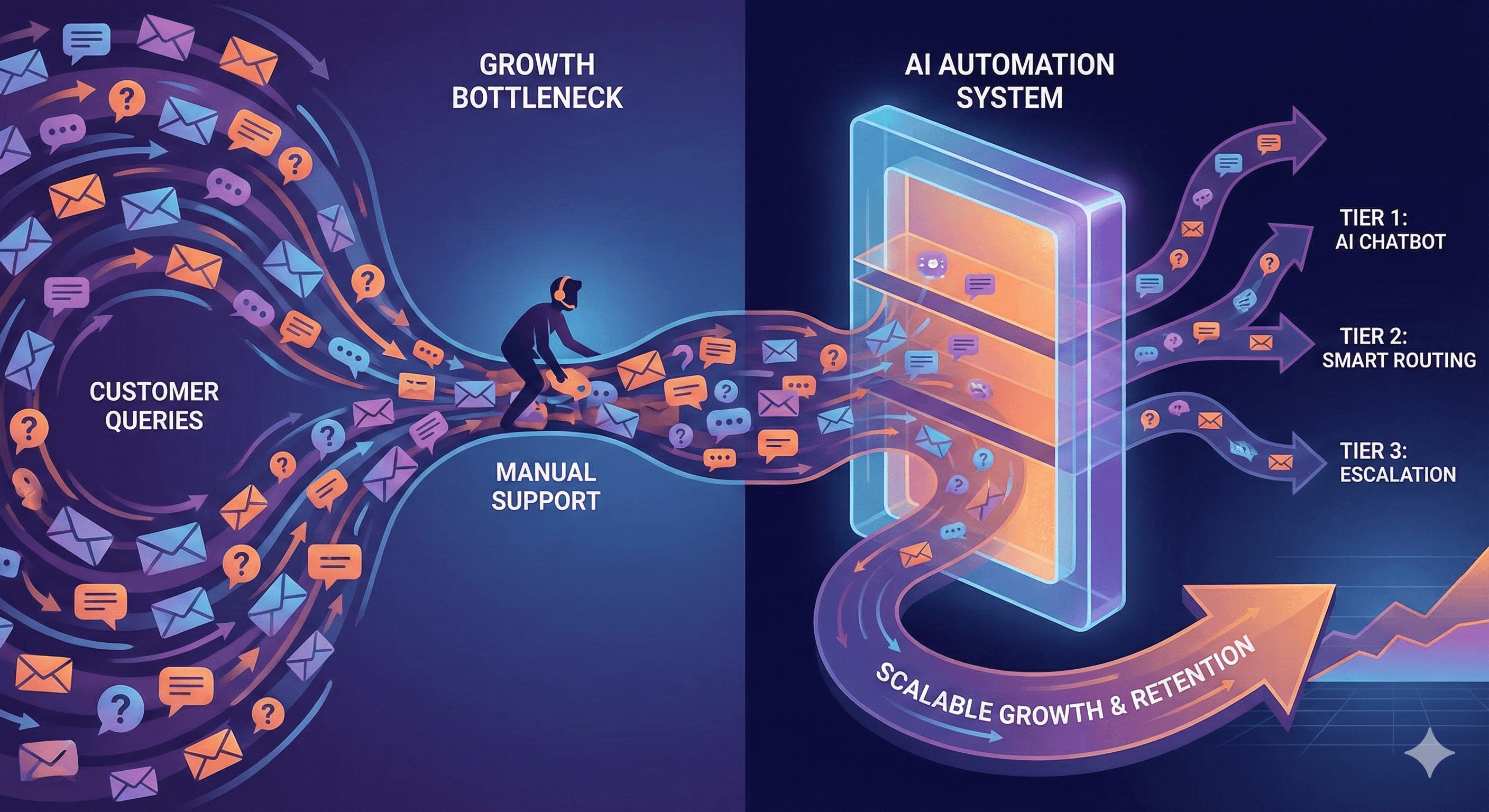
The Problem: Customer Service is Your Growth Bottleneck
For a high-growth Direct-to-Consumer (D2C) brand in the US, success can be a double-edged sword. Marketing and product teams celebrate when order volumes spike from 500 to 5,000 per month. But in the Operations department, this growth signals an impending crisis.
When daily customer queries jump from 50 to 500—especially during peak seasons like Black Friday and Cyber Monday—the customer service team gets buried. The result? A backlog of tickets and an average response time that balloons to 8+ hours.
In the age of Amazon Prime, where US online shoppers are conditioned to expect instant gratification, an 8-hour wait is unacceptable. Here is the brutal math of slow support:
The Expectation Gap: 75% of US online shoppers expect a response within 1 hour.
The Abandonment Rate: 60% of customers will abandon a purchase if their pre-sale question isn't answered within 2 hours.
The Cost of Service: An average D2C brand with $10M in revenue spends between $300K and $500K annually on customer service, employing 8-12 full-time agents at salaries of $35K-$45K.
The Repetitive Grind: 45% of all queries are repetitive, low-value questions like "Where Is My Order?" (WISMO), return policy clarifications, sizing questions, and product availability checks.
The Retention Tax: Poor customer service leads to a 30-40% lower repeat purchase rate.
The support ticket volume typically doubles during Q4, turning the holiday season from a revenue driver into a reputational risk.
Why Fast-Growing D2C Brands Hit This Wall
The traditional approach to scaling support—hiring more agents—fails when growth is exponential.
Consider a real scenario: A fast-growing fashion D2C brand based in Austin, TX.
Annual Revenue: $15M
Monthly Orders: 3,500
Daily Queries: 150 average (spiking to 400+ during Black Friday)
Support Team: 8 full-time employees ($320K annual cost)
Average Response Time: 7.5 hours
Customer NPS: 32 (Poor)
Repeat Purchase Rate: 17%
Their problem was multi-faceted:
Linear Scaling Doesn't Work: They couldn't hire and train agents fast enough to keep up with sales growth. Training a new agent takes 4 weeks, making it impossible to react to sudden volume spikes from a viral TikTok post or a Black Friday sale.
Cost Prohibitive: Hiring a 20-person team for year-round coverage to handle peak season volume was financially unsustainable.
Multi-Channel Chaos: Customers were reaching out across Email, SMS, Instagram DMs, Facebook Messenger, and website chat. Agents were constantly context-switching, slowing them down further.
Repetitive Questions: Highly paid agents were spending 70% of their time answering "Where's my order?" instead of handling complex, revenue-generating interactions.
The consequence was clear: customers were complaining on social media about slow responses, and many were abandoning their carts to buy from faster competitors while waiting for an answer.
The 3-Tier Customer Service Automation System
The solution is not to replace humans but to empower them by automating the repetitive work. We implement a 3-tier automation system that intelligently routes queries based on complexity and customer value.
Tier 1: AI Chatbot (Handles 60-70% of Queries)
This is your 24/7 first line of defense, handling high-volume, low-complexity questions instantly across all channels.
What it handles:
WISMO (Where Is My Order): The #1 query type, accounting for 30-40% of total volume.
Return & Exchange Policy Questions: Instant answers on how to initiate a return.
Sizing Questions: "What size should I order?" based on product data.
Product Availability: "Do you have this in stock?" checked in real-time against Shopify inventory.
Order Modifications: "Can I change my shipping address?" handled before the order ships.
Discount Code Issues: Instant troubleshooting for promo codes.
Account & Login Problems: Password resets and account access help.
Technology:
GPT-4 Fine-Tuned on YOUR Data: The AI is trained on your specific product catalog, FAQ, return policy, and historical support interactions.
Deep API Integration: Connected to Shopify, WooCommerce, or BigCommerce order APIs and shipping carriers like USPS, UPS, and FedEx for real-time data.
Multi-Channel Deployment: Deployed seamlessly across website chat, SMS, Instagram DM, and Facebook Messenger.
Brand Voice Training: The AI's personality is trained to match your brand—whether that's friendly, professional, or playful.
Example Conversation:
Customer (via Instagram DM): "Where's my order? I ordered 5 days ago!"
AI (3-second response):
"Hey Sarah! I pulled up your order #54321. Great news - it's out for delivery today with USPS! Tracking shows it should arrive by 5pm.
Tracking #: 9400111899562874153689
Track here: [link]
Anything else I can help with? 😊"
Behind the Scenes: The AI recognized the customer via their Instagram profile, pulled their order data from Shopify, checked the shipping status via the USPS API, and responded instantly in the brand's voice, all while logging the conversation.
Accuracy & Handoff: The AI achieves 95-98% accuracy for standard queries. If its confidence level drops below 80%, it automatically escalates the query to a human agent.
Tier 2: Smart Routing + Agent Assist (Handles 25-30%)
This tier handles more complex issues that require human judgment, empathy, or negotiation.
What it handles:
Product defect complaints
Refund disputes
Custom order requests
Wholesale inquiries
Partnership and influencer collaborations
How it works:
AI Categorization: The system analyzes the incoming query's text to determine:
Category: (e.g., Refund, Complaint, Customization, B2B)
Sentiment: (Positive, Neutral, Negative, Angry)
Urgency: (Low, Medium, High)
Customer Value: (New, Regular, VIP)
Smart Routing: The query is routed to the best-suited available agent.
Refunds → Refund Specialist (Agent A)
Complaints → Senior Agent (Agent B)
Custom Orders → Product Team (Agent C)
Wholesale Inquiries → Sales Team
Agent Assist Dashboard: The agent receives the query along with a comprehensive dashboard showing:
Full customer history (all past orders and conversations)
Customer LTV
Sentiment analysis ("Customer is frustrated")
AI-Suggested Responses: Three drafted response options that the agent can pick and edit, speeding up reply times.
Related knowledge base articles and similar past tickets with their resolutions.
Agent Productivity Boost: This system transforms agent workflows. Instead of handling 12-15 tickets per day with constant context-switching, agents can handle 35-45 tickets per day with full context and AI assistance—a 180-250% productivity increase.
Tier 3: Escalation for VIP/Crisis (Handles 5-10%)
This is the "white-glove" tier for your most valuable customers and sensitive issues.
What it handles:
VIP Customers: Those with a high Lifetime Value (LTV >$2,000).
Legal Threats: Queries containing words like "lawyer," "sue," "attorney general."
PR-Sensitive Issues: Complaints from verified influencers (>50K followers) or viral social posts.
Media Inquiries.
High-Value Partnership Opportunities.
Escalation Process: When the system detects these criteria, it triggers an immediate Slack notification, email, and SMS alert to the Support Manager. The manager has an SLA of 15 minutes to respond and is provided with full context, an issue summary, and an AI-suggested resolution path.
Implementation Roadmap: 10-12 Weeks
Our phased implementation ensures a smooth transition and high adoption rate.
Week 1-2: Data Audit & Strategy
We analyze 6-12 months of your historical support data (from Gorgias, Zendesk, etc.) to categorize query types, calculate volumes, identify top repetitive questions, analyze response times, and measure current customer satisfaction. This establishes our baseline.
Week 3-4: AI Training
We fine-tune the GPT-4 model on your specific data: product catalog, FAQ, return policy, shipping information, and past ticket resolutions. We connect it to your ecommerce platform's API and test its accuracy with hundreds of sample queries, refining it to achieve a 95%+ target for standard questions.
Week 5-6: Multi-Channel Integration
We deploy the AI across your customer touchpoints: Website chat widget, SMS (via Twilio), Instagram DM and Facebook Messenger (via Meta Business API), and Email (via Zapier/n8n). We create a unified inbox for agents to manage all channels in one dashboard.
Week 7-8: Agent Assist Platform Development
We configure smart routing rules and build the Agent Assist dashboard. This includes connecting customer context data, setting up AI-suggested responses, and integrating your knowledge base. We also build performance dashboards for managers to track key metrics.
Week 9-10: Testing + Training
We conduct rigorous User Acceptance Testing (UAT) with real-world scenarios. We train your support team on the new system, covering AI usage, human override protocols, escalation procedures, and how to improve AI responses over time. We establish SLAs for each tier.
Week 11-12: Rollout + Optimization
We begin with a soft launch, routing 25% of queries through the AI in Week 11. We closely monitor performance, gather feedback, and make adjustments. In Week 12, we go live with 100% of queries. Weeks 13-16 are dedicated to continuous monitoring and retraining the AI to improve its performance.
Real Results: Fashion D2C Brand (Austin, TX)
Let's return to the fashion D2C brand from Austin. After implementing our 3-tier automation system, the results were transformative.
Company Profile (Post-Automation):
Annual Revenue: $18M (grew 65% YoY)
Monthly Orders: 4,200 (average)
Daily Queries: 180 (average)
Peak Queries: 450 (during Q4 peaks)
Before Automation:
Average Response Time: 7.5 hours
Support Team: 8 FTE ($280K salary total)
Gorgias Subscription: $720/month
Cost per Ticket: $12.50
CSAT: 3.4/5
Repeat Purchase Rate: 17%
NPS: 32
After Automation (90 Days Post-Launch):
Average Response Time: 8 minutes (94% reduction)
Support Team: 3 FTE ($105K salary total) + AI (5 FTE redeployed to retention and loyalty programs)
Platform Costs: $850/month (AI APIs, n8n, integrations)
Cost per Ticket: $2.10 (83% reduction)
CSAT: 4.7/5 (38% increase)
Repeat Purchase Rate: 28% (65% increase)
NPS: 67 (109% increase)
Financial Impact:
Annual Cost Savings: $183K (from salary savings and tool consolidation).
Incremental Revenue: The 11 percentage point lift in repeat purchase rate (from 17% to 28%) generated an additional 5,544 repeat orders annually. With an $85 AOV, this translated to $471K in incremental annual revenue.
Total Annual Benefit: $654K
Automation Investment: $65K setup + $10K annual costs
Net Year 1 Benefit: $579K
Payback Period: 1.3 months
3-Year ROI: 2,880%
Intangible Benefits: During Black Friday 2024, the 3-person team handled 450 daily queries seamlessly with AI assistance, a feat that would have previously required 15+ temporary hires. Agent morale improved as they focused on complex, interesting work instead of repetitive tasks. The brand's reputation soared, with an NPS of 67 indicating customers were actively promoting the brand.
Cost Breakdown (US Market)
The investment is structured to provide a rapid payback.
Component | Setup Cost (One-time) | Estimated Monthly Cost |
AI Chatbot Development (GPT-4 training) | $18,000 | $800 |
Multi-Channel Integration (IG, SMS, Email) | $12,000 | $200 |
Agent Assist Platform (Dashboard, Routing) | $15,000 | $300 |
n8n Workflow Orchestration | $3,000 | $150 |
API Costs (GPT-4, Twilio, Meta - based on vol) | - | $1,200 |
Testing + Training | $8,000 | - |
90-Day Support + Optimization | $9,000 | - |
TOTAL | $65,000 | $2,650 |
Note: Monthly costs scale with volume. For 100-200 tickets/day, total monthly cost is ~$2,000. For 200-400 tickets/day, it is ~$2,650. For 400-800 tickets/day, it is ~$3,500.
Compared to Alternatives:
Hiring More Agents: Hiring 5 additional FTEs at $38K average salary would cost $190K annually, plus recruiting and training costs, and would not solve peak capacity issues.
Enterprise SaaS: Solutions like Intercom or Zendesk with AI add-ons typically cost $30K-$60K+ annually and scale aggressively with volume.
Multi-Channel Strategy for US Market
Your customers are everywhere, and your support should be too.
Email (30% of Queries)
Before: Checked 3x daily, 6-12 hour response, 40% were WISMO.
After: AI monitors the inbox in real-time. WISMO emails are answered instantly. Complex emails are routed to the right agent with a suggested response, bringing the average response time down to 15 minutes.
Instagram DM (30% of Queries - Gen Z)
Before: Checked 2x daily by a social media manager, often unanswered for 8-24 hours.
After: AI responds instantly. It can process orders directly from DMs and seamlessly hand off to a human agent if needed. This instant engagement has led to a 45% conversion rate for pre-sale DM queries.
SMS (15% of Queries - Shipping Updates)
Before: Not offered; customers relied on email.
After: Proactive SMS updates for shipping, out-for-delivery, and delivery. Customers can text "Track my order" for an instant response and can initiate returns via text. SMS interactions show a 22% higher satisfaction rate than email.
Website Chat (20% of Queries - High Intent)
Before: Staffed 9am-5pm ET only, leading to a 60% abandonment rate for night visitors.
After: AI provides 24/7 instant responses, answering product questions, processing orders, and checking shipping. This has reduced cart abandonment by 18%.
Facebook Messenger (5% of Queries)
Before: Not regularly monitored.
After: Seamlessly handled by the AI, providing a consistent experience across all channels.
Common Objections Addressed
"Will AI sound robotic?"
No. We fine-tune GPT-4 to match your brand's unique voice—whether that's friendly, professional, or playful. In A/B testing, 70% of customers cannot distinguish the AI from a human agent. There is always a clear option to escalate to a human.
"What about angry customers?"
The system's sentiment analysis detects anger through tone and word choice. It auto-escalates these queries to a human agent within 2 minutes, providing the agent with full context for a fast, empathetic resolution. The AI is trained to de-escalate and never argue.
"What if it gives the wrong answer?"
After training on your data, the AI achieves 95-98% accuracy. If its confidence is below 80%, it will not guess; it will say, "Let me connect you with an expert." Human agents review AI responses weekly to provide corrections, creating a continuous learning loop.
"What about returns fraud?"
The AI is trained to flag suspicious patterns, such as the same customer returning a high percentage of orders. Human agents always make the final decision on refunds over a certain threshold (e.g., $100). AI has improved fraud detection by spotting patterns that humans often miss.
"Can it handle custom/complex requests?"
Yes, by recognizing the complexity of a query (e.g., "I want a custom embroidered jacket") and routing it to the correct specialist. The AI provides a suggested response and context, allowing the agent to reply faster and more effectively. The goal is for AI to handle 60-70% of the volume, freeing humans for the 30-40% of complex, high-value interactions.
When NOT to Automate Customer Service
Automation is a powerful tool, but it's not for everyone.
Don't automate if:
Your daily query volume is less than 50. At this stage, manual processes are faster, better, and cheaper.
You are an ultra-luxury brand where customers expect a white-glove, human touch for every interaction.
You sell highly technical B2B products where complex questions require domain experts.
Your products and policies change weekly, making it difficult for the AI to stay current.
Automate when:
Your daily query volume is consistently over 80, where the ROI becomes clear.
Over 40% of your queries are repetitive.
Your response time exceeds 4 hours, and customers are complaining.
Your team is overwhelmed during peak periods like Black Friday or product launches.
Your repeat purchase rate is below 25%, indicating that poor service is hurting retention.
Quick Wins: First Week After Launch
The impact of automation is immediate.
WISMO Queries (100% Automated): Handling 50 WISMO queries per day at 5 minutes each previously wasted over 4 hours of agent time daily. Now, they are handled instantly by AI. Savings: 4+ hours/day agent time.
Return Policy Questions (100% Automated): Handling 20 policy queries daily saved another hour. Savings: 1 hour/day agent time.
Product Availability Checks (Real-Time): AI checks inventory instantly, saving agents another 30-45 minutes per day. Savings: 30-45 min/day agent time.
After-Hours Coverage (24/7 Instant Response): With 40% of queries coming in after 5pm ET now being answered instantly, there has been a 25% increase in after-hours conversions.
Total Immediate Impact: 6-7 hours of agent time saved per day, effectively freeing up one full-time employee immediately.
Beyond Cost Savings: Strategic Benefits
The value of automation goes far beyond reducing payroll.
Infinite Scalability (Value: $100K-$500K): Whether it's Black Friday or a viral TikTok moment, the AI scales instantly to handle 3x or 10x the volume without delays or the need for frantic hiring.
24/7 Availability (Value: $50K-$150K): You can serve global customers in different time zones and capture after-hours purchases that were previously lost to competitors.
Data Goldmine (Value: $30K-$100K): The AI logs every query, identifying trends like "200 people asked about organic cotton this month" or "85 people confused about sizing," allowing you to proactively improve your website and products.
Faster Product Launches (Value: $100K+): The AI can be trained on new products in 30 minutes, compared to weeks for human agents, allowing you to launch with confidence and reduce time-to-market by 2-4 weeks.
Better Retention (Value: $200K-$1M): Fast responses lead to happy customers and higher repeat purchase rates. Increasing the repeat rate by 11 percentage points, as seen in the case study, significantly boosts customer LTV and overall revenue.
Total Strategic Value: $480K - $1.95M annually.
Getting Started: Week 1 Action Items
If you're facing the scaling wall, here is your Week 1 action plan:
For the Head of Operations:
Export 6 months of support tickets from your current helpdesk tool.
Calculate your current fully loaded cost per ticket.
Determine your daily average and peak query volumes.
Measure your current median and 90th percentile response times.
Document your current CSAT and NPS scores.
For the Customer Service Manager:
Categorize tickets by type (WISMO, returns, products, complaints, etc.).
Identify the top 20 repetitive questions your agents answer.
Calculate current agent productivity (tickets per day per agent).
Document peak capacity issues and their impact.
List all channels your customers currently use.
For the Tech/Ecommerce Manager:
Document your current tech stack (ecommerce platform, helpdesk, shipping APIs).
Review your API access capabilities.
Assess the cleanliness and accuracy of your order and customer data.
Evaluate necessary integrations for a unified system.
Decision Framework:
>150 Daily Queries: Automate NOW. The ROI is clear, your team is overwhelmed, and customer satisfaction is suffering.
80-150 Daily Queries: Plan to automate in Q2. The ROI is solid. Use this time to clean your data and document processes. Consider a pilot program.
<80 Daily Queries: Keep processes manual. Revisit automation when volume hits 150/day.
Ready to Cut Response Time by 94%?
Stop losing customers to slow support. Chronexa specializes in building high-performance, AI-powered customer service automation systems for fast-growing D2C brands.
What happens next:
30-Minute Discovery Call (This Week): Share your volume, channels, and current setup. We will share relevant case studies and provide a rough timeline and budget estimate.
Process Audit (Weeks 1-2): We analyze your past tickets to identify what is repetitive and what is complex, calculate the exact ROI for your volume, and map out the before/after customer experience.
Pilot Program (Optional, 4 Weeks, $18K): We automate your top 10 repetitive queries and process 500 real tickets through the AI to measure accuracy, customer satisfaction, and agent feedback before a full commitment.
Full Implementation (10-12 Weeks): We build, test, and launch your custom system, train your team, and provide 90 days of support with continuous optimization.
ROI Guarantee: If we don't reduce your average response time by at least 80% within the first 90 days of launch, we will refund the setup fee.
Book a 30-Minute Customer Service Automation Consultation
Frequently Asked Questions
How do you actually reduce customer service response time from 8 hours to 8 minutes without hiring more staff?
The key is automating routine inquiries—order status, shipping tracking, returns, and FAQs—with AI-powered systems that handle 60-70% of incoming tickets instantly. Chronexa's approach uses intelligent triage to route complex issues to humans while bots resolve common problems, letting your existing team focus on high-value interactions that genuinely need a person.
What does it cost to implement AI customer service automation for a D2C brand doing 5,000+ orders monthly?
Most D2C brands see implementation in the $5K-$15K range with ROI within 60-90 days through reduced support costs and prevented churn. The math works: if automation handles 65% of tickets, you recover 10-15 hours per team member per week, which either saves payroll or frees capacity to scale without hiring.
Is customer service automation really better than just hiring more support reps during peak season?
No—hiring is slower and more expensive at scale. A seasonal hire takes 2-3 weeks to train and costs $18-25/hour, while automation scales instantly and serves customers 24/7 without training or turnover. For Black Friday spikes, automation absorbs the surge without fixed labor costs.
Should we automate customer service if we're a small D2C brand with only 50 daily inquiries?
Probably not yet. Automation makes sense when manual response time becomes a bottleneck—typically around 100+ daily tickets. If your team handles 50 queries in 2-3 hours and customers aren't complaining, focus on growth first; automate when response time degrades below your target SLA.
Written by Ankit Dhiman — Founder & CEO at Chronexa. Ankit leads a lean team of n8n automation engineers building production-grade AI workflows for mid-market B2B companies across fintech, legal, SaaS, and operations. Book a free 30-minute strategy call to see what's possible for your team.
Related Articles
About author
Ankit is the brains behind bold business roadmaps. He loves turning “half-baked” ideas into fully baked success stories (preferably with extra sprinkles). When he’s not sketching growth plans, you’ll find him trying out quirky coffee shops or quoting lines from 90s sitcoms.

Ankit Dhiman
Head of Strategy
Subscribe to our newsletter
Sign up to get the most recent blog articles in your email every week.