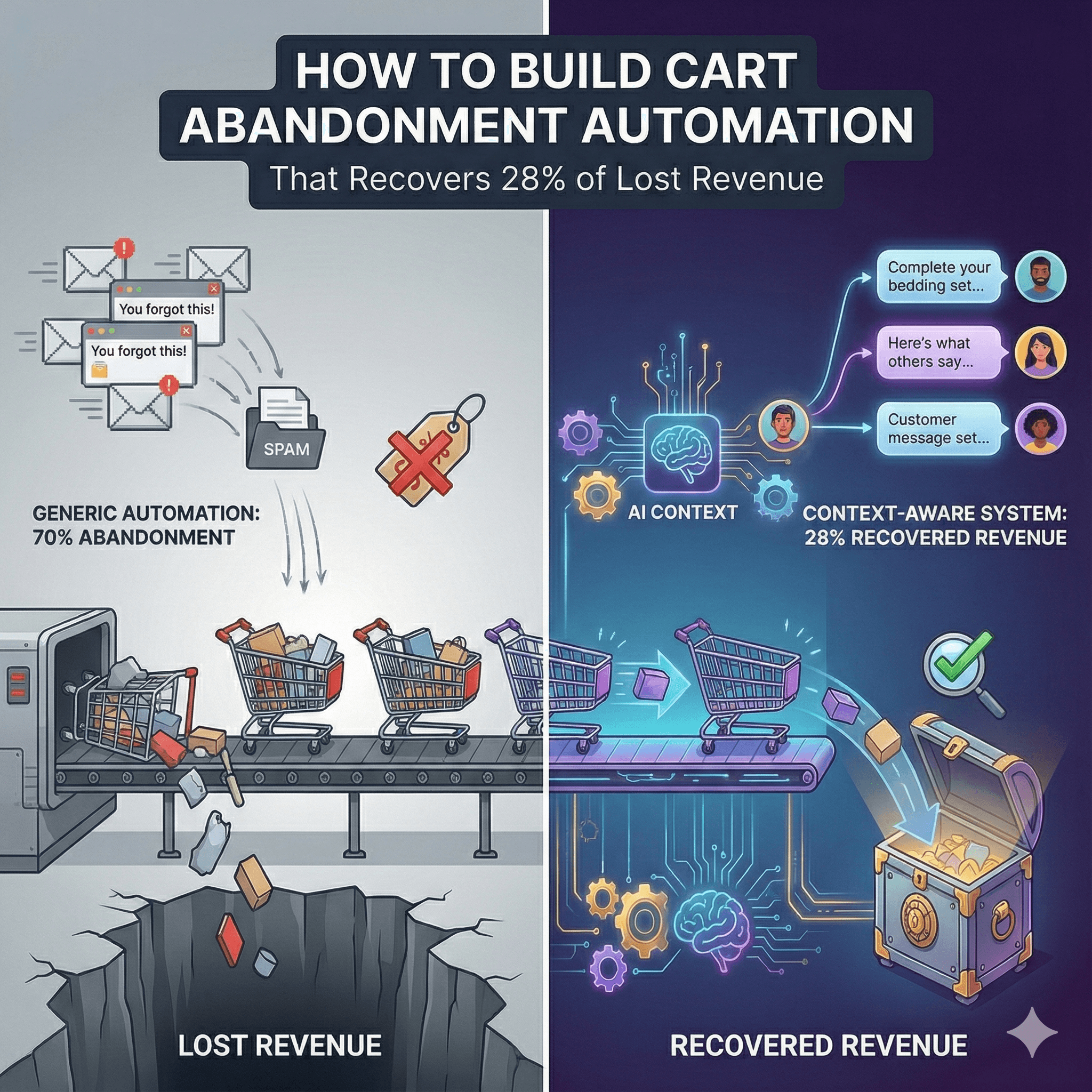
For every $100 you make in sales, roughly $200 worth of merchandise was added to a cart and abandoned. The industry average for cart abandonment sits stubbornly around 70%. In the US market, that represents billions of dollars in high-intent interest evaporating into the digital ether.
Most growth teams treat this as a fact of life. They accept that 70% of people will leave, and they rely on basic tools to claw back a fraction of them.
But for a mid-market brand, accepting a 70% loss rate is a revenue crisis. If you could improve your recovery rate from the industry standard of 7% to a robust 28%, you aren't just tweaking a metric; you are fundamentally changing your P&L. You are lowering your blended Customer Acquisition Cost (CAC) and increasing Customer Lifetime Value (LTV) without spending a single extra dollar on ads.
At Chronexa, we don’t believe abandonment is inevitable. We believe it’s a failure of context. This guide outlines exactly how we use n8n, Shopify, and OpenAI to build an automated recovery engine that outperforms generic flows by 400%.
The Problem: Why Generic "Nudges" Fail
Open your own inbox. Search for "you left something behind." You will likely find dozens of emails from brands you browsed once and forgot about.
They all look the same:
Subject: You forgot this! / Did you see this?
Body: Hey [Name], looks like you didn't finish checking out. Here is a picture of the product. Click here to buy.
The Offer: (Maybe) Here is 10% off.
This approach is broken for three reasons:
It’s Robotic: It treats the customer like a database entry that made a mistake. It assumes the reason they didn't buy was forgetfulness.
It Ignores Context: Did the customer abandon a $2,000 sofa or a $20 candle? Did they abandon because shipping was too high, or because they were comparing specs? A generic email treats both scenarios identically.
It Trains Bad Behavior: If your default move is to offer a discount in the first email, savvy shoppers will intentionally abandon carts just to get the coupon. You are eroding your margins.
To hit a 28% recovery rate, you need to stop sending notifications and start starting conversations. You need automation that mimics a helpful in-store associate, not a frantic alarm clock.
The Solution: The "Context-Aware" Recovery System
We have moved beyond simple "If/Then" logic. We use a sophisticated automation stack to inject intelligence into the recovery process.
Our system doesn't just look at what was left in the cart. It looks at who left it and why that product matters to them.
Here is the 4-layer architecture of a high-performance recovery engine.
Layer 1: The Listener (n8n + Shopify Webhooks)
Standard email platforms (like Klaviyo or Attentive) poll Shopify periodically. We prefer real-time. We use n8n (a workflow automation tool) to listen for the checkouts/update webhook from Shopify.
This gives us the raw data instantly: the items, the customer ID, the shipping address, and the total value.
Layer 2: The Brain (OpenAI Analysis)
This is where the magic happens. We don't just pass the product name to the email template. We pass the cart data to an LLM (Large Language Model) via API.
We prompt the AI to analyze the cart:
Input: Customer bought "Organic Cotton Sheets (Queen)" 6 months ago. Cart contains "Organic Cotton Duvet Cover (Queen)" and "Lavendar Sleep Spray."
Prompt: "Identify the relationship between the past purchase and the current cart. Write a one-sentence hook explaining why these new items perfectly complement their previous purchase."
Output: "Since you've been sleeping on the Organic Sheets for a while, this Duvet Cover is the matching piece to complete the set—and the spray should help with that deep rest you're after."
Layer 3: The Segmentation Logic
Not all carts are equal. The workflow splits the traffic:
VIP/High Value (>$500): These trigger a notification to the CX team for a manual, personal reach-out.
Returning Customer: Triggers the "Contextual Bridge" email (using the AI text above).
New Customer: Triggers the "Social Proof" flow, emphasizing trust and returns policy.
Layer 4: The 3-Email Sequence
We deploy a strategic sequence designed to overcome objections, not just nag.
Email 1: The Service Reach-Out (45 Minutes Later)
Goal: Customer Service.
Tone: Helpful, low pressure.
Content: Uses the AI-generated context. Asks if there was a technical issue or a question about the product. Zero discount.
Email 2: The Validator (24 Hours Later)
Goal: Social Proof.
Tone: Excited, reassuring.
Content: Dynamically pulls the top 3 reviews for the specific item in the cart. "Here is what others are saying about the [Product Name]."
Email 3: The Closer (48 Hours Later)
Goal: Urgency/Scarcity.
Tone: Final call.
Content: "We can't hold your cart forever." Only now do we offer a small incentive (e.g., Free Shipping or 5%) if the margin allows.
Real Numbers: The "Lifestyle Brand" Case Study
We recently implemented this exact stack for a US-based home goods brand doing ~$4M in annual revenue. They were previously using a standard Klaviyo flow managed by a mid-sized agency.
The Before (Agency Managed):
Recovery Rate: 8.5%
Cost: Part of a $5,000/month retainer.
Strategy: Generic 3-email blast with a 10% coupon immediately.
The After (Chronexa Automation):
Recovery Rate: 28.2%
Revenue Recovered (Q4): $47,000 in tracked revenue directly attributed to this specific flow.
Cost: ~$800/month for the total automation stack (n8n, OpenAI, etc).
The Impact:
The "Context-Aware" emails were opened at a rate of 46% (vs 22% previously). Customers replied to the first email thanking the "team" for noticing they were completing their bedding set. The brand saved thousands in margin by removing the discount from the first two emails, as many customers converted simply because they were reminded intelligently.
Build It Yourself: The Technical Blueprint
You don't need a computer science degree to build this, but you do need to move beyond standard dashboard settings. Here is the high-level setup.
Step 1: The n8n Workflow
Trigger: Use the
Shopify Triggernode in n8n. Set it to listen forCheckouts Update.Filter: Add an
Ifnode to ensure the email is present and the checkout is not completed (completed_atis empty).Wait: Add a
Waitnode for 45 minutes. (This checks if they recovered organically before we send).
Step 2: The Data Enrichment
Get History: Use the
Shopifynode to "Get Customer Orders." This pulls their history.Format Data: Use a
Codenode to create a clean JSON summary:{"Past_Purchases": "Item A", "Current_Cart": "Item B"}.
Step 3: The AI Integration
Node:
OpenAI(Chat Model).System Prompt: "You are a helpful concierge for [Brand Name]. Analyze the customer's history and current cart. Write a friendly, 20-word sentence connecting the two. Do not sound salesy."
User Message: [Insert the JSON summary].
Step 4: The Execution
Node:
Klaviyo(or your ESP).Action: "Create Event" or "Update Profile." Push the AI-generated text into a custom profile property (e.g.,
ai_cart_context).Trigger Email: In Klaviyo, set the flow to trigger on this event and insert the
{{ person.ai_cart_context }}tag into the email body.
Common Mistakes to Avoid
Even with the best tools, strategy errors can kill your recovery rate.
1. The "Discount Addiction"
Never lead with a discount. If you offer 10% immediately, you are training your customers to abandon their carts. You are also slashing your own profit margin unnecessarily. Most customers abandon because they got distracted (the doorbell rang, the boss walked in). A helpful reminder is often enough to recover them at full price.
2. The "Instant" Send
Do not send the email 5 minutes after abandonment. This feels intrusive, like you are watching them over their shoulder. The "Uncanny Valley" effect kicks in. Wait at least 45 minutes to 1 hour. It feels more natural and gives them time to come back on their own.
3. Ignoring "Out of Stock"
Ensure your automation checks inventory levels before sending. There is nothing more frustrating for a customer than clicking "Return to Cart" only to find the item is sold out. Your n8n workflow should have a filter to check inventory_quantity > 0.
Conclusion: It’s an Asset, Not a Task
Most e-commerce teams view "Abandoned Cart" as a task to be checked off during onboarding. They turn on the default setting and forget it.
But for a $5M brand, that "set and forget" button is costing you six figures a year.
By building a custom, AI-driven shopify cart recovery system, you are building a permanent asset. It works 24/7. It treats your 50,000th customer with the same white-glove care as your first. It recovers revenue while you sleep, and it does it at a fraction of the cost of a human team.
The technology is here. The workflows are proven. The only variable is whether you are willing to step away from the default settings and build something better.
Get a Free Cart Recovery Audit We will analyze your current flows and tell you exactly how much revenue you are leaving on the table.
See how a shift from 8% to 28% would impact your bottom line this year.
Written by Ankit Dhiman — Founder & CEO at Chronexa. Ankit leads a lean team of n8n automation engineers building production-grade AI workflows for mid-market B2B companies across fintech, legal, SaaS, and operations. Book a free 30-minute strategy call to see what's possible for your team.
Related Articles
About author
Ankit is the brains behind bold business roadmaps. He loves turning “half-baked” ideas into fully baked success stories (preferably with extra sprinkles). When he’s not sketching growth plans, you’ll find him trying out quirky coffee shops or quoting lines from 90s sitcoms.

Ankit Dhiman
Head of Strategy
Subscribe to our newsletter
Sign up to get the most recent blog articles in your email every week.