The New Reality: Retention is the Only Sustainable Growth Strategy
For the past decade, the D2C playbook was simple: arbitrage cheap social media impressions into traffic, optimize conversion rates, and count the cash.
That playbook is officially dead.
As a VP of Marketing or CMO at a US D2C brand today, you are facing a brutal reality. The iOS privacy changes decimated ad targeting efficiency. Competition has saturated nearly every vertical. The result is a Customer Acquisition Cost (CAC) that has skyrocketed, often exceeding $240 for a qualified customer in competitive niches like beauty, wellness, or home goods.
If your Average Order Value (AOV) is $150, you are underwater on the first transaction. You are essentially paying for the privilege of a customer trying your product once.
The only way the math works—the only way to achieve healthy unit economics and satisfy investors—is if that customer comes back for a second, third, and fourth purchase without requiring another $240 in ad spend.
The "One-and-Done" Crisis
The existential threat facing most mid-market D2C brands ($20M - $100M revenue) is the "one-and-done" customer.
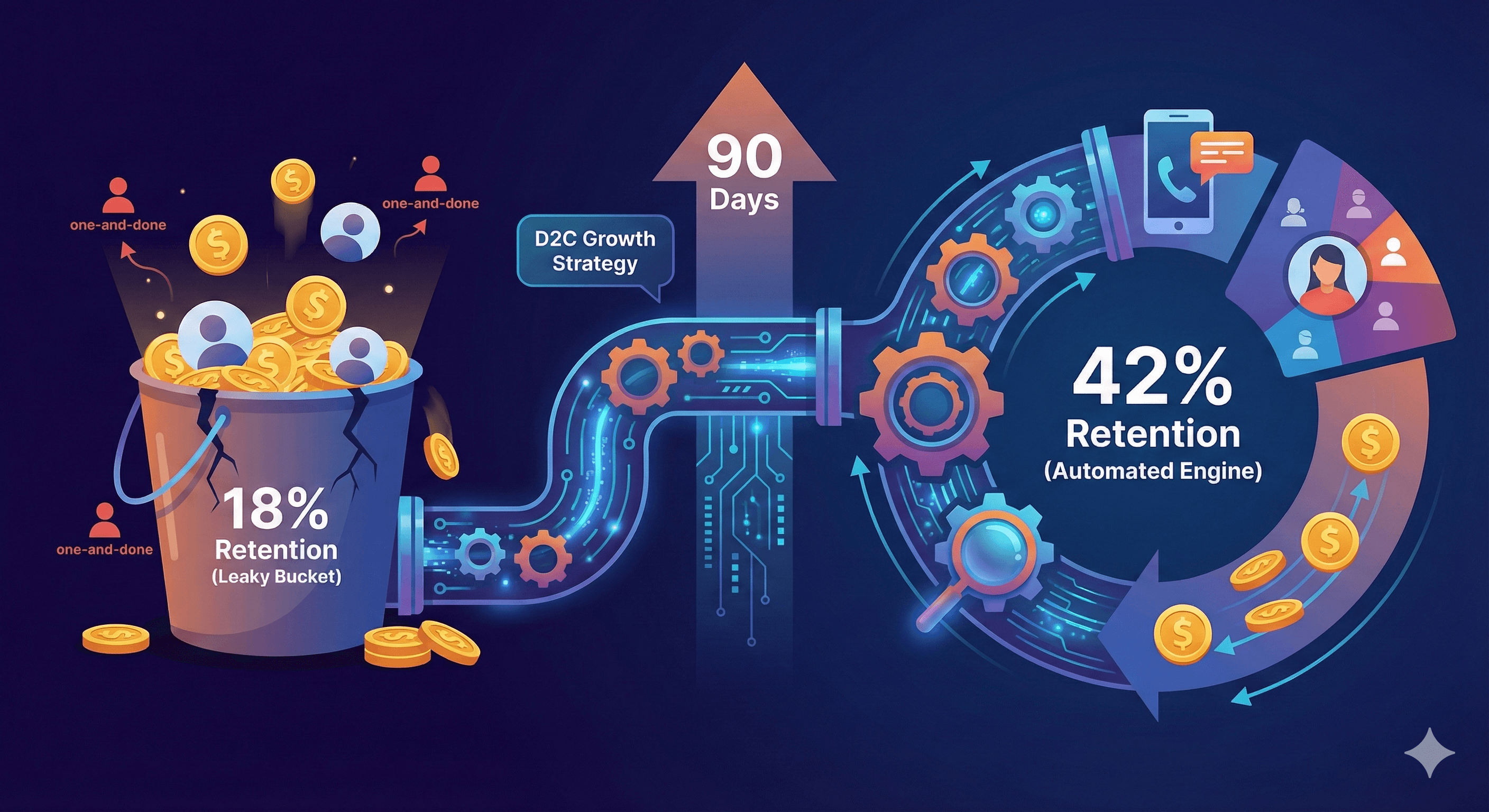
We audit dozens of brands annually. The median repeat purchase rate (customers who buy more than once within 12 months) often hovers stubbornly around 18-22%.
An 18% repeat rate means you are constantly on a hamster wheel, lighting cash on fire to acquire 82% of customers who will never generate profit. You cannot scale a business on an 18% retention rate in this CAC environment. You will run out of addressable market or run out of runway first.
The target is 40%+. A brand with a 40% repeat purchase rate has fundamentally different unit economics, a higher valuation multiple, and a war chest to outspend competitors on acquisition because their Lifetime Value (LTV) supports it.
Moving from 18% to 42% doesn't happen by sending more generic newsletters. It happens by building an automated, data-driven retention engine.
Here is the 5-pillar framework we use to execute this turnaround in 90 days.
The 5 Pillars of Repeat Purchase Automation
If you are relying on manual email campaigns and basic "abandoned cart" flows, your retention strategy is running on 2015 technology. To hit a 42% repeat rate, you need an integrated ecosystem that reacts to customer behavior in real-time.
We utilize a best-in-class US tech stack—typically leaning on Klaviyo for email data, Attentive or Postscript for SMS, and n8n for sophisticated cross-platform orchestration—to build five core automation pillars.
Pillar 1: The "Hyper-Specific" Post-Purchase Flow
Most brands treat the post-purchase email sequence as a digital receipt and a generic "thank you." This is a massive missed opportunity. The moment immediately after purchase is when dopamine is highest, but also when "buyer’s remorse" anxiety begins to creep in.
Your post-purchase flow determines whether a customer consumes the product correctly, enjoys the experience, and is primed to buy again.
The Mistake: Sending the same "Thanks for your order!" sequence to everyone.
The Automation Strategy: We build distinct post-purchase flows based on what they bought and if they are a first-time buyer vs. returning.
If you sell skincare, the customer who bought the "Acne Treatment Kit" needs entirely different education than the customer who bought the "Anti-Aging Moisturizer."
Example Sequence (First-Time Buyer - Complex Supplement Product):
Email 1 (Immediate - Transactional + Brand Voice): Order confirmation, setting expectations on shipping speed, and high-level excitement building.
Email 2 (Delivery Day - The "Unboxing"): "It’s here! Open this first." Immediate instructions on how to take the first dose. Crucial for products where usage compliance dictates results.
Email 3 (Day 5 - Expectation Management): "What you should be feeling right now." Addresses common drop-off points (e.g., "You might not see changes yet, that’s normal. The magic happens around Day 14.").
Email 4 (Day 14 - The "Micro-Win" Check-in): Asking them to notice small improvements. Social proof from peers about their Day 14 results.
Email 5 (Day 25 - The Soft Reorder Nudge): Based on consumption modeling, they should be running low. "Don't break your streak. Restock before you run out."
This isn't just communication; it's automated customer success that ensures the product delivers value, which is the prerequisite for a second purchase.
Pillar 2: Behavioral Trigger Automation (Beyond the Cart)
You likely already have abandoned cart and abandoned checkout flows. These are table stakes.
To reach a 42% repeat rate, we need to automate based on subtler behavioral signals that indicate intent before items hit the cart. We need to react to what they are looking at, not just what they almost bought.
The Automation Strategy: Using Klaviyo’s "Viewed Product" and "Active on Site" metrics combined with n8n orchestration to trigger hyper-relevant flows.
The "Window Shopper" Flow:
If an existing customer visits the site 3 times in a week, views the "Summer Collection" category page twice, but never adds to cart, they are high-intent but hesitant.
Trigger: 3x site visits + 2x category view in 7 days + No purchase.
Action: Send a targeted email featuring bestsellers from the viewed category with social proof reviews. If they still don't bite in 48 hours, trigger an SMS with a time-sensitive "free shipping on Summer Collection" offer.
The "Replenishment Prediction" Flow:
This is not a static timer. This is predictive. If you sell coffee, and a customer buys a 12oz bag every 18 days on average, we automate the reminder for Day 16.
Trigger: Predicted date of exhaustion approaches.
Action: A helpful, low-pressure reminder. "Running low on your morning brew? Click here to reorder your usual in two taps."
Pillar 3: The Ruthless Segmentation Strategy
The era of "batch and blast" newsletters to your entire 200k list is over. It damages sender reputation and trains customers to ignore you.
High retention rates are built on relevance. Relevance requires ruthless segmentation based on RFM (Recency, Frequency, Monetary) data and product affinity.
The Automation Strategy: We build dynamic segments that update in real-time, ensuring customers only see messages relevant to their relationship stage.
Key Segments We Build:
The Whales (High LTV, High Frequency): Your best customers. Never send them a discount. Send them early access, exclusive content, and "founder's notes." They value status over savings.
The At-Risk Loyalists (High LTV, Low Recency): They used to love you but haven't bought in 90 days. This is an emergency. They need a high-value "win-back" offer that acknowledges their past loyalty.
The One-Hit Wonders (Low Frequency, Recent Purchase): The 18% majority. They bought once 30 days ago. They need education on complimentary products and social proof to validate their initial decision.
The Discount Hunters (Low Monetary, High Discount Usage): Only buy during 30% off sales. Suppress them from full-price campaigns to protect margins. Only engage during major sale events.
By automating content delivery based on these segments, you stop fatiguing your list and increase engagement rates on every send.
Pillar 4: Compliant, High-Impact SMS Marketing
For US D2C brands, SMS is the highest-converting channel, often seeing 98% open rates and 15%+ click-through rates.
However, it is a privilege to be in someone's text inbox, and it is heavily regulated. Mentioning TCPA (Telephone Consumer Protection Act) compliance isn't just legal fine print; it's critical to avoiding massive class-action lawsuits.
The Mistake: Treating SMS like email and blasting weekly promos. This leads to massive unsubscribe rates and brand damage.
The Automation Strategy: Use SMS (via Attentive or Postscript integrated with Klaviyo) exclusively for high-urgency, high-value transactional or VIP communication.
SMS Best Practices We Automate:
Strict Frequency Caps: Never more than 2-4 marketing texts per month, excluding transactional messages.
The VIP Velvet Rope: Only offer SMS opt-in in exchange for significant value (e.g., "Join the SMS list for 1-hour early access to our Black Friday sale").
Two-Way Conversational SMS: Don't just broadcast. Use automation to invite replies. "Hey [Name], saw you were looking at the moisturizer. Do you have any questions about ingredients before you buy? Reply here." Route replies to your CX platform (like Gorgias) for human handling. This builds immense trust.
Pillar 5: Integrated Loyalty & Referral Loops
A loyalty program shouldn't be a separate widget in the corner of your website that nobody uses. It needs to be deeply integrated into your marketing automation flows.
The Automation Strategy: Gamify the journey to the second and third purchase.
The "Points Nudge" Flow:
Instead of a generic "buy again" email, use data.
Trigger: Customer hits 400 loyalty points (where 500 points = $20 off).
Email: "You are SO close. You have 400 points. Your next purchase gets you a $20 voucher. Here are some items that will get you over the finish line."
The Post-Positive Review Referral:
Don't ask for referrals right away. Wait until they love you.
Trigger: Customer leaves a 5-star review on Yotpo or Okendo.
Action (24 hours later): "Thanks for the love! Since you're a fan, here is a unique link to give your friends $20 off their first order. If they use it, you get $20 too."
The Blueprint in Action: The 90-Day Turnaround
How does this framework translate into reality? Here is a composite case study based on recent client engagements in the US health and wellness space.
The Brand Profile (Day 0)
Vertical: D2C Nutritional Supplements
Annual Revenue: $25 Million
AOV: $85
Repeat Purchase Rate (RPR): 19%
The Pain: Heavy reliance on Facebook/TikTok ads. CAC crossed $130, severely impacting profitability. Email revenue was only 12% of total revenue.
The Goal: Increase RPR to 35%+ and email/SMS revenue contribution to 30%+.
Month 1: The Foundation (Audit, Strategy & Build)
Weeks 1-2: Data & Tech Audit. We audited their Klaviyo instance, finding poor deliverability and generic flows. We identified that Shopify data wasn't syncing correctly with their SMS provider (Attentive), causing compliance risks.
Weeks 3-4: The Rebuild. We wiped the slate clean. We designed the new hyper-specific post-purchase flows based on their top 3 product SKUs. We built out the core RFM segments in Klaviyo. We set up n8n to orchestrate data flow between Shopify, their reviews platform (Okendo), and Klaviyo to ensure real-time trigger accuracy.
Month 2: The Activation (Live Triggering & Optimization)
Week 5: The new post-purchase and abandoned browser flows went live.
Weeks 6-7: We launched the segmented campaigns. "Whales" received an exclusive founder's update, while 90-day lapsed customers received a targeted win-back offer. SMS was activated specifically for the replenishment flows.
Week 8: Optimization. We A/B tested subject lines and SMS timing. We found that SMS replenishment reminders sent at 11 AM EST on Tuesdays performed 22% better than weekends.
Month 3: The Acceleration (Loyalty & Scaling)
Weeks 9-12: We integrated the loyalty program data into the flows, turning passive points into active purchase incentives. We launched a referral automation specifically targeting customers who had made 3+ purchases and left a positive review.
The Results (Day 90)
The transformation in unit economics was drastic.
Repeat Purchase Rate: Increased from 19% to 41%.
Email/SMS Revenue Contribution: Increased from 12% to 34%.
Financial Impact: By converting an additional ~22% of their 8,000 monthly new customers into repeat buyers, the brand generated over $1.4 Million in incremental revenue in the first quarter post-implementation, with near-zero additional ad spend.
The Investment: Tech Stack & Financials
For a VP of Marketing, getting budget approval requires transparency on costs and ROI. This is not a cheap exercise, but it is a necessary investment in infrastructure.
The US D2C Tech Stack
We recommend and typically implement the following stack for brands in the $20M-$100M range:
Email/CDP: Klaviyo (The standard for Shopify D2C)
SMS: Attentive or Postscript (Must have robust compliance features)
Reviews: Okendo or Yotpo
Loyalty: LoyaltyLion or Yotpo Loyalty
Orchestration Layer: n8n (The glue that enables complex, custom triggers between these apps without expensive enterprise middleware)
The Financial Investment
Implementing a system of this caliber requires significant upfront expertise to architect the strategy, migrate data, build the flows, write the copy, and design the assets.
Typical Agency Setup Fee (One-Time): $55,000 - $75,000. This covers the 90-day intensive build, audit, strategy, and implementation of all 5 pillars.
Ongoing Management & Optimization: $2,500 - $5,000 / month. Automation is not "set it and forget it." It requires constant A/B testing, segment refinement, and adaptation to new product launches and seasonal events.
The ROI Calculation:
For a $25M brand, an investment of roughly $80k in Year 1 to generate $4M+ in incremental, high-margin repeat revenue is perhaps the highest ROI activity a CMO can undertake.
Conclusion: Stop Renting Your Customers
If your repeat rate is stuck at 18%, you don't have a brand; you have a leaky bucket that you are desperately trying to fill with expensive ad traffic.
The era of easy acquisition is over. The era of retention has begun. By implementing these five pillars of automation, you stop renting your customers from Zuckerberg and ByteDance and start owning the relationship, turning one-time buyers into high-LTV brand advocates.
It’s time to fix the bucket.
Want to automate the manual ops holding back your fulfilment and inventory workflows?
Chronexa builds custom n8n automations for D2C and supply chain teams — from order routing and PO reconciliation to inventory sync across Shopify, Amazon, and Walmart.
Book a Free 30-Minute Strategy Call →
Further reading: See how D2C founders scale fulfilment without scaling headcount — E-Commerce Order Operations Automation: How D2C Founders Scale Fulfillment
Written by Ankit Dhiman — Founder & CEO at Chronexa. Ankit leads a lean team of n8n automation engineers building production-grade AI workflows for mid-market B2B companies across fintech, legal, SaaS, and operations. Book a free 30-minute strategy call to see what's possible for your team.
Related Articles
About author
Ankit is the brains behind bold business roadmaps. He loves turning “half-baked” ideas into fully baked success stories (preferably with extra sprinkles). When he’s not sketching growth plans, you’ll find him trying out quirky coffee shops or quoting lines from 90s sitcoms.

Ankit Dhiman
Head of Strategy
Subscribe to our newsletter
Sign up to get the most recent blog articles in your email every week.