The Problem: Your "Leaky Bucket" Top of Funnel
For a D2C growth marketer in the US, traffic is rarely the problem. Between Meta (Facebook/Instagram), TikTok, influencers, and paid search, you can turn on the faucet whenever you have the budget.
The problem is the bucket has holes in it.
Today's D2C customer journey is fragmented across devices and platforms.1 A potential customer might first see an Instagram Reel, click a link to a giveaway landing page on their phone, later visit your desktop site and see a popup, and finally interact with a quiz.
Each of these touchpoints has its own data silo.
Meta Lead Ads: Stuck in a CSV file inside Ads Manager.
Website Popups (e.g., Justuno, Privy): Living in the popup app's database.
Quizzes (e.g., Octane AI, Typeform): Isolated in the quiz platform.
Giveaways (e.g., ViralSweep, Gleam): Another separate spreadsheet.
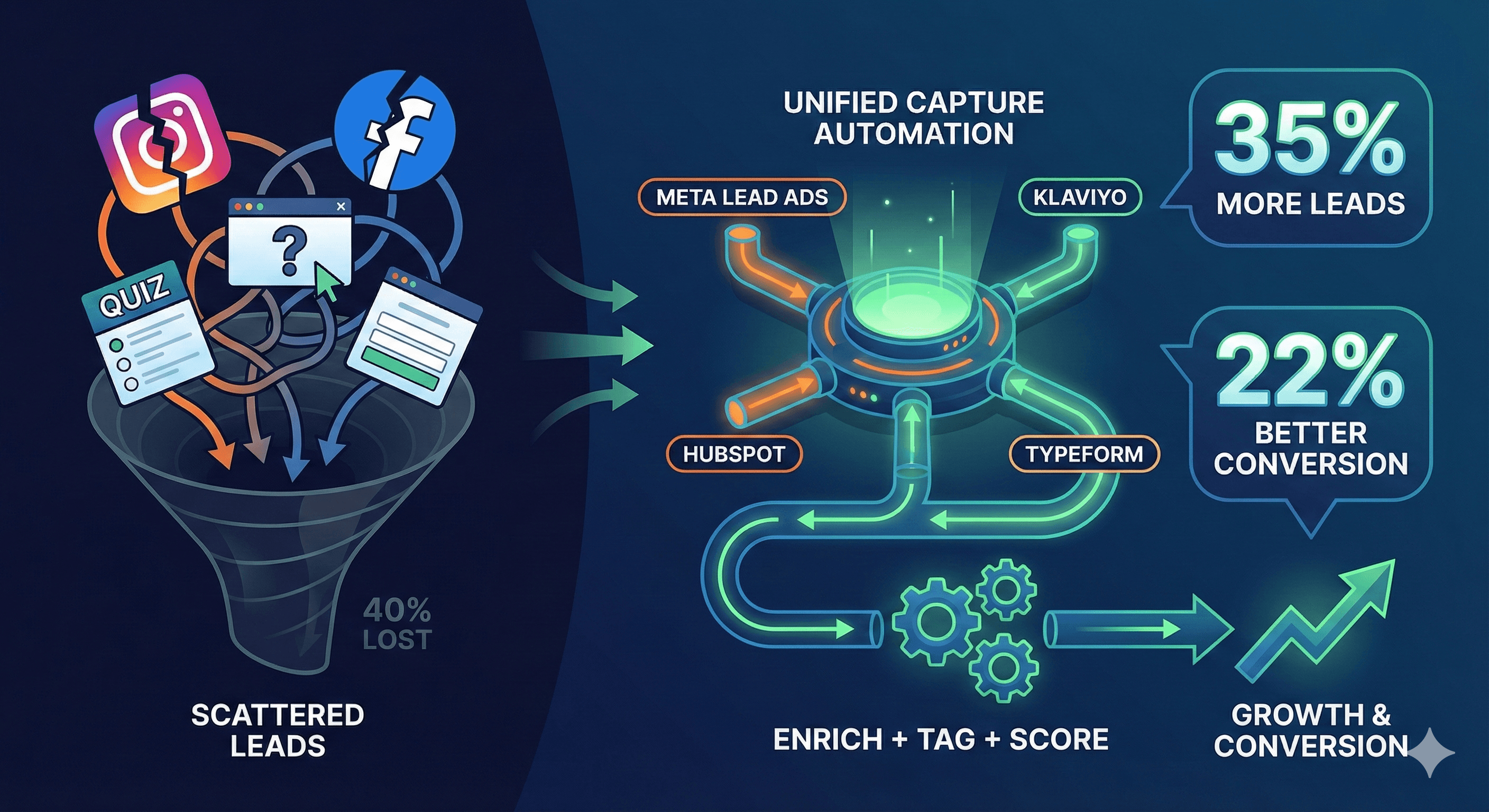
For many mid-sized D2C brands, we see a staggering statistic: nearly 40% of leads generated at the top of the funnel never make it into the primary CRM or email marketing platform (like Klaviyo or HubSpot) in a usable timeframe.
A marketing coordinator manually downloading four different CSVs every Friday and uploading them to Klaviyo is not a strategy. It’s a liability. By the time those leads are uploaded, they have forgotten who you are, and your welcome series is irrelevant.
This manual, fragmented process isn't just annoying; it's expensive. You paid for those leads. Losing them to data friction is flushing budget down the toilet.
The solution is to stop treating lead capture as a series of disconnected events and start treating it as a unified, automated system.
The Multi-Channel Capture System: A Unified Data Layer
To capture 35% more leads, you need to build an automated data layer that sits between your various acquisition channels and your central source of truth (your CRM/CDP).
At Chronexa, we design this as a hub-and-spoke model using an orchestration tool like n8n. The CRM (e.g., Klaviyo) is the hub, and every lead source is a spoke that automatically feeds data into it in real-time.
Here is how we architect the system, channel by channel.
1. Meta (Facebook & Instagram) Lead Ads Automation
Meta Lead Ads are incredibly powerful for D2C because they reduce friction—the form pre-fills with the user's Facebook data. However, the native integration with CRMs is often clunky or requires third-party tools that break.
The Manual Way: A marketer logs into Ads Manager, navigates to the "Leads Center," downloads a CSV for the last 7 days, formats the columns, and uploads it to Klaviyo. This happens maybe once a week.
The Automated Way:
We set up a webhook that listens for a new lead submission on Meta in real-time.
Trigger: User hits "Submit" on an Instagram Lead Ad for a "Summer Catalog" download.
Action 1 (Instant): The data (Name, Email, Phone, Ad Set Name) is pushed instantly to n8n.
Action 2 (Tagging): n8n tags the lead in Klaviyo with
Source: Meta Lead Ad,Campaign: Summer Catalog, andStatus: New Lead.Action 3 (Nurture): This tag instantly triggers a specific Klaviyo welcome flow designed for catalog requesters, delivering the asset via email within 60 seconds.
Result: Zero latency. The user gets what they asked for immediately, while their interest is highest.
2. Website Popups and Embedded Forms
Your website forms are likely your highest volume source. Whether it's a "10% Off First Order" popup or a newsletter footer opt-in, this data needs to flow instantly.
The Automated Way:
Most modern popup tools (Justuno, Privy, Wisepops) have webhooks.
Trigger: User submits email for a discount code on a Justuno popup.
Action 1 (Enrichment): Before sending to Klaviyo, we can route the email through a data enrichment API (like Clearbit) to append data points like location or estimated household income, if relevant to the brand.
Action 2 (Contextual Tagging): The lead is pushed to Klaviyo with context:
Source: Website Popup,Page URL: /collections/womens-running-shoes.Action 3 (Personalization): The Welcome Email they receive references running, instead of a generic brand introduction.
Result: Higher relevance in the first touchpoint, leading to better open rates and conversion.
3. Interactive Content: Quizzes and Typeforms
Quizzes (e.g., "Find Your Perfect Skincare Routine") are lead generation goldmines because they provide zero-party data—explicit preferences told to you by the customer.
The Manual Way: Quiz data sits in Octane AI or Typeform. A marketer occasionally exports it to see aggregated results, but the individual responses aren't linked to the customer profile in the CRM.
The Automated Way:
Every quiz response should update the customer's profile in real-time.
Trigger: User completes a Typeform skincare quiz, indicating they have "Dry Skin" and are worried about "Fine Lines."
Action 1 (Profile Update): n8n receives the webhook. It finds the existing profile in Klaviyo based on email and adds custom properties:
Skin Type: Dry,Primary Concern: Fine Lines.Action 2 (Segmented Flow): The user is added to the "Dry Skin / Anti-Aging" segment, triggering a tailored email series featuring products containing hyaluronic acid and retinol, with educational content on those ingredients.
Result: The marketing shifts from generic blasting to helpful, personalized recommendations based on data the customer willingly provided.
4. Giveaways and Contest Platforms
Giveaways (via ViralSweep or Gleam) generate massive lead volume in a short burst. Manually handling 20,000 entrants is a nightmare.
The Automated Way:
Trigger: New entry in ViralSweep.
Action 1 (Validation): We can run the email through a verification API (like ZeroBounce) to flag throwaway or spam trap emails before they enter your CRM and hurt your sender reputation.
Action 2 (Tagging): Valid emails are pushed to Klaviyo tagged
Source: Giveaway,Campaign: Holiday 2024 Giveaway.Action 3 (Specific Nurture): They are placed into a "Giveaway Entrant" flow that is distinct from a standard welcome series. It acknowledges the contest, manages expectations on when winners are announced, and softly introduces the brand's value proposition without being overly aggressive on sales immediately.
Result: Clean data list growth and a respectful introduction to thousands of new potential customers.
Auto-Enrichment and Lead Scoring
Capturing the contact info is just step one. To truly maximize value, you need to enrich and score the leads automatically.
Auto-Enrichment
When a lead comes in with just an email, we can automatically ping services like Clearbit to see if we can append public data points like location, job title, or social handles. For a high-ticket D2C brand (e.g., selling $2,000 e-bikes), knowing a lead's general location or profession can help prioritize personal outreach from a sales concierge.
Automated Lead Scoring in Klaviyo/HubSpot
Not all leads are equal. A lead from a "Win an iPhone" giveaway is less valuable than a lead who took a 10-question product finder quiz.
We set up automated scoring rules within the CRM that update in real-time based on the data flowing in via n8n:
+50 Points: Completed Product Finder Quiz
+30 Points: Source = Meta Lead Ad (High Intent Offer)
+10 Points: Source = Website Popup
+5 Points: Source = Giveaway
+5 Points per interaction: Opened email, clicked link
-20 Points: Has not engaged in 30 days
This score allows you to create a "Hot Leads" segment for special offers or personalized outreach, while letting lower-score leads nurture slowly in automated flows.
The Results: More Leads, Better Conversion
Implementing a unified, automated lead capture architecture is a foundational change for a D2C marketing team. The results are typically immediate and significant.
Based on our deployments for US D2C brands in the $20M-$50M revenue range, we see:
35% Increase in Capture Rate: By eliminating manual CSV transfers, human error, and data silos, you stop the "leakage." Every valid lead submitted across any channel makes it into your CRM.
22% Improvement in Welcome Flow Conversion: Because the welcome email is sent instantly (when intent is highest) and is often personalized based on the source or quiz data, open rates and click-through rates on that critical first touchpoint improve dramatically.
Hundreds of Hours Saved: Marketing coordinators get their Fridays back. No more cleaning CSVs or wrestling with messy imports. The team can focus on creative strategy, not data entry.
The Investment: Tech Stack & Financials
This isn't a simple plugin installation. It is data infrastructure architecture.
The US D2C Tech Stack
Hub CRM: Klaviyo or HubSpot Marketing Hub
Lead Sources: Meta Ads Manager, Justuno/Privy, Octane AI/Typeform, ViralSweep/Gleam
Orchestration Layer: n8n (self-hosted or cloud)
Enrichment/Validation (Optional): Clearbit, ZeroBounce
The Financial Investment
For a growth-stage D2C brand, this is a capital investment in your marketing engine.
Typical Setup & Architecture Fee (One-Time): $45,000 - $60,000. This covers auditing all current lead sources, designing the data schema in your CRM, building all n8n workflows, setting up enrichment integration, and end-to-end testing.
Ongoing Management & Monitoring: $1,200 - $2,000 / month. APIs change, new channels are added, and workflows need monitoring to ensure 99.9% uptime. This fee covers maintenance and minor adjustments.
The ROI Reality: If you are spending $100,000 a month on ads and losing 40% of your leads to data friction, that's $40,000 a month in wasted ad spend. An investment of ~$50k to plug that hole pays for itself in just over a month.
Stop the Leaks. Start the Growth.
As a growth marketer, your job is to maximize the return on every top-of-funnel dollar. You cannot do that if your lead capture process is a leaky bucket of manual spreadsheets.
Automating your multi-channel data ingestion isn't just about saving time; it's about respecting the capital you are deploying to acquire customers. It's time to build an infrastructure that captures the full value of your marketing efforts.
Want to automate the manual ops holding back your fulfilment and inventory workflows?
Chronexa builds custom n8n automations for D2C and supply chain teams — from order routing and PO reconciliation to inventory sync across Shopify, Amazon, and Walmart.
Book a Free 30-Minute Strategy Call →
Further reading: See how D2C founders scale fulfilment without scaling headcount — E-Commerce Order Operations Automation: How D2C Founders Scale Fulfillment
Written by Ankit Dhiman — Founder & CEO at Chronexa. Ankit leads a lean team of n8n automation engineers building production-grade AI workflows for mid-market B2B companies across fintech, legal, SaaS, and operations. Book a free 30-minute strategy call to see what's possible for your team.
Related Articles
About author
Ankit is the brains behind bold business roadmaps. He loves turning “half-baked” ideas into fully baked success stories (preferably with extra sprinkles). When he’s not sketching growth plans, you’ll find him trying out quirky coffee shops or quoting lines from 90s sitcoms.

Ankit Dhiman
Head of Strategy
Subscribe to our newsletter
Sign up to get the most recent blog articles in your email every week.