For a CRO or VP of Sales at a Series A to C SaaS company, the most painful metric isn’t CAC or churn; it’s "time spent selling."
You hire expensive, talented account executives (AEs) with OTEs ranging from $150k to $300k+. You hire them to hunt, negotiate, and close revenue. Yet, study after study reveals a brutal reality in the US B2B market: the average sales rep spends roughly 35% of their time actually selling.
Where does the other 65% go? It vanishes into the administrative black hole of your tech stack. It goes to internal meetings, content searching, and, most significantly, feeding the CRM beast.
Salesforce or HubSpot is the single source of truth for RevOps and leadership. It is essential for forecasting, board reporting, and pipeline visibility. But for the frontline rep, the CRM has become a massive data entry tax that penalizes them for doing their job.
Every minute an AE spends manually logging a call, updating a deal stage, copy-pasting contact info from LinkedIn, or fighting for lead ownership is a minute they are not generating ARR. In high-growth SaaS companies ($5M–$100M ARR), this friction is not just an annoyance; it is the primary throttle on revenue velocity.
The goal of modern Revenue Operations is not to train reps to be better data entry clerks. It is to utilize B2B SaaS sales automation to abstract the data requirements away from the rep entirely.
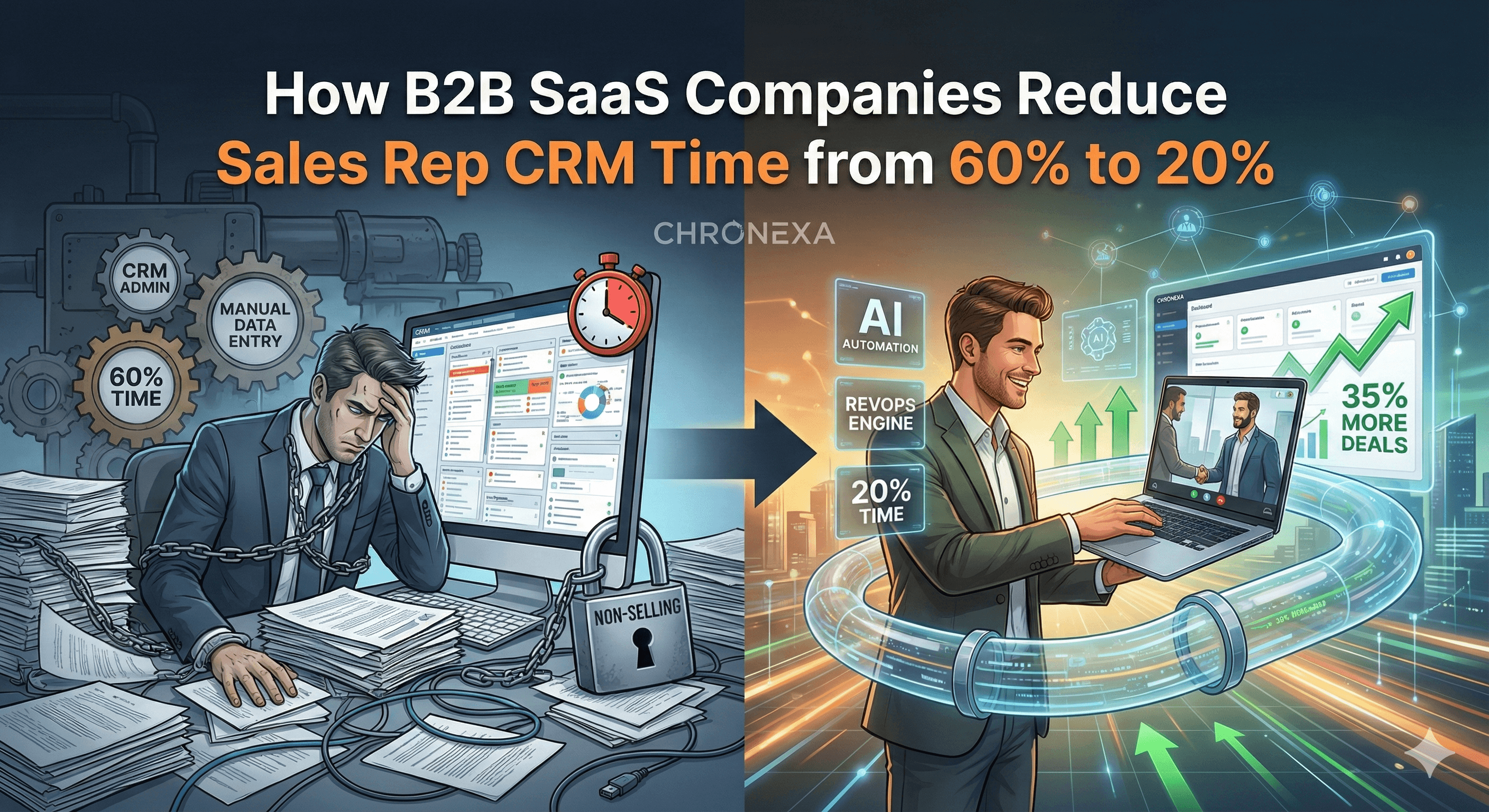
We are seeing forward-thinking revenue leaders flip the script, taking non-selling CRM time down from a crippling 60% to a manageable 20%. Here is the methodology, the math, and the automation architecture behind that shift.
The Math of Mediocrity (The Cost of the 60%)
Before discussing the solution, we must quantify the problem. Many leadership teams accept high administrative loads as the "cost of doing business." It is not. It is revenue leakage.
Let’s look at the "Rep Productivity Math" for a typical Series B US SaaS company:
Rep OTE (On-Target Earnings): $200,000
Annual Quota: $1,000,000 ARR
Total Working Hours/Year: ~2,000 (50 weeks x 40 hours)
Current State: Reps spend ~60% of their time on non-selling, CRM-related admin tasks (1,200 hours).
Selling Time: ~40% (800 hours).
In this scenario, you are paying $120,000 of that rep’s OTE for administrative work. More importantly, you are squeezing a $1M quota into only 800 hours of actual selling effort.
Where the Time Goes: The "Swivel-Chair" Effect
Why is the burden so high? It’s rarely one single task; it’s death by a thousand clicks. It’s the constant "swivel-chairing" between everyday tools (Gmail, Outlook, Slack, Zoom, LinkedIn Sales Navigator) and the system of record (Salesforce/HubSpot).
The friction points are obvious but ignored:
Manual Data Capture: Finishing a Zoom call, opening Salesforce, navigating to the opportunity, typing up notes, and manually updating next steps.
Lead Routing Latency: A hot inbound lead sits in a queue because the round-robin rules in native HubSpot aren't nuanced enough, requiring a manager to manually assign it.
Deal Hygiene & Slippage: Reps "sandbagging" close dates because updating them is tedious, leading to massive forecast inaccuracy at quarter-end.
Context Switching: Finding a relevant case study in Google Drive to attach to an email, then logging that activity in the CRM.
Every time a rep has to leave their workflow to update the CRM, their cognitive flow is broken. They stop being a salesperson and start being a database administrator.
The traditional approach to solving this—"more training" or "stricter enforcement"—fails every time. AEs will always prioritize closing a deal over updating a field.
The only viable solution for scaling SaaS companies is to stop asking reps to feed the CRM and start building systems that feed it for them.
The Paradigm Shift—CRM as an Output, Not an Input
To reduce CRM time from 60% to 20%, leadership must adopt a new philosophy regarding RevOps automation.
The paradigm shift is this: The CRM should be a record of what happened, not the place where work happens.
Reps live in their inbox, on calls, and in Slack/Teams. The goal of automation is to invisibly capture the exhaust data from those activities and structure it perfectly within Salesforce or HubSpot without the rep ever lifting a finger.
This requires moving beyond native integrations (which are often shallow) and utilizing a sophisticated orchestration layer—tools like n8n—combined with generative AI models. This middleware sits between the rep's daily tools and the CRM, handling the heavy lifting of data translation, entry, and logic.
When you achieve this, the CRM transforms from a burden into a true utility. Reps begin to trust the data because they know it’s accurate, and leadership gets the visibility they need without nagging the team.
The Four Pillars of Automated Revenue Operations
How do we practically shave 40% of the workweek off a rep's plate? We focus automation efforts on four high-friction pillars of the sales cycle.
Pillar 1: Zero-Touch Data Capture and Enrichment
The lowest-hanging fruit is eliminating manual logging of activities and contacts.
The Old Way: A rep had a 45-minute discovery call. They hang up, open Salesforce, create a new contact for the prospect's colleague who joined unexpectedly, type up a summary of the call, manually check MEDDIC fields, and create a follow-up task. Time elapsed: 15-20 minutes.
The Automated Way (AI + Orchestration):
The rep hangs up the Zoom call. They do nothing else.
The Workflow:
Trigger: Zoom call ends.
AI Processing: The call recording is immediately sent to a transcription service. An LLM (like GPT-4) analyzes the transcript against your specific sales methodology (e.g., MEDDIC or SPICED). It extracts key metrics, identified pain points, decision-maker status, and agreed-upon next steps.
CRM Update: The orchestration layer (n8n) takes this structured data and pushes it into Salesforce. It updates the Opportunity "Next Steps" field, logs the call activity with the AI summary, and checks off relevant MEDDIC checkboxes.
Enrichment: If a new participant was detected on the calendar invite, the workflow pings a data provider (like Clearbit or ZoomInfo), enriches the contact data, and creates the new Contact record in Salesforce automatically associated with the Account.
Time Saved per Call: 15 minutes. Multiply that by 10-15 calls a week per rep.
Pillar 2: Intelligent Speed-to-Lead and Routing
In B2B SaaS, response time is everything. Yet, leads often sit in limbo due to complex territory rules, enrichment delays, or manual SDR triage.
The Old Way: A demo request comes in. It syncs to HubSpot. It waits for enrichment. An SDR manager reviews it in the morning, realizes it’s an Enterprise target, and manually reassigns it to an AE based on complex vertical territories. Time to first touch: 4–12 hours.
The Automated Way (Orchestration-Led Routing):
The Workflow:
Trigger: Form fill on website.
Instant Enrichment: The workflow instantly pings multiple data sources to determine company size, tech stack, and industry.
Complex Logic: Based on ARR potential and vertical, the automation applies complex routing logic that goes far beyond native CRM capabilities. (e.g., "If FinTech AND >$50M revenue AND West Coast, route to Rep A; if Rep A is out-of-office, route to Rep B").
Instant Handoff: The assigned rep receives a Slack notification immediately with the lead details, the enriched context, and a one-click button to launch a pre-configured outreach sequence in Outreach or Salesloft.
SLA Monitoring: If the lead is not acted upon in 30 minutes, the workflow escalates an alert to the sales manager.
Result: Speed-to-lead drops from hours to seconds, and reps stop fighting over "who gets the lead."
Pillar 3: Deal Hygiene and Slippage Alerts
Pipeline reviews are often painful interrogations because the data in the CRM is stale. Reps push close dates out at the last minute, causing massive forecast variance.
The Old Way: Sales managers chase reps every Friday to update their close dates and next steps. Reps mass-update dates without real justification just to get management off their backs.
The Automated Way (Proactive Deal Defense):
We stop relying on reps to remember to update deals and start using data to force the issue.
The Workflow:
Monitor Inactivity: The automation monitors opportunities in late stages (e.g., "Negotiation"). If there has been no tracked email activity, meetings, or stage progression in 7 days, it triggers an alert.
Rep Nudge: The rep receives a Slack message: "Opportunity 'Acme Corp' closes in 10 days, but there's been no activity in a week. Is this deal slipping?"
One-Click Update: The Slack message contains buttons: "Push Date 30 Days," "Mark Closed-Lost," or "Update Next Steps." The rep clicks a button right in Slack, and the CRM is updated instantly.
Manager Visibility: If the deal "slips" more than twice, the manager is automatically notified to intervene.
This keeps the pipeline pristine in real-time without requiring the rep to navigate Salesforce dozens of times a day.
Pillar 4: Automated Forecasting
Forecasting is usually a mess of spreadsheets outside the CRM because the CRM data isn't trusted.
The Automated Way:
By automating data capture (Pillar 1) and deal hygiene (Pillar 3), the CRM data becomes reliable enough to automate the forecast itself.
We build workflows that snapshot pipeline data weekly, apply AI-driven win-probability scores based on historical performance of similar deals, and generate a weighted forecast automatically delivered to the CRO every Monday morning. Reps submit their "commit" numbers via a simple Slack input, rather than complex spreadsheet jockeying.
Section 4: The Business Case—Results and ROI
Transitioning to an automated RevOps infrastructure is a significant undertaking, but the ROI for Series A-C SaaS companies is undeniable.
When you successfully reduce non-selling time from 60% to 20%, you effectively double the sales capacity of your existing team without hiring a single new AE.
The "After" Math
Let’s revisit our Series B SaaS example:
Rep OTE: $200,000
Total Hours: 2,000
Previous Selling Time: 800 hours (40%)
New Selling Time: 1,600 hours (80%)
You have just handed each rep an additional 800 hours per year to prospect, run demos, and multi-thread deals.
Typical Results Profile:
Based on deployments of this architecture in mid-market SaaS organizations, we typically see:
35% increase in closed-won deal volume per ramped rep.
20% decrease in sales cycle length due to faster routing and better deal momentum.
Significant improvement in rep morale and retention, as they are relieved of administrative drudgery.
The Investment Profile
This level of automation does not happen via out-of-the-box Zapier connections. It requires a dedicated data architecture approach, treating RevOps as an engineering discipline.
For a typical Series B SaaS company ($20M-$50M ARR) running Salesforce/HubSpot and a standard sales stack (Outreach, ZoomInfo, etc.), the investment to build this "invisible CRM" infrastructure typically looks like this:
One-Time Architecture & Implementation Fee: $95,000. This covers deep process mapping, data schema design, building the complex orchestration workflows (n8n), configuring AI models, and rigorous UAT.
Ongoing Managed Infrastructure: $3,200 / month. Automation is never "set it and forget it." APIs change, processes evolve, and AI models need tuning. This covers the infrastructure costs, monitoring, and proactive optimization of the workflows.
The ROI Calculation:
If you have a team of 10 AEs with $1M quotas, a 35% lift in closed-won deals represents $3.5 Million in incremental ARR.
Compared to a first-year investment of roughly $133,400 ($95k + 12x $3.2k), the ROI is massive and immediate.
Furthermore, consider the alternative: To get that same increase in sales capacity through hiring, you would need to hire, onboard, and ramp 3-4 new AEs, costing well over $1 Million in salaries, benefits, and CAC before they become productive.
Conclusion: Stop Feeding the Beast
In the current efficiency-obsessed SaaS environment, you cannot afford to have your highest-paid individual contributors acting as expensive data entry clerks.
The traditional view of the CRM as a mandate for reps is obsolete. The modern view is the CRM as a utility that serves the rep.
By embracing deep CRM automation and reducing administrative overhead from 60% to 20%, you do more than just clean up your data. You unleash the full revenue potential of the team you have already built. It’s time to stop feeding the CRM beast and start letting your reps hunt.
Building B2B SaaS? Your RevOps stack shouldn't require a human to run.
Chronexa helps SaaS founders automate CRM hygiene, onboarding sequences, churn signals, and sales ops workflows — so your revenue engine runs without the headcount.
Book a Free 30-Minute Strategy Call →
Written by Ankit Dhiman — Founder & CEO at Chronexa. Ankit leads a lean team of n8n automation engineers building production-grade AI workflows for mid-market B2B companies across fintech, legal, SaaS, and operations. Book a free 30-minute strategy call to see what's possible for your team.
Related Articles
About author
Ankit is the brains behind bold business roadmaps. He loves turning “half-baked” ideas into fully baked success stories (preferably with extra sprinkles). When he’s not sketching growth plans, you’ll find him trying out quirky coffee shops or quoting lines from 90s sitcoms.

Ankit Dhiman
Head of Strategy
Subscribe to our newsletter
Sign up to get the most recent blog articles in your email every week.