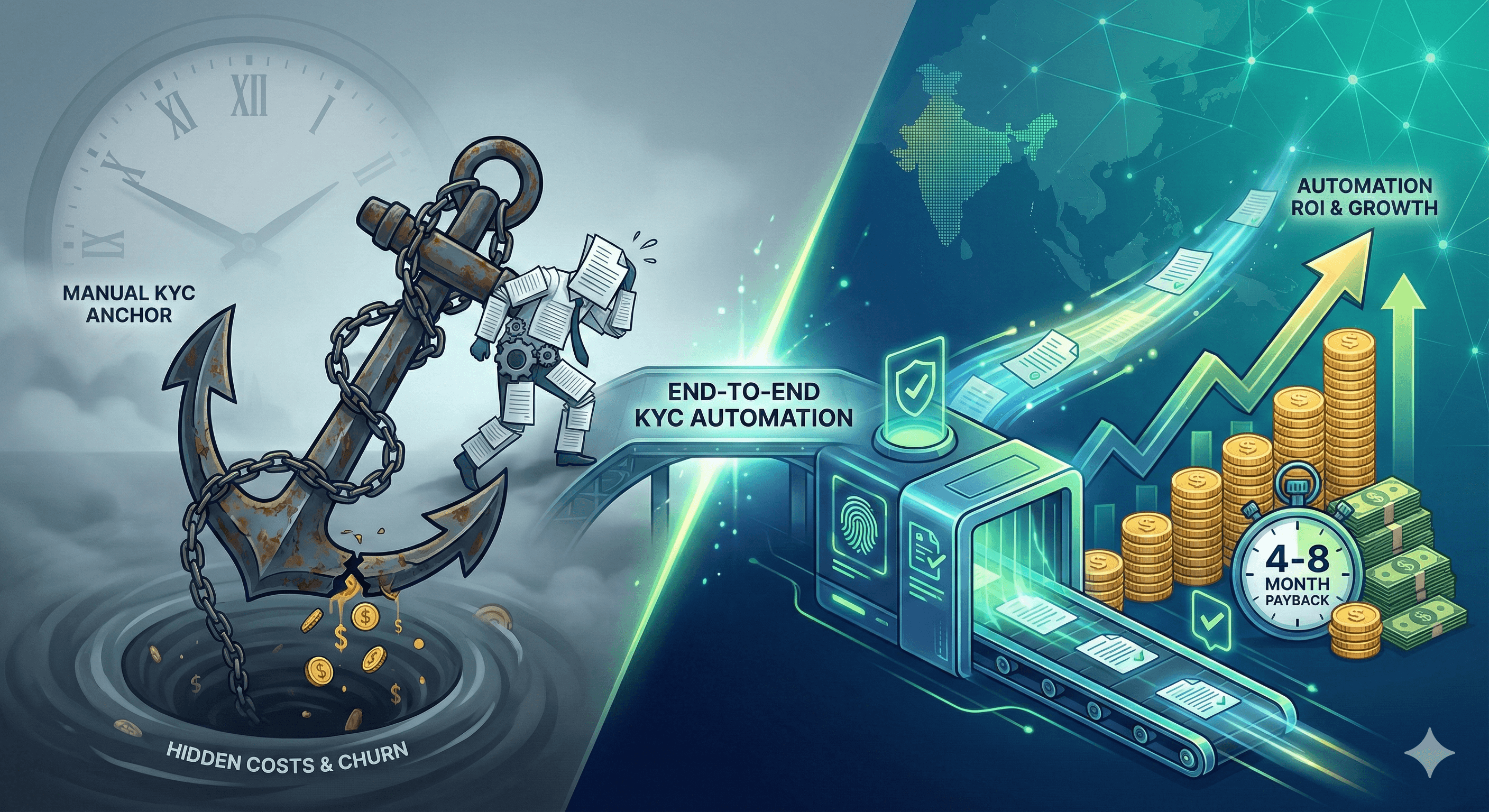
For Series B and C fintech companies scaling rapidly, manual KYC is an operational anchor. If you are processing over 500 KYC requests monthly, manual methods are likely bleeding capital through hidden operational costs and lost revenue.
Based on data from mid-sized fintechs in India and SE Asia, implementing end-to-end KYC automation typically yields ₹1.5 Cr to ₹5 Cr in annual savings, with a payback period on initial investment ranging between 4 to 8 months.
Below, we break down the true cost formula, provide a detailed example scenario, and offer a framework to calculate your own ROI.
Why Fintech KYC Costs Are Hidden
If you ask most fintech Operations VPs what their cost per KYC is, they will usually quote the direct cost of the verification API plus a fraction of an analyst's salary—perhaps ₹500 to ₹1,000.
If you ask the CFO, the number is often closer to ₹5,000 per customer.
Why the discrepancy? Operational leaders see the invoice cost. CFOs see the total cost of ownership (TCO) and the opportunity cost. When a KYC process takes 14 days, the cost isn't just the 30 minutes an analyst spends reviewing documents; it includes:
The Churn Tax: The 35-40% of customers who abandon sign-up during the two-week wait. You paid the Customer Acquisition Cost (CAC) for them, but got zero Lifetime Value (LTV).
Compliance Overhead: The salaries of highly skilled compliance officers who spend 60% of their day on data entry instead of strategic risk analysis.
Audit Panic: The hundreds of man-hours spent quarterly frantically gathering data for RBI or SEBI audits because records aren't centralized.
The Growth Ceiling: The inability to launch a new product line because your current operations team physically cannot handle more volume without hiring 20 more people.
Automation isn't just about buying a faster API; it's about removing the operational drag on your unit economics.
The True Cost Formula
To calculate the real ROI of KYC automation, you must first establish your current "True Cost." We use the following formula when auditing prospective clients:
Total Annual KYC Cost = (Direct Costs + Indirect Costs + Opportunity Costs) × Monthly Volume × 12
1. Direct Costs (The Visible Spend)
These are the easiest to track but often the smallest piece of the pie.
Compliance Staff Salaries: Average fully loaded cost of ₹8L–₹15L annually per FTE in India.
Point Solution Tools: Fragmented costs for OCR APIs, individual database checks (credit bureaus, watchlists), and manual verification services (₹50K–₹2L annually).
Physical/Legacy Storage: Costs associated with secure physical document storage or legacy on-premise servers (₹1L–₹2L annually).
2. Indirect Costs (The Hidden Bleed)
These costs do not appear on a single invoice but significantly impact the P&L.
Customer Acquisition Waste: If your CAC is ₹3,000 and 40% of users drop off during KYC, your effective CAC is significantly higher. Automation reclaims this lost marketing spend.
Error Remediation: Manual processes have high error rates. Rectifying a compliance failure or a false positive can cost ₹50K–₹3L in man-hours per incident.
Audit Preparation: Compliance teams often spend 80-120 hours per quarter preparing for audits. That is ₹2L–₹4L of salary cost annually just for data gathering.
3. Opportunity Costs (The Strategic Loss)
Misallocated Talent: Smart compliance officers doing manual document review instead of fraud investigation or policy strategy.
Delayed Revenue: Sales teams waiting 14 days for approval means 14 days of delayed revenue recognition.
Product Stagnation: Product launches delayed by months because operations cannot guarantee support capacity.
ROI Calculation Example: The 500 KYC/Month Fintech
Let’s apply this formula to a hypothetical Series B lending platform scaling up in India.
Current State (Manual Operations)
Monthly KYC Volume: 500 completed onboarding requests.
Compliance Team: 8 FTE dedicated to KYC (gathering, reviewing, back-and-forth emails).
Average Salary: ₹12L annually (fully loaded).
Processing Time: 14 days average from submission to approval.
Customer Drop-off Rate: 38% during the 14-day wait.
Calculated True Cost per KYC: ~₹5,200.
Total Annual Manual Cost: ₹3.12 Crores
Future State (After End-to-End Automation)
We implement an automated workflow using n8n, AI document processing, and real-time API integrations (DigiLocker, etc.).
Monthly KYC Volume: 500 (volume remains consistent for comparison).
Compliance Team: 3 FTE required for handling exceptions and final approvals. (5 FTE are redeployed to fraud analysis and risk strategy).
Processing Time: 2 days (80% cleared in minutes, 20% exceptions take up to 48 hours).
Customer Drop-off Rate: Drops to 9% due to faster turnaround.
New Cost per KYC: ~₹520 (primarily API costs and reduced labor allocation).
Total Annual Automated Cost (Opex): ₹67 Lakhs
The ROI Math
Gross Annual Savings: ₹3.12 Cr - ₹67 L = ₹2.45 Crores
Automation Investment (Capex/Opex): ₹11L one-time setup + ₹14L estimated annual API/infrastructure costs = ₹25 Lakhs Year 1 Cost.
Net Savings (Year 1): ₹2.45 Cr - ₹25 L = ₹2.20 Crores
Payback Period: (₹25L Investment / ₹2.45Cr Annual Savings) × 12 = 5.4 Months
In less than two quarters, the investment pays for itself, adding over ₹2 Crores to the bottom line in the first year.
Interactive ROI Calculator Framework
While we cannot embed a calculator in this blog post, you can use the framework below with your own numbers to get a preliminary estimate.
Step 1: Input Your Baseline Data
Monthly KYC Volume: [ e.g., 750 ]
Current True Cost per KYC: ₹[ e.g., 5000 ] (If unknown, use ₹5,000 as a Series B conservative average)
Size of Dedicated Compliance Team: [ e.g., 12 ] FTEs
Average Fully Loaded Salary per FTE: ₹[ e.g., 10,00,000 ] annually
Current Average Processing Time: [ e.g., 10 ] days
Estimated Customer Drop-off Rate: [ e.g., 35 ] % during KYC
Step 2: Estimated Outputs (Based on Chronexa Benchmarks)
Current Estimated Annual Spend: ₹[ (Volume x Cost x 12) ]
Projected Post-Automation Annual Spend: ₹[ (~10-15% of Current Spend) ]
Estimated Annual Savings: ₹[ (Current - Projected) ]
Estimated Automation Investment (Year 1): ₹[ Typically ₹20L - ₹40L depending on complexity ]
Estimated Payback Period: [ Typically 4-8 Months ]
ROI by Volume Tier: The Economy of Scale
Automation ROI is highly elastic relative to volume. The high fixed costs of setting up the infrastructure pay off exponentially as volume increases.
Monthly KYC Volume | Estimated Annual Savings | Typical Payback Period | 3-Year Estimated ROI |
200 - 400 | ₹80 Lakhs – ₹1.5 Cr | 8 – 10 Months | ~420% |
400 - 800 | ₹1.5 Cr – ₹2.8 Cr | 5 – 7 Months | ~680% |
800 - 1500 | ₹2.8 Cr – ₹5 Cr | 4 – 5 Months | ~920% |
1500+ | ₹5 Crores+ | 3 – 4 Months | 1200%+ |
Note: 3-Year ROI includes ongoing maintenance and API costs but assumes stable volume.
Hidden Benefits Not in the ROI Calculator
The spreadsheet doesn't capture everything. The qualitative benefits of automation often outweigh the immediate cost savings for C-suite executives looking at long-term strategy.
Scalability Without Headcount: You can handle 10x the volume next month without needing to hire, train, and manage 10x the compliance staff.
Regulatory Confidence: Automated workflows create immutable audit trails. Passing RBI/SEBI inspections becomes a matter of exporting logs, not weeks of panic.
Improved Customer Experience (NPS): Moving from a 14-day wait to a 2-day turnaround significantly boosts Net Promoter Score and encourages word-of-mouth referrals.
Team Morale & Retention: Skilled compliance professionals burn out quickly when doing data entry. Redeploying them to strategic risk work improves retention of valuable institutional knowledge.
Faster Time-to-Market: Operations is no longer the bottleneck for launching new financial products or entering new geographies.
When ROI Doesn't Justify Automation
To be transparent, automation is not the correct strategy for every fintech at every stage.
Low Volume (<100 KYC/month): At Seed stage, the setup cost of enterprise-grade automation likely outweighs the labor savings. Manual processes are often faster and cheaper here.
Volatile Processes: If your KYC requirements change fundamentally every week due to product pivots, the cost of constantly re-engineering the automation will kill the ROI. Stabilize the process first.
Complex Corporate KYC: High-value B2B onboarding involving multi-layered corporate structures and beneficial ownership investigations often requires human judgment that current AI cannot reliably replicate.
Ultra-High-Touch Models: If your value proposition is white-glove concierge service for HNWIs, automated chatbots and forms may degrade the perceived value.
Real ROI Examples
Example 1: Series B Digital Lending Platform (350 KYC/Month)
A lender struggling with a 3-week onboarding backlog.
Total Investment (Year 1): ₹22 Lakhs
Annual Savings Realized: ₹1.2 Crores
Payback Period: 7.5 Months
Hidden Benefit: The operational agility allowed them to launch two new credit products 8 weeks ahead of schedule.
Example 2: Series C Payment Gateway (1,200 KYC/Month)
A high-volume processor facing massive compliance team churn due to repetitive work.
Total Investment (Year 1): ₹35 Lakhs
Annual Savings Realized: ₹4.8 Crores
Payback Period: ~4 Months
Hidden Benefit: Compliance team attrition rate dropped from 40% to 12% within one year as roles became more strategic.
Beyond Cost: Strategic Value for the CFO
For the CFO of a scaling fintech, KYC automation transcends simple cost-cutting. It is a strategic initiative that impacts valuation.
It demonstrates operational maturity to Series C investors. It provides the agility to react to new RBI guidelines in days rather than months. It turns compliance from a cost center into a scalable infrastructure layer that supports rapid growth.
Calculate Your Exact ROI
Estimates are useful, but your business requires specific data.
Book a 30-Minute ROI Consultation
In this session, we will plug your actual volume, cost, and headcount data into our detailed financial model to provide:
Your exact projected annual savings.
A month-by-month payback schedule.
Quantification of your current "hidden costs."
A realistic implementation timeline based on your tech stack.
Written by Ankit Dhiman — Founder & CEO at Chronexa. Ankit leads a lean team of n8n automation engineers building production-grade AI workflows for mid-market B2B companies across fintech, legal, SaaS, and operations. Book a free 30-minute strategy call to see what's possible for your team.
Related Articles
About author
Ankit is the brains behind bold business roadmaps. He loves turning “half-baked” ideas into fully baked success stories (preferably with extra sprinkles). When he’s not sketching growth plans, you’ll find him trying out quirky coffee shops or quoting lines from 90s sitcoms.

Ankit Dhiman
Head of Strategy
Subscribe to our newsletter
Sign up to get the most recent blog articles in your email every week.