The New Operational Standard: Speed is Survival
For D2C operations managers in the US market, the benchmark has moved. The "Amazon Effect" isn't just a buzzword; it’s a baseline consumer expectation. Your customers assume that if they click "buy" before noon on a Tuesday, that package is moving across a warehouse floor before the end of the day.
Yet, for many mid-market D2C brands ($10M - $100M revenue), the reality inside the "black box" of fulfillment is drastically different.
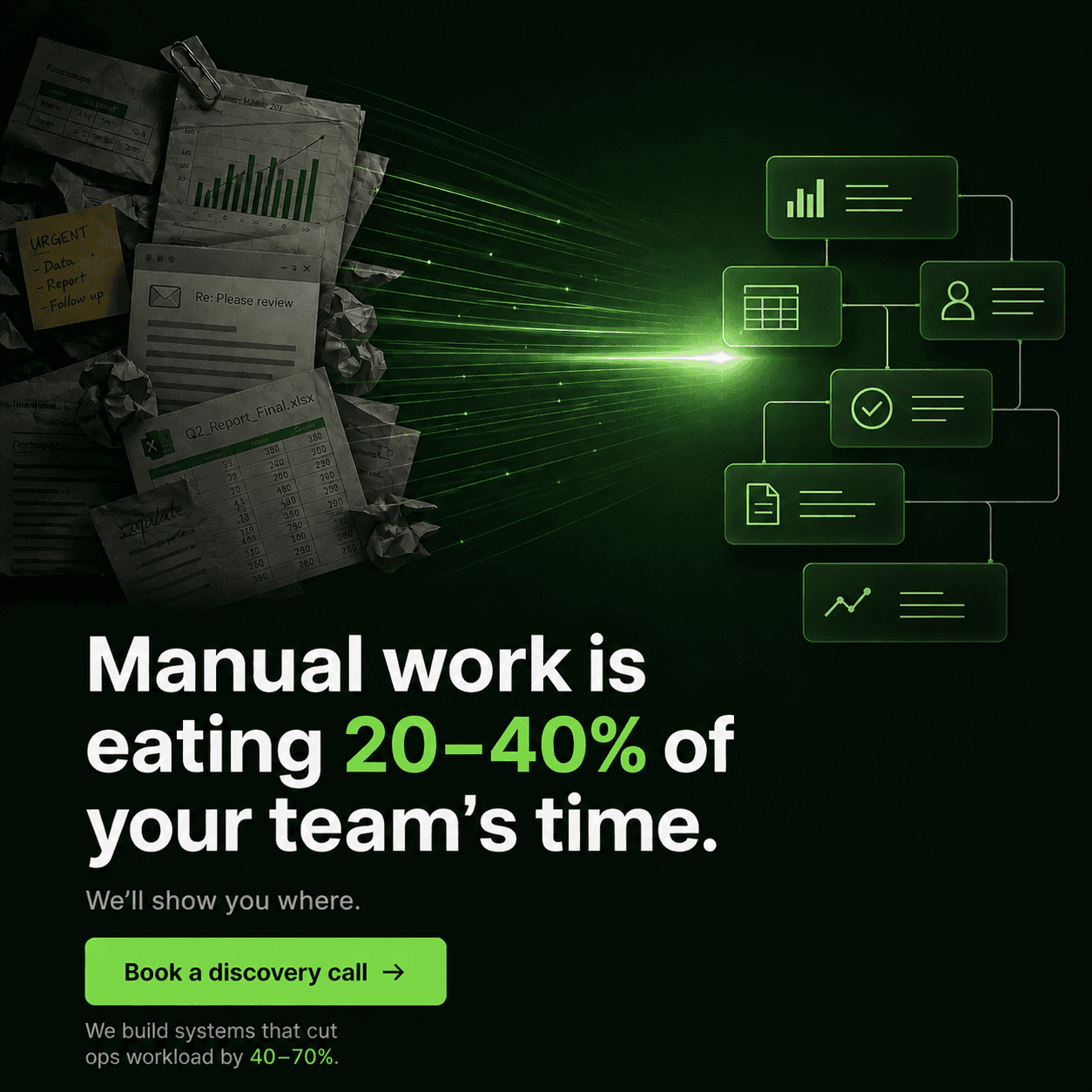
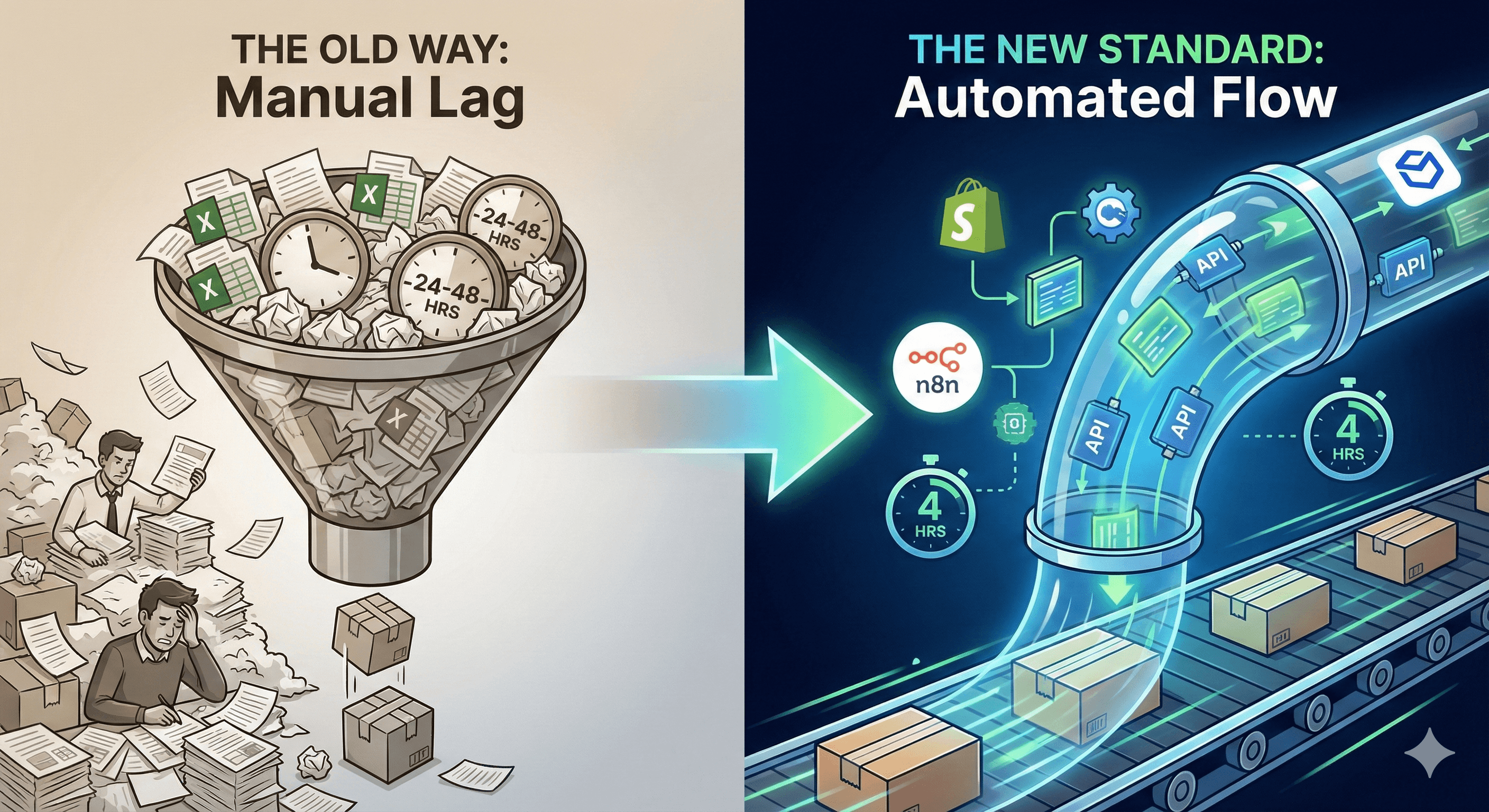
The front end—your Shopify Plus store, your sleek ad campaigns—runs at the speed of light. But the moment an order is placed, it hits an analog wall. The process shifts from digital speed to manual drag. Orders sit in a queue waiting for a batch export. CSV files are downloaded, manipulated in Excel to check inventory across multiple locations, and then manually uploaded to a 3PL portal or shipping software like ShipStation.
This "hidden factory" of manual steps introduces massive latency. It turns what should be a near-instantaneous data handoff into a 24 to 48-hour lag before a shipping label is even generated.
In the current US e-commerce landscape, a 48-hour fulfillment window is a competitive disadvantage. It increases "Where Is My Order" (WISMO) ticket volume, decreases customer lifetime value, and leaves you vulnerable to faster competitors.
The goal for modern D2C operations is clear: compress the time between "Order Placed" and "Label Generated" down to four hours or less, regardless of volume spikes.
This is achieved not by hiring more warehouse staff to type faster, but by implementing end-to-end D2C order fulfillment automation.
The Anatomy of the 48-Hour Lag (The Problem)
To fix the bottleneck, we must first dissect it. Why does it take two days to put a product in a box?
For many growing brands, the fulfillment tech stack is a patchwork of platforms that don't speak the same language fluently. You have Shopify for orders, maybe Netsuite for ERP, a WMS (Warehouse Management System) at your 3PL (like ShipBob or a regional partner), and carrier APIs for USPS/UPS/FedEx.
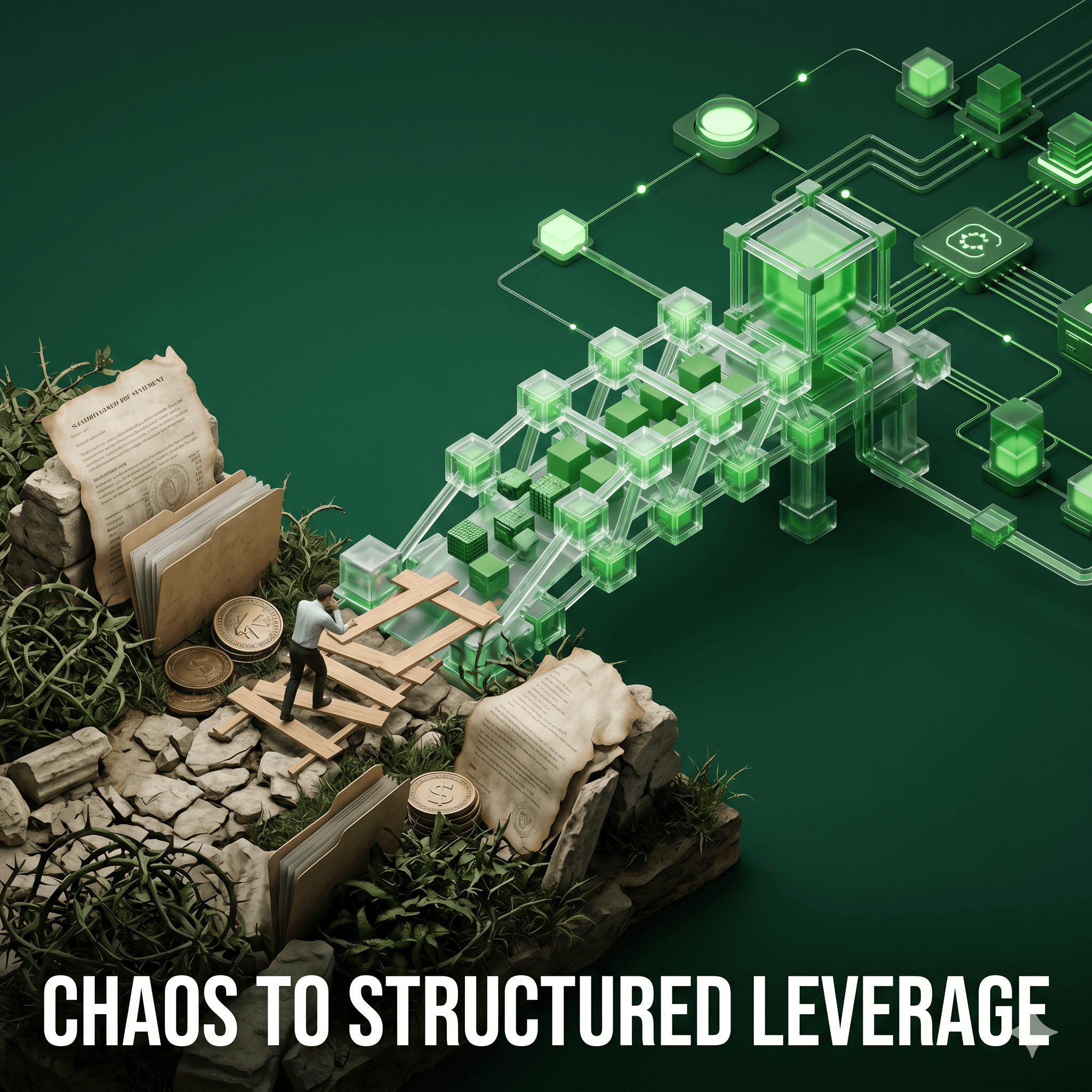
Without an orchestration layer, humans become the middleware.
The Typical Manual Workflow:
The Accumulation Phase (0-12 Hours): Orders accumulate in Shopify throughout the day. To be efficient, the ops team waits until a cutoff time (e.g., 1:00 PM EST) to process them in a single batch. An order placed at 2:00 PM waits until tomorrow.
The Manual Data Scrub (12-16 Hours): An Operations Associate downloads the day's orders into a CSV. They manually review for high-risk fraud flags that Shopify missed. They check addresses that look incomplete.
The Routing Headache (16-20 Hours): If you use a hybrid model (e.g., an East Coast 3PL and a West Coast 3PL), someone has to look at the shipping address on the spreadsheet and manually assign that order to the correct warehouse to minimize USPS zones and shipping costs.
The Handoff and Wait (20-48 Hours): The cleaned CSVs are uploaded to the 3PL's portal. The 3PL receives the batch, queues it for their pick-and-pack shifts the next morning, and eventually prints labels.
The Cost of Manual Intervention
Beyond speed, this manual process is a breeding ground for expensive errors.
Address Errors: A human eye missing a typo in a street address leads to failed delivery, return shipping costs, and a replacement shipment.
Inventory Mismatches: If Shopify says stock exists but the 3PL is actually out, the manual batch process might not catch it until the pick-and-pack phase days later, leading to overselling.
Incorrect Routing: Sending a package from your New Jersey warehouse to Seattle when you had stock in your Nevada warehouse eats into margins dramatically on carrier fees.
The manual process is unscalable. When Black Friday hits and volume 10x's, your fulfillment time doesn't just slow down; it breaks completely.
The Blueprint: The 4-Hour Automated Fulfillment Engine
Moving from a 48-hour cycle to a 4-hour cycle requires a fundamental shift from batch processing to event-driven automation.
In an automated architecture, we utilize an orchestration layer (often built on powerful iPaaS tools like n8n or Workato) that acts as the central nervous system, connecting your sales channels directly to your logistics execution systems in real-time.
Here is how the optimized, 4-hour workflow operates.
Step 1: Instant Order Capture and Validation (Time: T+ 0:01)
The moment an order is marked "Paid" in Shopify, a webhook immediately triggers the automation workflow. There is no waiting for a batch.
Before the order is routed anywhere, the system runs instantaneous automated checks:
Address Validation: The shipping address is pinged against an API (like SmartyStreets or USPS API) to verify deliverability and correct minor formatting errors automatically. If it fails validation, it is immediately flagged for human review (see "Exception Handling" below).
Fraud Scoring: High-value orders are run through a secondary fraud check API.
Inventory Allocation: The system checks real-time inventory levels across all defined locations to ensure the items are physically available to pick.
Step 2: Intelligent Order Routing Logic (Time: T+ 0:05)
This is the most critical component for multi-node D2C brands. You cannot rely on a human to decide which warehouse ships the order.
The automation applies predefined business logic to route the order to the optimal Fulfillment Center (FC):
Logic Rule A (Geo-Routing): If the shipping zip code is Zone 1-4 for the West Coast FC, route there. If Zone 1-4 for the East Coast FC, route there.
Logic Rule B (Inventory Availability): If the optimal geo-FC is out of stock of an item, automatically reroute to the backup FC that has inventory, even if shipping costs are slightly higher (prioritizing fulfillment speed over lowest cost).
Logic Rule C (Split Shipments): If a single order contains Item A (in stock only at West Coast FC) and Item B (in stock only at East Coast FC), the automation can automatically split the Shopify order into two child orders and route them independently.
Step 3: WMS Injection and Rate Shopping (Time: T+ 0:10)
Once routed, the automation transforms the order data into the exact JSON format required by the receiving WMS's API (whether that is ShipBob, a bespoke 3PL system, or ShipStation for internal warehouses).
The order is injected directly into the pick queue. Simultaneous to this injection, the system performs real-time rate shopping against carrier APIs (UPS, FedEx, USPS, DHL). Based on the promised delivery window (e.g., "Free 5-7 Day Shipping" vs. "Paid 2-Day Express"), the automation selects the cheapest carrier service that meets the SLA.
Step 4: The Feedback Loop—Tracking Write-Back (Time: T+ 4:00)
The warehouse floor team picks, packs, and scans the item. A shipping label is generated.
Crucially, the automation doesn't stop here. It listens for the "Shipped" event from the WMS or shipping software. As soon as that tracking number is generated, the automation:
Captures the tracking number and carrier.
Connects back to Shopify via API.
Marks the original order as "Fulfilled."
Injects the tracking information.
Triggers Shopify's native "Your Order Has Shipped" email to the customer.
This entire cycle, from customer click to tracking email, occurs without a single manual file export or human decision.
Visualizing the Automated Flow
To understand the difference, visualize the data path of an order in the new system.
[Visual Diagram Description: The Automated Order Highway]
A flow chart showing data movement from left to right.
Far Left Block: "Sales Channel (Shopify)" -> An arrow labeled "Webhook (Order Paid)" points right.
Middle Block: "Automation Orchestration Layer (The Brain)" -> This large central block contains three internal process sub-blocks:
Sub-block 1: "Validation & Fraud Check API"
Sub-block 2: "Inventory Check & Logic-Based Routing"
Sub-block 3: "Carrier Rate Shopping API (USPS/UPS/FedEx)"
Right Side Blocks (Branching): Two arrows lead from the central block to two different destinations representing fulfillment nodes:
Top Right Block: "West Coast 3PL WMS (API Injection)"
Bottom Right Block: "East Coast Internal Warehouse (ShipStation API)"
Feedback Loop Arrow: Curved arrows lead from both "WMS" blocks back to the "Shopify" block on the far left, labeled "Tracking Number Write-Back & Status Update."
Exception Management: When Things Go Wrong
Experienced operations managers know that 100% automation is a myth. Things break. Addresses are undeliverable; inventory counts are off.
A robust D2C shipping automation system isn't defined just by its happy path, but by how it handles exceptions without clogging the pipes.
We build "quarantine" workflows for failed orders.
The Automated Exception Workflow:
If an order fails address validation, or if an item shows in-stock on Shopify but the WMS API rejects the order due to a sudden stock-out (a race condition), the order does NOT just disappear.
The automation flags the order in Shopify with a specific tag, such as "Error: Address Invalid" or "Error: WMS Sync Failure."
It automatically sends an alert to a dedicated Slack channel for the CX or Ops team (e.g.,
#shipping-exceptions).The order sits in a holding state, preventing it from being lost, until a human reviews and resolves the specific issue.
This ensures that only problematic orders require human touch, while 95%+ of orders flow through untouched.
Beyond the Label: Returns and Post-Purchase
Fulfillment doesn't end when the box leaves the dock. In the US market, an easy return process is as critical as fast shipping.
Your fulfillment automation must integrate with your returns management platform (e.g., Loop Returns or AfterShip).
When a customer initiates a return, the automation should:
Auto-generate the USPS/UPS return label.
Notify the 3PL WMS to expect an incoming RMA (Return Merchandise Authorization).
Once received and scanned at the warehouse, trigger the refund or store credit process back in Shopify.
Closing this loop automatically drastically reduces ticket volume for the CX team.
The Investment: The ROI of Speed
Transitioning from manual processing to a fully automated event-driven architecture is an infrastructure investment.
For a typical D2C brand doing $20M-$50M in revenue with moderate complexity (e.g., Shopify Plus, two fulfillment nodes, 500+ SKUs), the investment looks like this:
One-Time Setup & Architecture Fee: $52,000. This covers the deep audit of current processes, API mapping between all platforms, building the custom routing logic, configuring exception handling, and rigorous end-to-end testing before go-live.
Ongoing Infrastructure & Monitoring: $1,500 / month. This covers the server costs for the orchestration layer, API call volume, and ongoing monitoring to ensure 99.9% uptime and rapid fixes if a third-party API changes.
The Return on Investment:
The ROI is realized through three primary drivers:
Labor Reduction: Reallocating 1-2 full-time operations staff from manual CSV shuffling to higher-value supply chain tasks.
Error Reduction (85%): Drastically cutting the costs associated with reshipping misaddressed orders or handling oversold inventory apologies.
Increased LTV: The hardest to quantify but most impactful. Customers who receive their tracking number in 4 hours buy again. Customers who wait 48 hours do not.
Speed is an Operational Asset
In the current US D2C landscape, you cannot compete on product alone. Operations is a key differentiator.
If your fulfillment process relies on humans moving data between systems, you have built a ceiling on your growth. By implementing true 3PL integration and order automation, you turn fulfillment from a bottleneck into a scalable, competitive advantage.
Four hours from "click" to "ship" is not a pipe dream; it is the standard for modern D2C operations.
About author
Ankit is the brains behind bold business roadmaps. He loves turning “half-baked” ideas into fully baked success stories (preferably with extra sprinkles). When he’s not sketching growth plans, you’ll find him trying out quirky coffee shops or quoting lines from 90s sitcoms.

Ankit Dhiman
Head of Strategy
Subscribe to our newsletter
Sign up to get the most recent blog articles in your email every week.