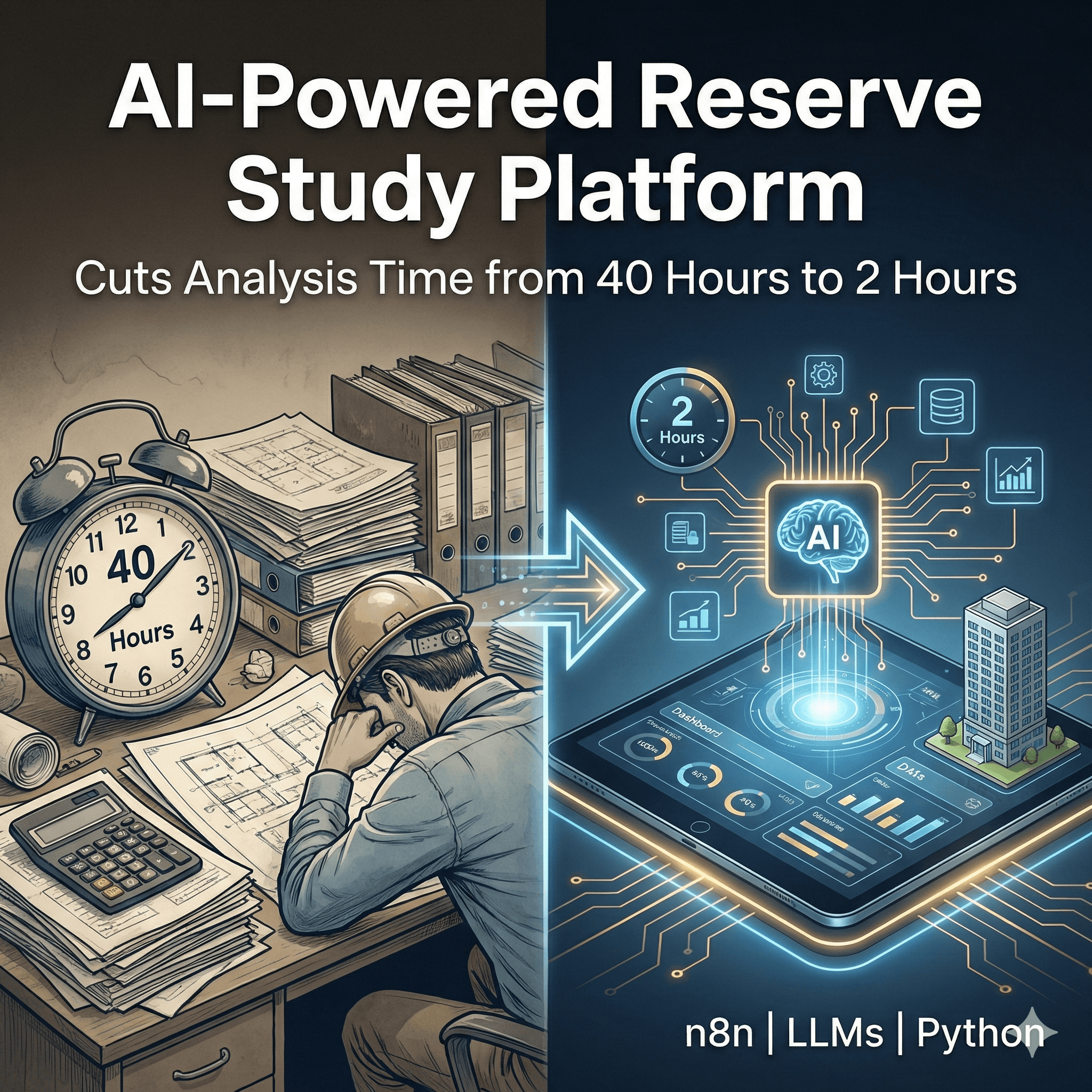
How We Built an AI-Powered Reserve Study Platform That Cuts Analysis Time from 40 Hours to 2 Hours
For Homeowners Associations (HOAs) and property managers, a "Reserve Study" is a high-stakes financial roadmap. It predicts when the roof will fail, when the pool needs resurfacing, and exactly how much money needs to be in the bank to pay for it over the next 30 years. Historically, these reports were handcrafted by engineers over several weeks.
At Chronexa, we partnered with a leading provider to transform this manual marathon into a high-speed automated sprint. By combining n8n orchestration, multi-modal LLMs, and deterministic financial modeling, we built a platform that maintains 98% accuracy while reducing the labor floor by 95%.
The Problem: The 40-Hour Manual Grind
Manual Reserve Study Process
Before our intervention, the workflow was a bottleneck of human labor:
Data Ingestion: Sifting through hundreds of messy PDFs, contractor invoices, and site photos.
Inventory Building: Manually listing every component (roofs, elevators, HVAC) and estimating their age and condition.
Financial Modeling: Calculating depreciation and 30-year funding plans in complex, error-prone spreadsheets.
Reporting: Writing a 40+ page compliance-heavy document.
Total Time: 40–60 hours per study.
Why Automation is Hard
This isn't a simple data entry task. It requires:
Unstructured Data Processing: Handling everything from 1980s blueprints to blurry smartphone photos of a boiler plate.
Domain Expertise: Distinguishing between different types of construction materials.
Zero-Margin for Error: These are legal documents; a math error could bankrupt an HOA's capital fund.
Our Solution Architecture: AI + Deterministic Logic
We didn't just "throw GPT at it." We built a multi-stage pipeline that uses AI where it excels (interpretation) and Python where it excels (math).
The Technical Stack
Orchestrator: n8n (for visual, auditable workflow logic)
Intelligence: OpenAI GPT-4o (document analysis and entity extraction)
Vision: Google Vision API + Tesseract (OCR for complex/faded text)
Math Engine: Custom Python scripts (deterministic financial projections)
Database: PostgreSQL (storing component histories and cost benchmarks)
UI: React-based "Human-in-the-Loop" dashboard
Workflow Breakdown
Stage 1: Intelligent Ingestion
The n8n webhook receives a bulk upload. The first AI agent acts as a "triage nurse," classifying files into categories (Invoices, Prior Studies, Site Photos). We use Google Vision API for high-resolution OCR on scanned blueprints, extracting raw text and layout data.
Stage 2: Structured Data Extraction
We feed the OCR text into GPT-4 with a highly specific system prompt: "Extract building components, age, and current condition. Output as a JSON schema."
Entity Recognition: The system identifies a "Trane 5-ton HVAC" and automatically looks up its expected useful life in our internal database.
Confidence Scoring: Every extraction is assigned a score. If the AI is unsure if a roof is "Good" or "Fair," it flags the item for the next stage.
Stage 3: The Deterministic Financial Engine
We made a conscious choice not to let the AI do the math. AI is probabilistic; finance must be deterministic.
A Python script takes the structured JSON and calculates:
Remaining Useful Life (RUL)
Future Replacement Cost (adjusted for regional inflation indices)
Recommended Monthly Contributions to reach "Fully Funded" status.
Stage 4: Human-in-the-Loop (HITL) Review
This is the "secret sauce." The data is presented in a React dashboard. High-confidence items are pre-approved; low-confidence items (flagged in red) require an expert to verify. An expert now spends 10 minutes reviewing the AI's work rather than 10 hours doing it from scratch.
Technical Challenges & Solutions
Challenge 1: OCR Accuracy on "Vintage" Documents
Problem: 1970s faded blueprints were unreadable by standard OCR.
Solution: We implemented a hybrid approach. We used image preprocessing (contrast enhancement/noise reduction) before passing the file to both Tesseract and Google Vision, using an AI consensus model to determine the most likely text.
Challenge 2: Domain Knowledge Gaps
Problem: Generic GPT-4 didn't know the specific cost difference between a "TPO" and "Modified Bitumen" roof in the Florida market.
Solution: We built a custom RAG (Retrieval-Augmented Generation) system. When the AI encounters a component, it queries our "Cost Benchmarking Database" to pull real-world local pricing before making a suggestion.
Results: Redefining the Bottom Line
The implementation transformed the client’s business model from a service-based agency to a tech-enabled platform.
Time per Study: 40 hours → 2 hours (95% reduction)
Cost per Study: $1,200 → **$120** (direct labor savings)
Accuracy: 98.2% (verified against historical manual studies)
Throughput: The team scaled from 5 studies/month to 50+ studies/month without adding headcount.
Technical Lessons for AI Builders
AI for Unstructured, Python for Structured: Use LLMs to "read" the mess, but use code to "calculate" the results. Never let an LLM do multi-step financial arithmetic.
Human-in-the-Loop is the Goal: In regulated industries, "100% automation" is a fantasy that leads to liability. Aim for "90% automated, 100% verified."
Surface the Uncertainty: Don't hide the AI's "Confidence Score." Show it to the user so they know where to focus their attention.
Tech Stack Code Snippet
Here is a simplified look at how our n8n node structures the request to the extraction engine:
JavaScript
Does your property management or fintech firm struggle with manual data bottlenecks?
At Chronexa, we specialize in building "Human-in-the-loop" systems that solve the 80% of work that burns your team's time.
Book a live demo with Chronexa to see how we can automate your specific workflow.
Would you like me to create a technical breakdown of how we handled the Python financial engine for
About author
Ankit is the brains behind bold business roadmaps. He loves turning “half-baked” ideas into fully baked success stories (preferably with extra sprinkles). When he’s not sketching growth plans, you’ll find him trying out quirky coffee shops or quoting lines from 90s sitcoms.

Ankit Dhiman
Head of Strategy
Subscribe to our newsletter
Sign up to get the most recent blog articles in your email every week.