B2B SaaS Lead Scoring: The AI Formula, Calculation Methodology & Implementation Cost
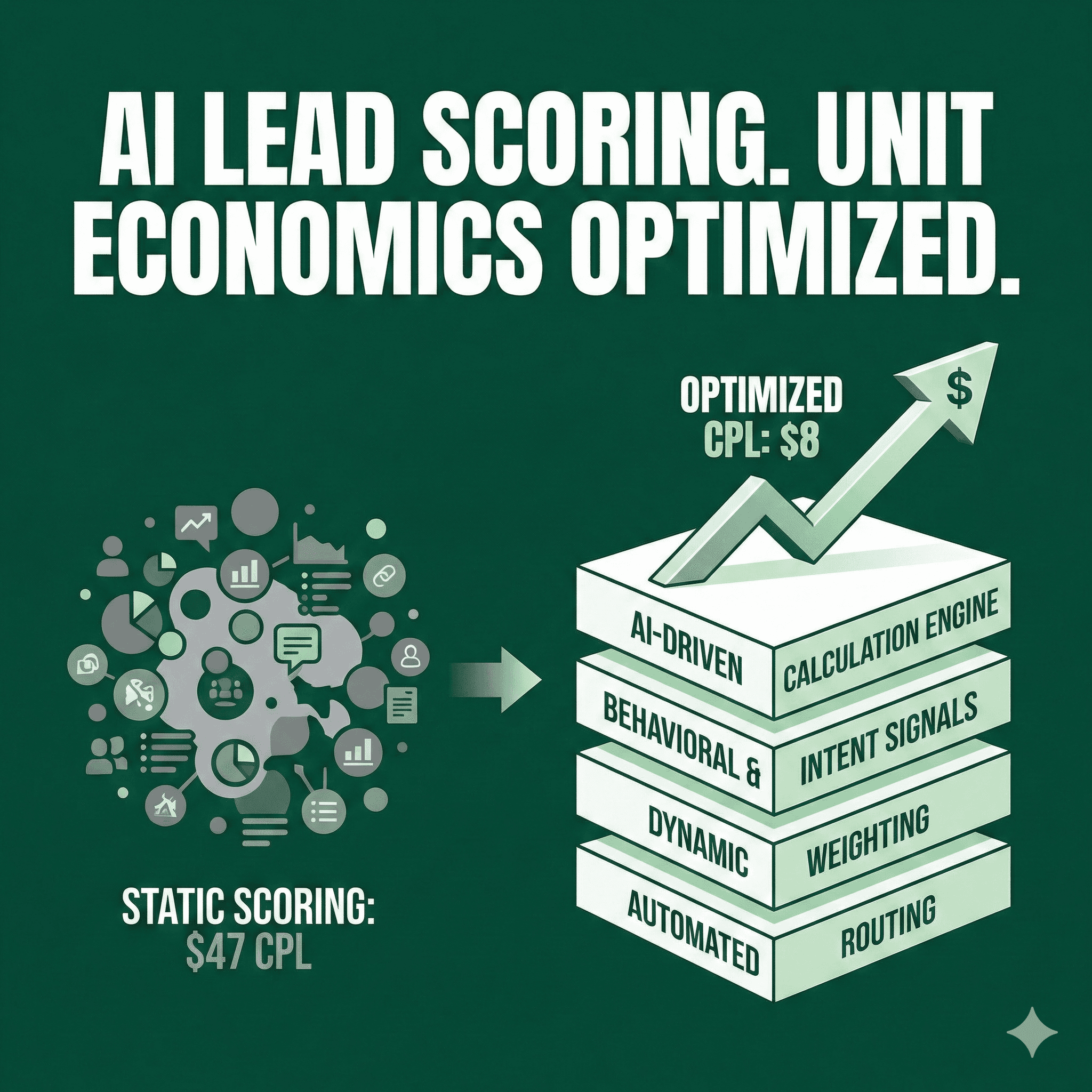
The average B2B SaaS company spends $47 per qualified lead. With poor lead scoring, 65% of those leads are worked by sales at the wrong time—or never. That's not a sales problem. That's a data infrastructure problem. When your SDRs are spending 40% of their day chasing leads that will never close, you aren't just losing money on acquisition; you're actively burning the morale and productivity of your most expensive human assets.
What AI Lead Scoring Actually Calculates
Traditional methodology for lead scoring has historically relied on a static "best guess" from the Sales and Marketing teams. You might give 10 points for a Director title and 5 points for a whitepaper download. The problem is that these static rules don't account for the nuance of modern buyer behavior.
AI-driven lead scoring systems operate on a multidimensional calculation that processes four distinct data streams simultaneously:
Firmographic & Technographic Signals: This is the baseline. It isn't just "Is this company big enough?" but "Do they use the specific tech stack (e.g., Snowflake, HubSpot, AWS) that makes our integration seamless?"
Behavioral Signals: This goes deeper than page visits. The system analyzes the velocity and sequence of actions. A lead who visits the pricing page twice in 24 hours after reading three technical case studies is mathematically more valuable than one who downloads ten top-of-funnel ebooks over six months.
Historical CRM Data: The AI looks at your "Closed-Won" accounts from the last 24 months. It identifies the "DNA of a Buyer"—the subtle, non-obvious commonalities that human RevOps managers miss.
Third-Party Intent Data: Integrating signals from platforms like G2, TrustRadius, or Bombora allows the system to see what a lead is doing outside of your website.
The final output is a weighted score that represents a "Propensity to Buy" percentage, allowing your sales team to stop "dialing for dollars" and start "consulting for closings."
The Calculation Formula Most Companies Get Wrong
The most common mistake in a lead scoring formula is equal weighting. Assigning 10 points to a "C-Level Title" and 10 points to "Attended a Webinar" assumes they have equal predictive power for revenue. They don't.
In a production-grade AI system, the calculation uses dynamic weighting. The weights aren't decided in a conference room; they are assigned by a model that identifies which signals actually correlated with revenue in your specific historical data.
Example: Dynamic Weighting Methodology
Signal Type | Signal Detail | Static Weight (Old Way) | AI Dynamic Weight (New Way) |
Firmographic | Fortune 500 Company | +20 | +8 (High noise, low conversion) |
Technographic | Uses Competing Software | 0 | +25 (High displacement potential) |
Behavioral | Viewed "Compare Us" Page | +5 | +40 (High-intent signal) |
Intent | Searching for "SaaS Pricing" | +10 | +15 (Late-stage indicator) |
In this calculation, the AI realizes that while a Fortune 500 lead looks good, they actually have a longer sales cycle and lower win rate for your specific product than a mid-market company using a specific competitor. The formula adapts to prioritize the path of least resistance to revenue.
Why Spreadsheet and CRM-Native Scoring Breaks at Scale
Most VPs of Sales start with HubSpot or Salesforce-native scoring. These tools are excellent for basic workflows, but they are fundamentally "Rules-Based Engines."
A rules-based engine is a static methodology. If you set a rule that says "Download = 5 points," that rule stays until a human changes it. But buyer behavior shifts. A whitepaper that was a high-intent signal in 2024 might be a low-intent "AI-generated summary" signal in 2026.
The Data Gap:
CRM-Native: Can only see data within its own ecosystem. If a lead is researching your competitor on G2, your CRM is blind to it.
AI-Integrated: Pulls from your data warehouse, your CRM, and external APIs.
The Result: A CRM-native score of "85" might be a false positive. An AI-calculated score of "85" is a statistically verified "Ready to Buy" signal.
When you are processing 5,000+ leads a month, the "false positive" rate of static scoring creates a massive "Hidden Tax" on your SDR team's time.
What It Actually Costs to Implement AI Lead Scoring
For a mid-market B2B SaaS company, there are three primary paths to fixing your lead scoring formula. The "right" choice depends on your engineering bandwidth and the complexity of your stack.
Path | Timeline | Implementation Cost | Long-Term Risk |
1. DIY (n8n + OpenAI) | 3–6 Months | $0 (Tools) + ~$150K (Labor) | High. Maintenance is a nightmare. If the lead dev leaves, the system breaks. |
2. Buy a SaaS Tool | 2–4 Weeks | $24K – $96K / Year | Medium. "Black box" logic. Hard to customize for unique B2B sales cycles. |
3. AI Systems Partner | 4–6 Weeks | $40K – $80K (One-time) | Low. Custom-built for your stack. You own the code and the logic. |
The DIY Trap
Many CTOs believe they can build a calculation engine in a weekend using n8n and an LLM. While a prototype is easy, a production system requires error handling, data normalization across messy CRM fields, and constant model retraining. We frequently see companies spend 300+ engineering hours ($150k+ in burdened labor) only to end up with a system that Sales doesn't trust because it hasn't been "tuned" to the actual revenue outcomes.
Real Results: $47 → $8 Cost Per Lead
The true power of an optimized lead scoring methodology is seen in the unit economics.
We recently worked with a B2B SaaS client in the Cybersecurity space. They were generating thousands of leads through content marketing, but their SDRs were overwhelmed. Their effective "Cost Per Qualified Lead" (the cost to get a lead that actually took a meeting) was $47.
By deploying an AI lead scoring system integrated directly with their HubSpot CRM and Outreach.io SDR sequences, we enabled "Lead Routing Automation." Only leads with a 90%+ propensity score were sent to the SDRs for manual 1-to-1 outreach. Leads with a 50–89% score were put into an automated "Nurture AI" track.
The Results:
CPL Reduction: Effective Cost Per Qualified Lead dropped from $47 to $8.
Sales Velocity: Time-to-first-touch for high-intent leads dropped from 24 hours to 4 minutes.
Revenue Impact: A 30% increase in pipeline value within the first quarter without increasing marketing spend.
This wasn't a "magic AI" fix. It was a mathematical alignment of sales effort with buyer intent.
Conclusion: Stop Working Every Lead
The "Hustle Harder" era of B2B sales is over. In 2026, the winner isn't the company with the most leads; it's the company with the best calculation of which leads matter today.
If your RevOps team is still arguing over whether a "Title" is worth 5 or 10 points, you are losing 60% of your marketing budget to inefficiency. You don't need more leads; you need a production-grade infrastructure that tells your sales team exactly who to call when they sit down at 9:00 AM.
We've built AI lead scoring systems for B2B SaaS companies processing 5,000–50,000 leads/month. We understand the messy CRM data and the complex sales cycles that standard tools miss.
Book Your Free Scoring Architecture Consultation →
Written by Ankit Dhiman — Founder & CEO at Chronexa. Ankit leads a lean team of n8n automation engineers building production-grade AI workflows for mid-market B2B companies across fintech, legal, SaaS, and operations. Book a free 30-minute strategy call to see what's possible for your team.
Related Articles
About author
Ankit is the brains behind bold business roadmaps. He loves turning “half-baked” ideas into fully baked success stories (preferably with extra sprinkles). When he’s not sketching growth plans, you’ll find him trying out quirky coffee shops or quoting lines from 90s sitcoms.

Ankit Dhiman
Head of Strategy
Subscribe to our newsletter
Sign up to get the most recent blog articles in your email every week.